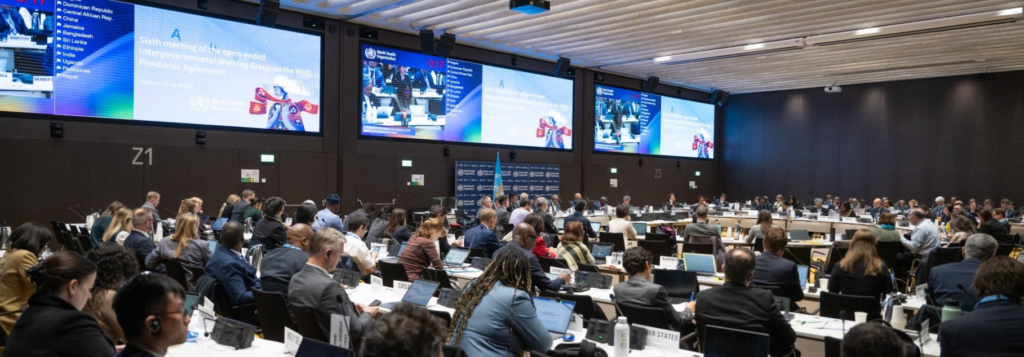
Two practical – and contrary – proposals were tabled at pandemic talks last week, detailing how information about dangerous pathogens should be shared. Health Policy Watch is sharing the two options – Africa’s Federated Model and the European Union’s Hybrid Model – to enable all interested parties to interrogate them before the next round of talks from 14-18 September.
The nitty-gritty details about a pathogen access and benefit-sharing (PABS) system – the last outstanding piece of the World Health Organization’s (WHO) Pandemic Agreement – are being hammered out in Geneva.
The PABS system, an annex to the Pandemic Agreement, will set out how dangerous pathogens are shared (access) during public health emergencies and how to share any medical products (benefits) produced as a result of manufacturers getting access to this information.
Federated model
According to the “federated model”, pathogen materials and data always stay in the hands of countries.
Each user – countries, manufacturers, etc – registers once with a central “catalogue” and receives a single identifying credential. The catalogue routes each request to the holding node – either a country or a regional node. Where a node adds its own terms, the user needs to accept them before they get any results.
Manufacturers have to accept a data access agreement (DAA) with the country or regional node and sign a benefit-sharing contract with the World Health Organization (WHO) to gain access to the information.
The WHO contract binds the manufacturer to set aside 10% of any products it develops as a donation and 10% at cost.
The rules governing the PABS system will be set by the Conference of the Parties made up of WHO member states, not the WHO or individual countries.

“Federated access is the only route. The data stays at the sovereign node, the analysis runs in place, and only the results leave,” according to the proposal.
“We hold sovereign rights over our sequence data and our sequence materials. Custody is never surrendered. Access is granted, the resource is not.”
The European Union and others have criticised a centralised system for potentially slowing down access to pathogen information.
However, that African proposal claims that the European Genomic Data Infrastructure project operates a similar system across 22 countries and can respond to queries “in about 5 to 30 minutes depending on dataset size”.
Hybrid model
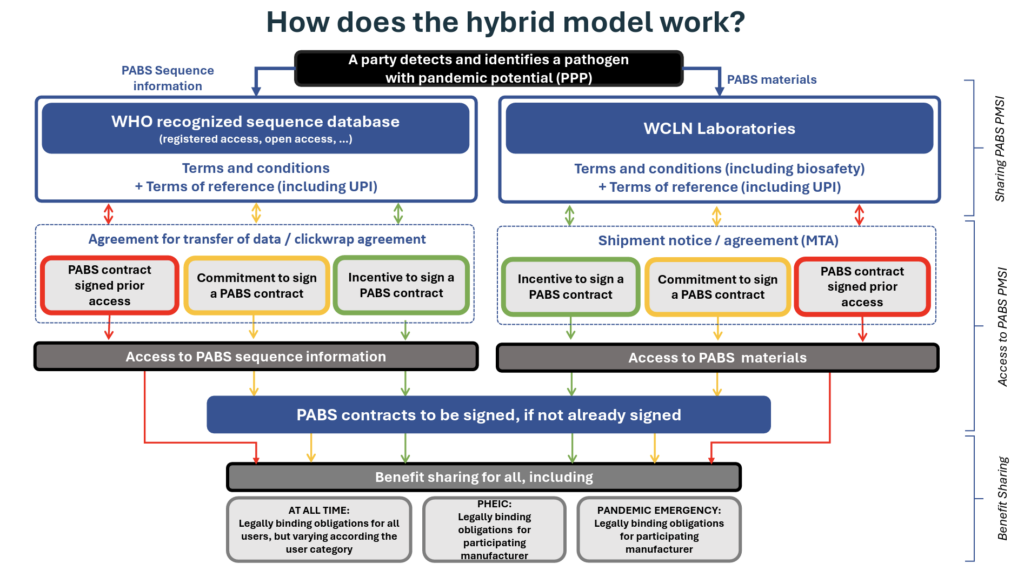
In contrast, the “starting premise” of the hybrid model is that the PABS system is “non-exclusive”, according to the EU proposal. This acknowledges that parties can and do share pathogen information on different platforms.
However, it envisages that any pathogen materials should be shared via the WHO-Coordinated Laboratory Network (WCLN).
The hybrid model also envisages “legally binding obligations” throughout, but with different requirements depending on different user categories and whether there is a public health emergency of international concern (PHEIC) or a pandemic.
“Recent Ebola and hantavirus outbreaks show that scientists use a range of platforms to share sequence information,” Alexandra Finch, project manager for the Panel for a Global Public Health Convention, told Civicus in an interview on Monday.
She cited a range of platforms used to share sequence information, like GenBank, which allows unrestricted access without registration, the closed GISAID, platform and “newer, hybrid models, like Pathoplexus, that let scientists choose between open release and time-limited restricted use”.
“A hybrid model reflects this reality best and could potentially draw in a wider pool of benefits,” said Finch, but added that several other conditions should come into play, including “enforceable benefit-sharing obligations”, and “persistent identifiers” to trace how the data is used.
‘Diverges from mandate’
But Sangeeta Shashikant, coordinator of the development and intellectual property programme at Third World Network, said that the hybrid model is a problem as it “diverges from the mandate established in Article 12” of the Pandemic Agreement.
“It allows a pathway for sharing PABS materials without any benefit-sharing conditions and for sharing PABS sequence information with databases promoting anonymous access,” says Shashikant.
“In doing so, it violates the key parameters of Article 12 and fails to ensure ‘equal footing’, legal certainty and even the benefits agreed in Article 12. While the proponents of the hybrid model do not want to add conditions, they want to ensure the dilution of the terms and conditions that developing countries want to see when providing access.”
In contrast, said Shashikant, the federated model “attempts to address the capacity gaps, especially in relation to sequence-sharing infrastructure in developing countries. It requires user registration and user acceptance of benefit-sharing conditions to deliver on the requirements of Article 12”.
‘Delink equity and access’
Meanwhile, Knowledge Ecology International (KEI) has long been critical of countries linking access to PABS samples or data to the Pandemic Agreement’s equity provisions.
KEI wants negotiators to “delink the primary equity obligations from conditions attached to access to the PABS materials and data” – for two main reasons.
“It is important for the information about the pathogens to be shared widely and quickly, and for the information to be used with other data, in a broader eco-system of databases and research tools,” KEI asserts.
“Secondly, there will be plenty of cases where researchers won’t need the PABS to get access to pathogens or their [digital sequencing information], and in those predictable cases, companies will have little or no incentive to be legally bound to the concessionary sharing of production,” KEI argues.
Instead, it proposes that the PABS annex includes an obligation on governments to “require that any manufacturer seeking to register or sell pandemic-related products provide evidence of a legally binding agreement with the WHO that addresses access to such products.
“This agreement would be separate from any agreement they may have regarding PABS material or data. The access provisions would be consistent with Article 12, Paragraph 6, of the Pandemic Agreement.”
Five years of talks
“Finalising the annex is a critical step toward enabling countries to consider the signature and ratification of the WHO Pandemic Agreement, strengthening global health security and pandemic prevention, preparedness and response for future generations,” said the WHO in a statement on Monday as the talks reach beyond five years,
WHO Director-General Dr Tedros Adhanom Ghebreyesus commended member States for their “continued dedication to multilateralism, dialogue and to finding common ground”.
“While differences remain, those differences can be bridged if we keep our shared goal in sight: a world where pathogens and scientific information are shared rapidly, and the benefits they generate are shared fairly and equitably. The task is vital, and urgent. The next pandemic will not wait. Neither should we.”
Image Credits: WHO / Mark Nieuwenhof.
Combat the infodemic in health information and support health policy reporting from the global South. Our growing network of journalists in Africa, Asia, Geneva and New York connect the dots between regional realities and the big global debates, with evidence-based, open access news and analysis. To make a personal or organisational contribution click the donate button below.