ANTALYA – The first draft of COP31’s main political decision includes a standalone paragraph on the accelerating risks of climate change to human health, setting up a potentially big symbolic victory for advocates who have fought for years to win a place for health inside the UN climate process.
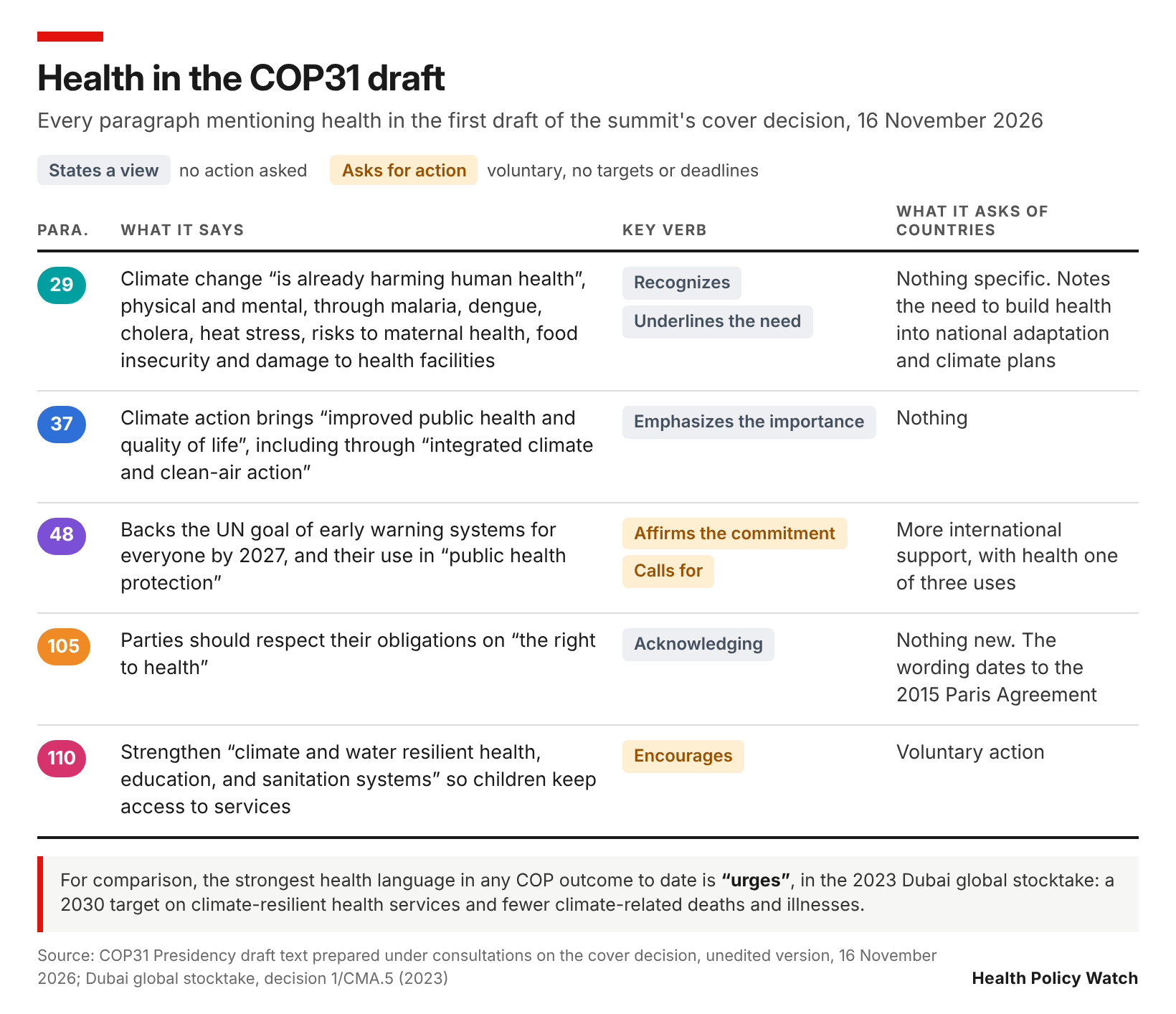
“Climate change is already harming human health, including physical and mental health, through climate-sensitive diseases such as malaria, dengue and cholera, heat stress, maternal health, food and nutrition insecurity and damage to health facilities during extreme events,” the draft states.
The text also “underlines” the need to strengthen the climate resilience of health systems by including health in national adaptation and climate plans, and by integrating climate information and early warning systems into public health protection.
The paragraph sets no targets, commits no funding and asks governments to do nothing specific. Its two verbs, “recognises” and “underlines”, sit at the bottom of the UN’s diplomatic vocabulary, signalling acknowledgement rather than action.
Beyond that paragraph, health appears in four of the draft’s other 143 paragraphs, each time linked to another issue: as a benefit of climate action, in early warning systems, in human rights language, and in services for children.
Negotiations in Antalya are due to close on Friday. As with every COP since 2003, they are likely to run overtime. The decision text – and health’s inclusion in it – will be up for debate until the final gavel, and many paragraphs are likely to be pruned as countries draw red lines.
The COP31 presidency said in a note accompanying the draft that the text is “not intended to reflect consensus”. Every element remains open, Türkiye and Australia said, “including whether they should be included at all”.
“Nothing will come out of the negotiations except for a vaguely worded statement,” a Swedish observer to the negotiations told Health Policy Watch, adding: “The parties are just too entrenched in their opposing positions.”
Co-benefits across the text
Elsewhere, the draft includes proposals with large potential health gains not framed as health measures. The text calls on countries to help raise electricity’s share of global energy use to 35% by 2035, a headline target of Türkiye’s voluntary Action Agenda. Electrifying transport, industry and buildings would cut the fuel burning behind much of the world’s air pollution, which kills around 8 million people every year.
Despite its status as the flagship initiative of the Turkish presidency, it faces steep opposition to inclusion in the final decision. The Arab Group has opposed top-down targets for energy and other sectors in the talks, and the African Group has rejected electrification targets that come without money to meet them, according to the Earth Negotiations Bulletin.
On record opposition to the target means it remains to be seen if the ‘greener’ references in the draft text to “accelerating the clean energy transition through increased clean electrification” and “tripling renewable energy capacity” will survive the final days of negotiations – even if only as purely voluntary declarations of intent.
The draft’s call for “accelerated action to phase out fossil fuels, including through the immediate transition away from fossil fuels in energy systems” is likely to be struck down before the summit closes. Oil-producing states forced phase-out language out of the Dubai deal in 2023, and at COP30 the Arab Group called any text targeting sectors of their economies “off the table”. The final Belém decision dropped all mention of fossil fuels, The final Belém decision made no mention of fossil fuels.
A separate demand that developed countries reach net zero by 2030, long pushed in negotiations by the Like-Minded Developing Countries, a bloc that includes China, India and Saudi Arabia, is unlikely to be accepted even by ambitious nations and blocs like the EU.
The EU, whose own legally binding target is climate neutrality by 2050, argues that China and Saudi Arabia should no longer be exempt from providing climate finance under UN rules, given their wealth and emissions records. Counted by the fossil fuels a country extracts rather than burns, Saudi Arabia accounts for the world’s fifth-largest share of historical warming, according to Carbon Brief analysis published on Tuesday.
The draft also “emphasises the importance of phasing out inefficient fossil fuel subsidies that do not address energy poverty or just transitions, as soon as possible”, repeating commitments made in Glasgow and Dubai. With the Iran war driving up fuel prices, agreement to phase out energy subsidies appears unlikely. Global fossil fuel subsidies are projected to exceed $1 trillion this year, according to the UN Development Programme.
The WHO’s own economic case for climate action rests heavily, in some cases almost entirely, on cutting those subsidies, a Health Policy Watch analysis found. In a report released days before the summit, WHO estimated that six climate policies could prevent 1.6 million deaths a year – yet some 1.2 million of those depend on removing fossil fuel subsidies and raising taxes on coal, oil and gas. The draft addresses only “inefficient” subsidies, and says nothing about taxing fossil fuels.
More health references, but few hooks for action
Health advocates were still heartened by the increased references to health in the climate text compared to previous years. However, they stressed that this was only a first step in light of the millions of lives impacted by the “global health emergency” caused by the climate crisis that many in the health world are calling on WHO to declare.
“Basically my impression is that there’s a lot of health coverage included in the current draft of the cover text but no hook for health to be more prominent in future negotiations or decisions to be implemented by countries,” said WHO’s Elena Villalobos, who leads ATACH, a strategic alliance to support health sector responses to climate change.
“The most important issue is related to commitments by parties to consider public health implications of all their adaptation and mitigation policies and programs – although all parties to the UN Climate Convention already agreed to these commitments, and they still are not being implemented nor reported. So we need a mechanism for that,” she added.
See related story:
Call for New WHO Instrument to Address Climate-Driven Global Health Emergency
Health not among the issues publicly raised by countries
Health was not among the issues countries publicly raised in the oral consultations on the cover decision, according to the presidency’s summary of them, meaning no country is on public record as sponsoring the health content of the text. Its inclusion suggests requests on health were added through written submissions, which are not published publicly.
Beyond the standalone paragraph, health appears in four of the draft’s other 143 paragraphs, each time linked to another issue: as a benefit of climate action, in early warning systems, in human rights language, and in services for children.
Negotiations in Antalya are due to close on Friday. As is tradition with every COP since 2003, they are likely to run overtime. The decision text will be up for debate until the final gavel, and many paragraphs are likely to be pruned as countries draw red lines.
The COP31 presidency said in a note accompanying the draft that the text is “not intended to reflect consensus”, and was drafted with “an inclusive approach to reflect the breadth of views expressed by Parties”. Every element remains open, Türkiye and Australia said, “including whether they should be included at all”.
New health initiatives launched at COP31 draw few pledges and less finance
The potential for a breakthrough inclusion in COP31’s final decision threatens to be overshadowed by the minimal support that has accompanied other health-related initiatives in Antalya.
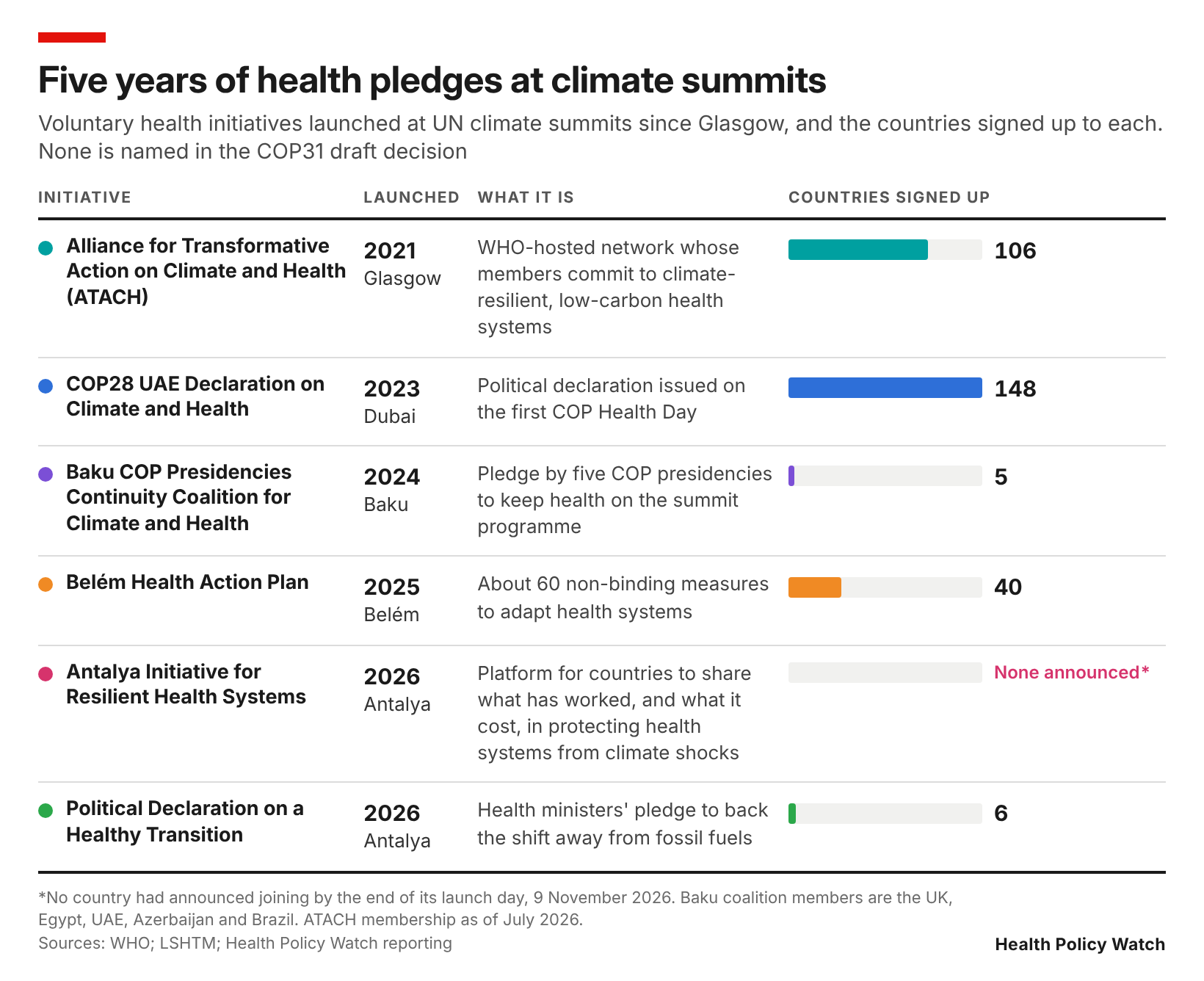
The Antalya Initiative for Resilient Health Systems, the flagship presidency health initiative launched by Türkiye with the World Health Organization (WHO) at the summit’s opening Health Day, has yet to announce any participating countries, staff or funding.
No government pledged new money for climate and health that day, the third consecutive COP without fresh government financing for health.
A second new pledge, a political declaration on a “healthy transition” led by Spain, had six signatories as of Tuesday out of nearly 200 countries at the talks: Spain, France, Peru, Tuvalu, Ireland and Barbados.
The declaration names fossil fuels as the main driver of climate change’s threat to health and as the cause of “millions of preventable deaths”. It commits signatories to use the public, economic and political influence of the health sector to drive action, and asks WHO “to lead the global effort to address the public health imperative of transitioning away from fossil fuels, as it did in the past with other harmful substances such as tobacco and alcohol”.
“The best clinical practice is one that integrates environmental perspectives in clinical decisions,” said Javier Padilla, Spain’s secretary of state for health, who spearheaded the declaration. “Putting the focus on the energy transition from the health perspective is an intelligent way to approach climate change.”
The declaration, and its minimal uptake, is the kind of outcome WHO Director-General Tedros Adhanom Ghebreyesus warned at the outset of the summit would not be enough.
Declarations “do not protect people,” Tedros told health ministers gathered in a sparse conference room on COP31’s Health Day on the opening day of the conference, 9 November. “Implementation does.” See related story:
‘Declarations Do Not Protect People’: COP31 Opens Under Pressure to Deliver Results Over Words
Building momentum

Nothing agreed or announced in Antalya so far pays for that implementation.
The movement on health at COP31 builds on a patchwork of voluntary frameworks and initiatives launched alongside the UN climate talks since Glasgow, with varying levels of support. The most concrete is WHO’s Alliance for Transformative Action on Climate and Health (ATACH), launched at Glasgow in 2021, whose 106 member countries commit to building climate-resilient, low-carbon health systems.
The COP28 Declaration on Climate and Health in Dubai, a broad statement of intent, drew the most signatures of any, with 148 countries.
COP29 in Baku produced a coalition of five past and incoming summit presidencies pledging to keep health on the COP programme, outside the formal negotiations.
The Belém Health Action Plan, the most detailed of all, has 40 signatories so far, up from 33 when it was announced at the close of COP30 last year.
Implementation absent from mounting pile of plans
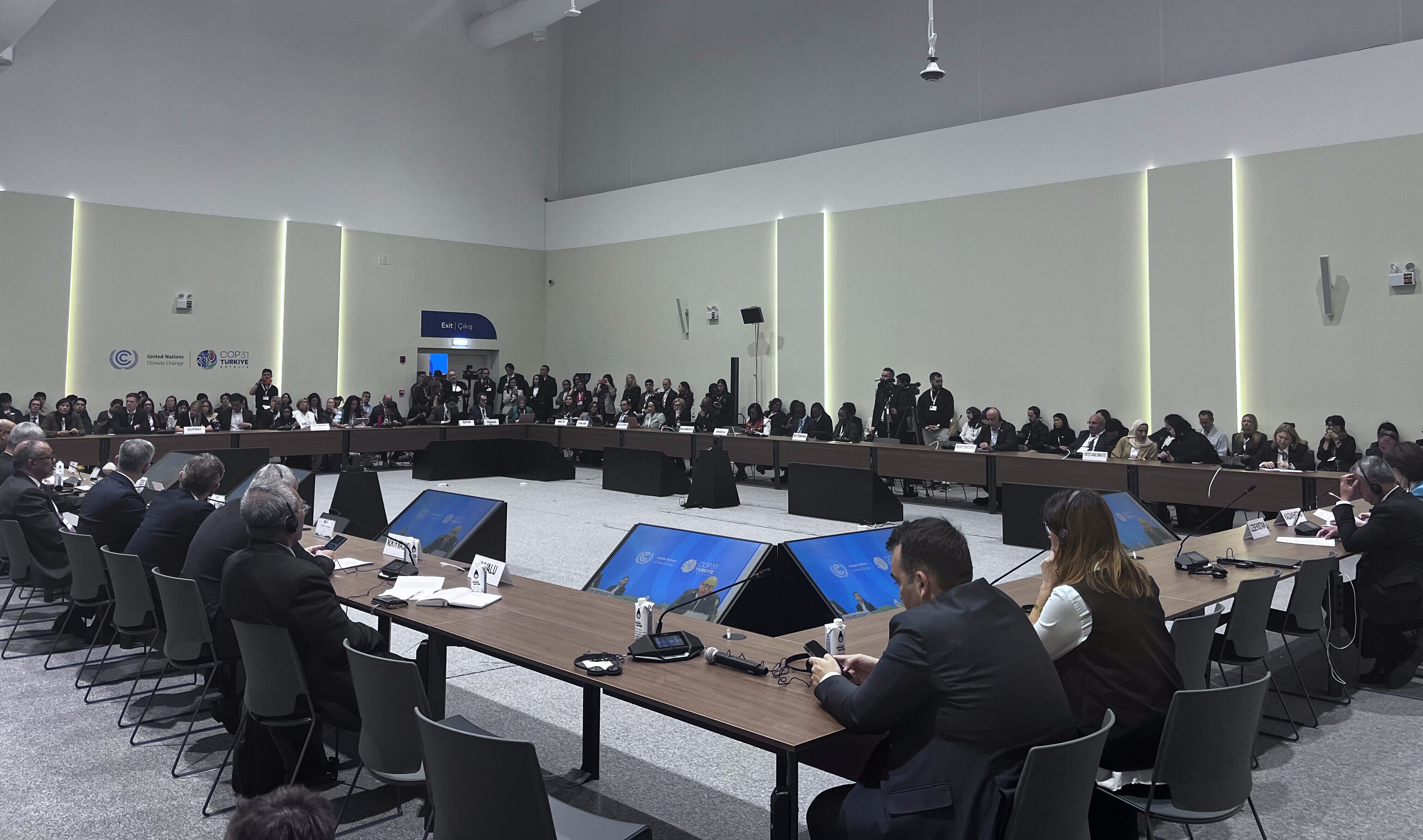
But while declarations and initiatives have launched, the money to act on them has yet to follow. In a WHO survey last year, more than 90% of countries named insufficient finance as a top barrier to their health and climate plans, Tedros said in his Health Day comments.
Multilateral climate funds have directed about 2% of adaptation finance and 0.5% of all their climate finance to health since 2004, according to a 2025 analysis by the Berlin-based think tank adelphi, roughly the share WHO reported at Glasgow. The Green Climate Fund, the UN’s largest climate fund, had financed a single health project in Malawi, as of COP29.
On Health Day, Brazil’s health minister Alexandre Padilha said international public commitments for health adaptation fell from about $3.2 billion in 2022 to $2.2 billion in 2024.
He also launched a “financing framework” for the Belém plan, developed with Wellcome and the Rockefeller Foundation, which maps which climate funds, development banks, philanthropies and national budgets could pay for each measure.
“This is not a new fund,” Padilha said of the framework, which he described as “a map”.
The Climate and Health Funders Coalition, a group of more than 35 philanthropies that pledged $300 million in Belém, said it had awarded more than $225 million in its first year and attracted $150 million in new commitments.
“There’s no way that philanthropy can fill the hole or deliver health systems for whole countries,” said Alan Dangour, director of climate and health at Wellcome, a coalition member. “Governments are slow-moving beasts and sometimes require a bit of a nudge.”
“The first thing we can do is provide some technical advice to give you some ideas of what needs to change,” he said. “Then of course finance needs to follow. That is a huge problem.”
No country asked to put health on the agenda
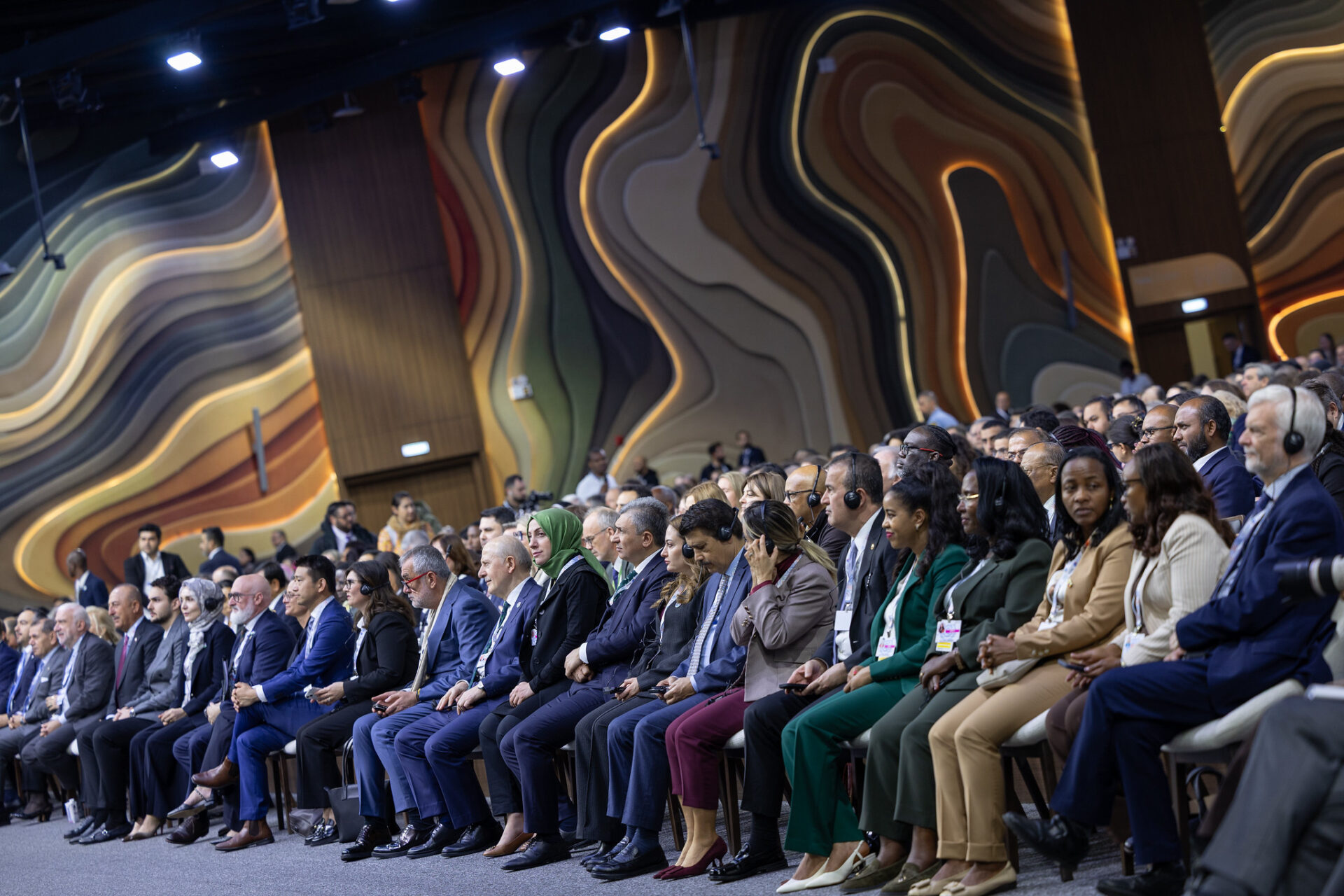
While health may at least get more of a mention in the final text, no country asked to add health to the formal negotiating agenda in Antalya, according to UN meeting records, despite WHO’s calls for health to be part of the negotiations.
“[Health] belongs in the negotiated text,” Tedros told ministers on Health Day. “It should be an explicit eligibility area for climate finance and its share should grow as adaptation finance grows.”
Only governments can propose items for the negotiating agenda, and they must file before a session opens. None of the agendas for COP31, the parallel Paris Agreement meeting or the two technical bodies that prepare their work lists a health item, indicating no country pursued the idea despite WHO’s vocal push.
With the COP31 agenda adopted on 9 November, the earliest health could gain an item of its own is the June 2027 technical sessions in Bonn or COP32 in Addis Ababa. A government would need to file in time, and no country could object when the agenda is adopted.
While WHO has argued for a dedicated negotiating track, other civil society groups with which Health Policy Watch spoke in Antalya expressed a preference for health to run through existing negotiations, warning that a standalone item could paradoxically cut health out of higher-profile parts of the talks.
One way or another, however, the endgame is the same: more investments in health-related climate action by countries and international actors.
“If health is more prominent, then finance will follow,” said Villalobos.
Image Credits: Fletcher/Health Policy Watch, Dennis Sylvester Hurd, UNFCCC.
Combat the infodemic in health information and support health policy reporting from the global South. Our growing network of journalists in Africa, Asia, Geneva and New York connect the dots between regional realities and the big global debates, with evidence-based, open access news and analysis. To make a personal or organisational contribution click the donate button below.