Scaling up six climate and health measures worldwide could prevent 1.6 million deaths a year and generate $3.9 trillion in economic benefits annually, the World Health Organization (WHO) said on Wednesday, days before the COP31 climate talks open in Antalya, Türkiye.
Five of the six measures, from improved heat-health warning systems to cleaner household fuels, would save about 360,000 lives a year. They would cost roughly $35 billion a year and return $24 for every dollar spent, according to the new WHO report.
But 1.2 million of the 1.6 million lives saved, and all $5.4 trillion a year in extra government revenue the report projects, would need to come from phasing out fossil fuel subsidies as well as taxing coal, oil and gas at higher rates, to reflect their pollution and climate damage.
And no cost is attached to the fossil fuel pricing reform recommended. The policies would also have to be adopted in all 168 countries the report covers to reach their targets.
“The climate crisis is a health crisis, but much of the harm it causes can be prevented with tools we already have,” said WHO Director-General Dr Tedros Adhanom Ghebreyesus. “This report shows that scaling up proven, affordable actions could save millions of lives, with the greatest gains in the countries that need them most.”
Fossil fuel subsidies are going up
WHO says the solutions are “available today, ready for global scale-up.” Yet it puts no figure on what the fuel reform would cost, including shielding households, transport operators and all other fossil fuel-dependent industries across the global economy from higher costs.
Meanwhile, governments are heading the other way. With the Strait of Hormuz still closed, the UN Development Programme said last month that fossil fuel subsidies could top $1 trillion this year.
“If countries are able to make the transition to cleaner energy sources, for example by phasing out subsidies on fossil fuels and putting efficient pricing on fossil fuels, that brings a very wide range of benefits,” said Dr Diarmid Campbell-Lendrum, who heads WHO’s climate change, air quality, energy and health unit, at a press briefing on Tuesday. “Most immediately in reducing air pollution, which takes almost 7 million lives every year around the world.”
Familiar figures, new price tags
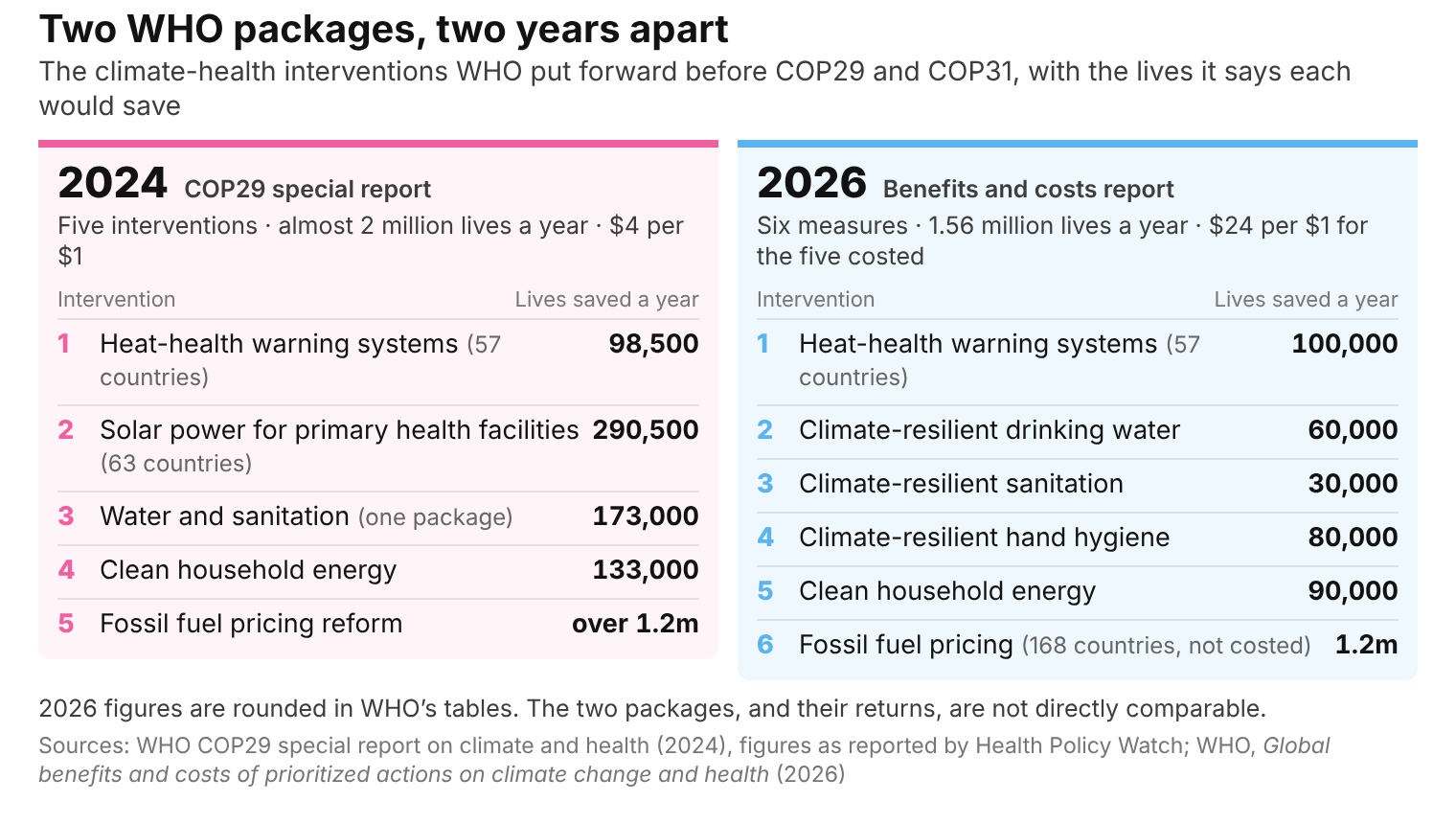
The estimates of how many lives each measure would save are based on previously published data from WHO’s 2025–2028 investment case, according to the report. These cover deaths averted from extreme heat, unsafe water and sanitation, and polluting cooking fuels, and through removing fossil fuel subsidies.
But the methods, analysis and results are also different from findings issued just before the 2024 COP29 UN Climate Conference in Baku, Azerbaijan.
At that time, WHO issued a report stating that five key interventions, including equipping energy-strapped health facilities with renewables, such as solar power, would save “almost 2 million lives a year” and return $4 per dollar invested. In contrast, the new report estimates only 1.6 million lives saved, but a return of $24 on each dollar invested in the measures.
The new report also drops solar power for health facilities, and splits water, sanitation and handwashing, previously one package, into three separate measures, so the two sets of interventions are not directly comparable.
Dr Frank Pega, the report’s lead author, said in a written response to Health Policy Watch that internal WHO guidelines for health economic analyses have been standardized so that health sector interventions can no longer be assessed with a benefit-cost analysis alone. That made solar power for health facilities ineligible for the 2026 report, he said.
The estimates of lives saved by each measure did not change between the two reports, Pega said. But the three water, sanitation and hygiene measures are now modelled together, which removes overlap in their health effects and lowers their combined total. Dropping solar, which WHO said in 2024 would save about 290,000 lives a year, accounts for most of the gap.
Assumes full fuel price reform in 168 countries
The new scenario also assumes a full fossil fuel price reform in 168 countries starting in 2024, a year that has already passed. This would include a removal of all existing fossil fuel subsidies plus new taxes to cover the indirect costs of fossil fuel use, such as air pollution, and the same VAT as other goods.
The estimates also assume universal access to safe drinking water, sanitation and clean cooking fuels by 2030.
In 2024, 2.1 billion people still lacked safely managed drinking water and 3.4 billion lacked safely managed sanitation, according to WHO and UNICEF data. Around 2 billion relied on polluting fuels to cook, a separate energy progress report co-authored by WHO found.
In a separate commentary, published in The Lancet, the authors admit these targets are “aspirational rather than realistic.”
Moving the needle?
“Constrained governments really need clear evidence, economic evidence, health evidence, on which investments deliver the greatest benefits,” said Pega. “Governments need to know not only what works, but what offers the greatest value for money.”
Campbell-Lendrum said 30 climate summits had produced too little progress.
“We sometimes hear that this is because there is too much uncertainty around the impacts, or that the actions that we need to take will cost too much,” he said.
“Well, today WHO is launching a report which demonstrates that that is not the case.”
But as WHO attempts to get eyes on the health argument to act against climate change in the run-up to COP31, whether or not this new report, running to more than 550 pages and 22 annexes, can move the needle remains an open question.
The health measures
Heat-health warning systems, which issue alerts when temperatures reach dangerous levels, could save about 100,000 lives a year if built in the 57 countries WHO identified as lacking one. At about $230 million a year, they offer the report’s highest return, $835 per dollar.
“Once they’re implemented,” said Pega, who put the time needed to build them at about five years, “they return huge benefits within a short time.”
Climate-resilient water, sanitation and handwashing services – built to keep working through floods, storms and droughts – together would save about 170,000 lives a year from diarrhoea and pneumonia, at a combined cost of about $30 billion. Returns range from $6 per dollar for drinking water to $32 for handwashing, the report said.
Those three figures are deliberately partial. WHO assumes a tenth of the benefits and costs of giving everyone these services comes from making them climate-proof, and counts only that tenth.
“These services are shown to provide an enormous return on investment,” Pega said of handwashing facilities. “So it’s clear that they’re a no-brainer intervention.”
Switching households from wood, charcoal and kerosene to gas, electric or improved stoves would save about 90,000 lives a year at a cost of about $5.2 billion, a return of $51 per dollar.
Fossil fuel reforms drive the climate and health gains
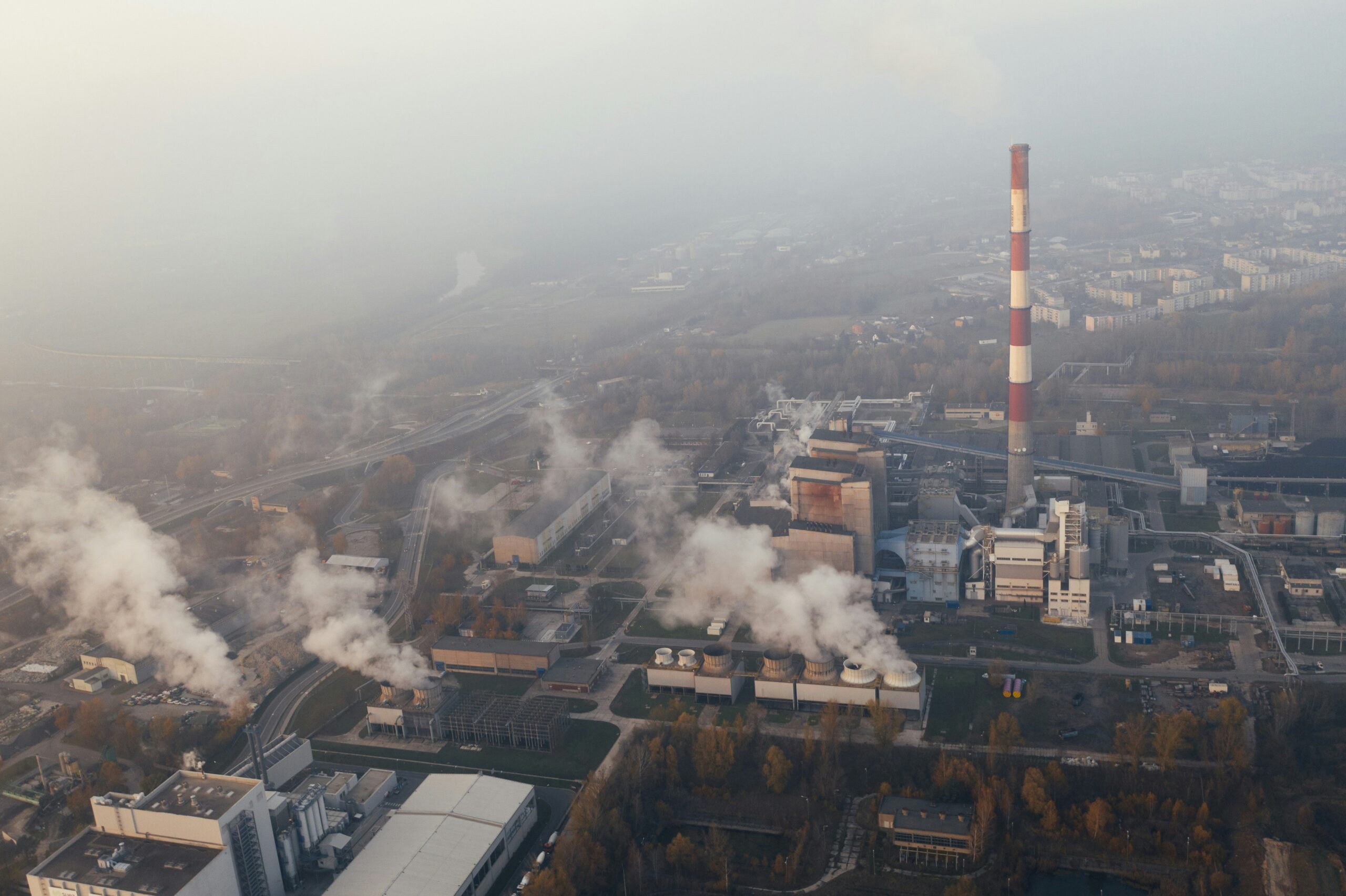
The fossil fuel reforms would also account for 98% of the climate benefits linked to the six WHO-recommended policies. That is about 16.4 billion of the 16.7 billion tonnes of greenhouse gas emissions, measured in CO2 equivalent, that the six would cut each year, according to International Monetary Fund (IMF) models.
But that would also mean changing how almost every government prices energy. By WHO’s count, 168 countries fall short of the standard, and the scenario modelled has all of them ending subsidies to fossil fuel producers and consumers, beginning in 2024.
Countries would also have to tax coal, oil and gas until prices cover both the cost of supplying them and the damage they cause, and charge fuel the same VAT as other goods. The IMF, whose figures WHO uses, counts two kinds of subsidies for fossil fuels.
Explicit subsidies are the money governments spend keeping fuel cheap, $725 billion in 2024, according to its latest data. Implicit subsidies are the IMF’s estimate of the damage fossil fuels cause that nobody pays for, mostly air pollution and climate change, which it put at $6.7 trillion that same year.
Removing explicit subsidies alone would avert about 70,000 air pollution-related deaths a year, the IMF estimates. Removing both would avert 1.1 million deaths annually, but the implicit subsidies can only be removed through new taxes that would push fuel prices even higher worldwide.
WHO’s own figure of 1.2 million lives saved comes from an older IMF analysis, based on 2019 data on fossil fuel use and subsidies. WHO moved the start date to 2024 without updating the IMF’s inputs, such as how much fuel countries burn and how large their subsidies are.
Those inputs have swung sharply since. The IMF put explicit subsidies at about $1.3 trillion in 2022, during the energy price spike, before they fell to $725 billion in 2024. Assuming nothing changed between 2019 and 2024, the report concedes, “is known to be false.”
In the same Lancet comment, Pega and his co-authors acknowledge that the fuel pricing estimates, which carry most of the report’s headline lives and dollars, “warrant further examination.”
Lives valued in dollars
WHO’s estimate of $3.9 trillion a year in economic benefits from all six measures is also a gross figure. It counts the value of the benefits without subtracting what the measures would cost, and the cost of the fuel price reforms is not estimated at all.
“These are not net benefits,” Pega said, “these are total benefits.”
For the five measures WHO costed, net benefits come to about $844 billion a year, less than a quarter of that total. Even so, savings on outright health-care costs, the part a budget-strapped health ministry would actually see, come to only about 0.5% of the five costed measures’ benefits – $4.75 billion a year worldwide.
Roughly nine-tenths of the five costed measures’ benefits come from the monetary value WHO assigns to the 360,000 lives they would save, according to Health Policy Watch calculations drawn from the report’s tables.
WHO puts a monetary value on each death averted using a “value per statistical life” (VSL), a method widely used to monetize human health gains – but also widely contested. The value is scaled to each country’s average income, so a death averted in a wealthier country counts for far more in WHO’s totals.
On WHO’s formula and the latest World Bank income data, a death averted is valued at about $195,000 in Burundi, $2.4 million in South Africa, $10.2 million in France and $13.4 million in the United States, according to Health Policy Watch calculations.
“Unlike productivity gains, tax revenues or GDP increases,” WHO notes in a Q&A published with the report, “VSL-based monetary estimates are not real economic flows.”
Taken together, low-income countries would account for about a fifth of the lives saved by the five costed measures but only about 6% of their projected economic benefits, according to Health Policy Watch estimates drawn from the report’s income-group tables.
High-income countries account for 4% of all deaths averted but nearly 30% of the $3.9 trillion in projected economic benefits, largely because each death averted in wealthy nations is valued so much higher.
Health still outside the negotiating room and text
Türkiye, which holds the COP31 presidency, has made resilient health systems one of ten themes in its action agenda and will open the summit next week with a Health Day. None of that is part of the formal negotiations.
“Everything that I’ve described up until now is sort of adjacent to the negotiations,” Campbell-Lendrum said. “Health should be in the negotiations.”
A WHO review of national climate plans published last month found that 91% of 140 parties mention health, but only 23% estimate what health-related climate action would cost.
WHO’s own COP31 briefing notes that, unlike many of the presidency’s other themes, health “carries no numerical target for 2035.” It also asks parties “to consider the inclusion of health in the UNFCCC process.”
Several civil society groups working on health in the climate talks oppose a stand-alone item. WHO, they say, has never spelled out what such an item would actually negotiate. A separate health track, they argue, could make it easier for countries to push health out of the rooms where fossil fuels and finance are decided, creating the kind of silo the health community has spent years arguing against.
Small delegations from vulnerable countries, already stretched across parallel negotiations, would also struggle to staff yet another negotiating track, civil society groups say, leaving negotiations on a health item to be shaped by larger, wealthier delegations, including fossil fuel producers.
“We are asking the countries there to negotiate as if people’s lives depend on it,” said Campbell-Lendrum of COP31, “because they do.”
Image Credits: CC, Health Policy Watch/WHO , WHO, 2026 , Marcin Jozwiak.
Combat the infodemic in health information and support health policy reporting from the global South. Our growing network of journalists in Africa, Asia, Geneva and New York connect the dots between regional realities and the big global debates, with evidence-based, open access news and analysis. To make a personal or organisational contribution click the donate button below.