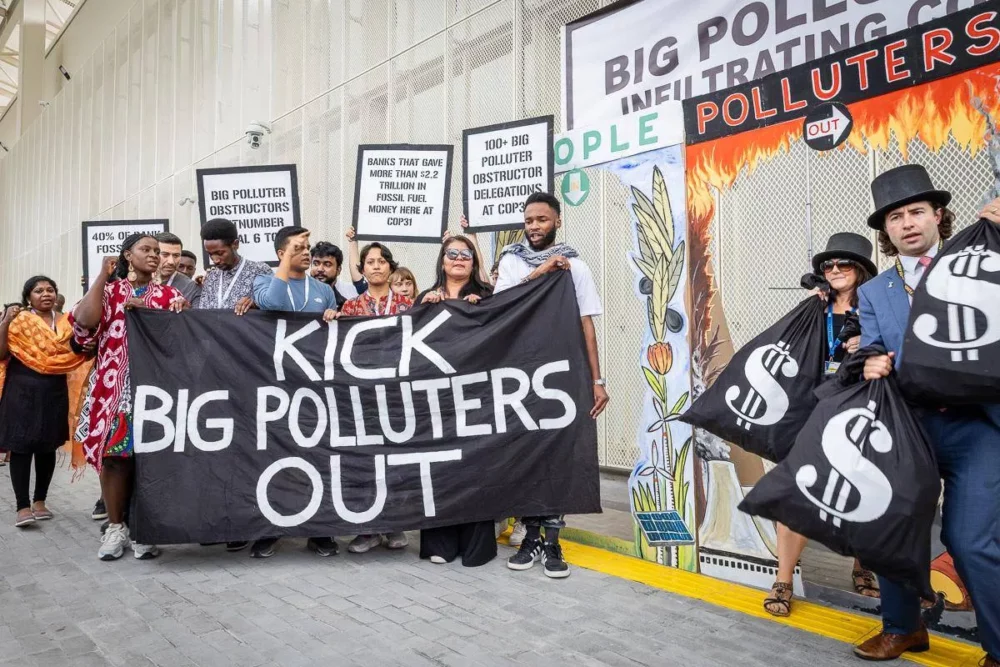
ANTALYA — More than 100 companies and industry groups with records of obstructing climate policy have sent delegations to the COP31 UN climate summit in Antalya that outnumber those of some of the world’s most climate-vulnerable nations, an analysis released Friday found.
The 103 groups, 60 of them from the fossil fuel industry, outnumber delegates from Saint Vincent and the Grenadines 100 to 1, Niger 25 to 1, the Philippines 8 to 1 and Nepal 6 to 1, according to the Kick Big Polluters Out (KBPO) coalition, which examined the summit’s provisional list of participants.
The report “exposes the invisible hand behind the false solutions campaign and the agenda fights we’re seeing at COP31,” said Rachitaa Gupta, lead coordinator of the Global Campaign to Demand Climate Justice.
“Allowing polluters to influence COP31 gives them legitimacy to continue with business as usual and breaches Global South communities’ trust in the COP31 process,” she added. “We cannot let the very systems responsible for the climate crisis take over climate negotiations.”
Each group was flagged because its lobbying is “notably misaligned with or obstructing climate policy,” based on scores from the think tank InfluenceMap. Thirty of the 100 banks that most finance fossil fuels also registered.
Together, they provided more than $2.2 trillion to the industry between 2021 and 2025, nearly 40% of all fossil fuel bank financing worldwide, according to the Banking on Climate Chaos database.
“You can’t put out a fire while handing the matches to the arsonists,” said Lien Vandamme of the Centre for International Environmental Law (CIEL), a KBPO partner. “And you certainly can’t expect the arsonists to write the evacuation plan.”
Who is in the room

The largest delegations came from the International Emissions Trading Association, with 29 people, BNP Paribas with 22, HSBC with 19 and Amazon with 12. ExxonMobil sent 13.
Most entered on “Party overflow” badges that governments hand to guests outside their official teams, or through nongovernmental organizations. Another 45 were guests of host Türkiye, and 31 sat on countries’ official negotiating delegations.
Asset manager BlackRock, which KBPO ranks among the most obstructive financiers, is on France’s delegation this year, the Guardian reported. Italy brought 50 fossil fuel industry representatives on its delegation, up from 12 at COP30, according to a separate count by the Fossil Free Politics campaign.
KBPO’s past tallies of fossil fuel lobbyists at UN climate negotiations counted a record 2,456 at COP28 in Dubai, nearly four times the number a year earlier. Another 1,773 attended COP29 in Baku, more than the combined delegations of the 10 most climate-vulnerable nations.
At COP30 in Belém, Brazil, the coalition counted 1,602, or one in every 25 participants, the highest share it has recorded.
Russia, Saudi Arabia and the Like-Minded Developing Countries (LMDCs), a negotiating bloc that includes China and India, the first and third-biggest emitters, and major oil producers such as Iran, Iraq and Venezuela, have repeatedly questioned whether the summit should produce an overarching political decision at all, Climate Home News reported, citing sources in the closed-door talks.
Swedish activist Greta Thunberg, attending her first UN climate summit since 2021, aimed her fire at the same industries on Thursday.
“The planet is not dying, it is being killed, and we know by whom,” Thunberg told reporters. “It’s more clear than ever in spaces like these that the situation could not be any less under control.”
“No one is coming to our rescue,” Thunberg added. “When our human rights are being threatened by states and other institutions, it’s our duty to stand up and be the adult in the room and fight for everyone’s human rights.”
Same faces at other UN environment talks
At last month’s UN biodiversity summit in neighbouring Armenia, Shell, TotalEnergies, Bayer and Rio Tinto were among the attendees identified by the investigative outlet DeSmog, even though organisers had removed company names from the delegate list.
CIEL has tracked the same pattern at negotiations on a global plastics treaty. At the August 2025 round in Geneva, it counted at least 234 fossil fuel and chemical industry lobbyists, more than the combined delegations of the European Union and its 27 member states, Health Policy Watch reported.
Nineteen of them sat on the national delegations of Egypt, Kazakhstan, China, Iran, Chile and the Dominican Republic. The self-described “like-minded” group of oil and petrochemical producers led by Saudi Arabia, Russia and Iran blocked any limits on plastic production. The talks collapsed without a treaty.
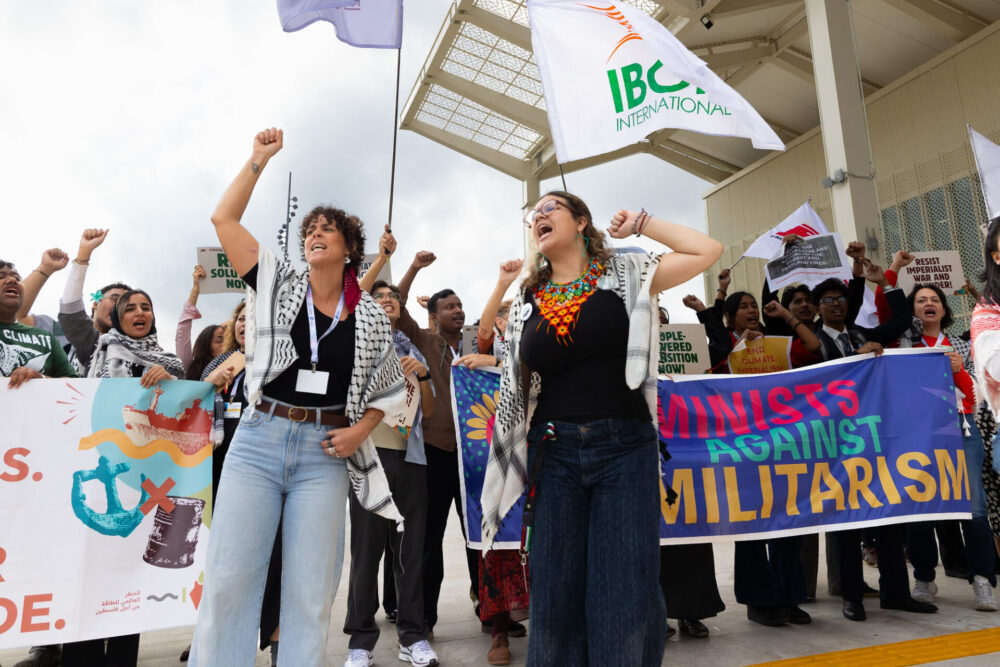
KBPO and the UN process’s women’s, youth and trade union constituencies are calling for a binding conflict-of-interest policy to keep polluters from shaping the talks.
“We come from Nepal demanding justice,” said Prakash Dalal of Pro Public/Friends of the Earth Nepal. “We cannot tolerate the disproportionate space given to them compared to civil society and our country delegations.”
War windfall
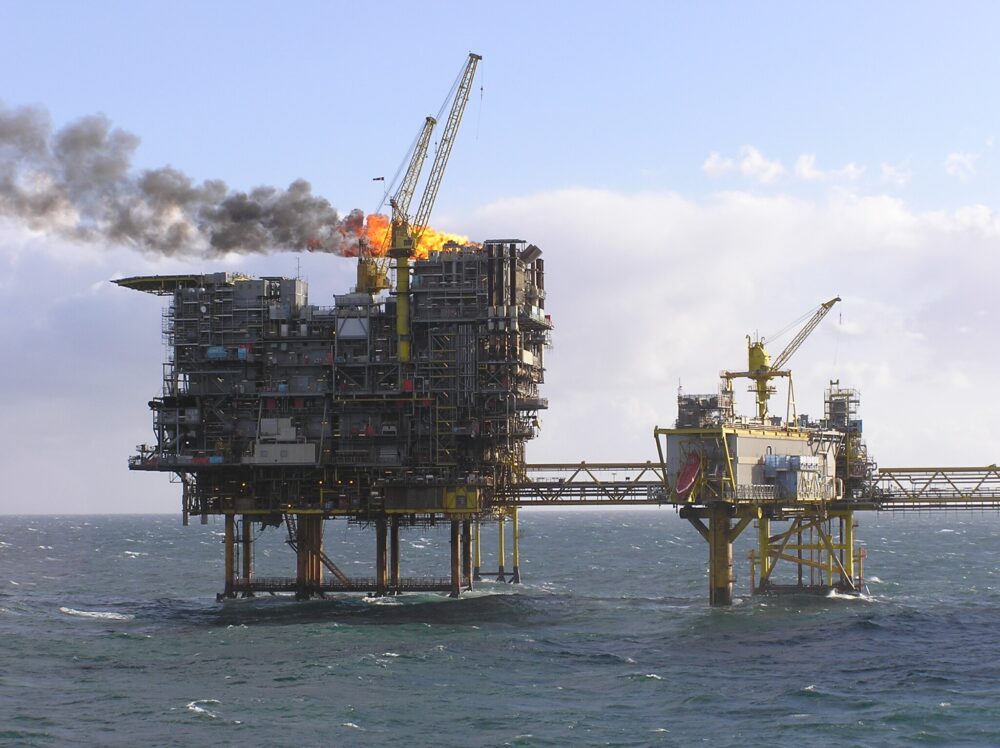
The delegations arrive as oil majors book near-record profits from the war on Iran, which began with US and Israeli strikes in February and has choked shipping through the Strait of Hormuz.
ExxonMobil, Chevron, BP, Shell and TotalEnergies earned a combined $56.3 billion in adjusted net income in the third quarter, the third-highest total on record, according to data compiled by Bloomberg. International oil prices have climbed almost 60% since the war began.
UN Secretary-General António Guterres accused the industry on Wednesday of “making a killing while killing our planet,” in his final address to a UN climate summit, Health Policy Watch reported.
“Fossil fuels must go the way of the dinosaurs,” Guterres told world leaders. “But that won’t happen on its own. The dinosaurs did not have a lobby. But fossil fuels do.”
The nine largest oil companies made $95 billion in profit last quarter alone, he said, while the fund created at COP28 to pay for climate disaster losses has received around $600 million, roughly what those companies earn in 14 hours.
“It’s time for governments to tax these windfall profits,” Guterres said, “and use them to help vulnerable countries recover.”
Emissions still climbing

Global fossil fuel emissions are projected to dip 0.4% this year to 38.2 billion metric tons of carbon dioxide, the Global Carbon Project reported on Tuesday in its annual report published at COP31.
Most of the decline comes from oil, down 1.9% largely because of the war’s energy shock. Coal emissions, meanwhile, are still rising, with the International Energy Agency (IEA) forecasting record coal demand this year as countries switch from expensive gas.
In its main scenario, the agency expects coal use to peak and oil demand to flatten around 2030, while gas demand keeps growing into the 2030s.
Including deforestation and other land use, total carbon dioxide emissions are set to reach a record 43.3 billion tons in 2026, up from 42.8 billion in 2025. At current rates, the world will use up its remaining budget for limiting warming to 1.5C in less than four years.
“A reduction driven partly by geopolitical shocks is not a sustainable climate solution,” said Pierre Friedlingstein of the University of Exeter, who led the study.
Fossil fuel industry sues governments over profits lost to climate action

The industry is also using private tribunals to challenge climate policies, according to a separate analysis published Thursday by PowerShift, Global Justice Now and the European Trade Justice Coalition.
Fossil fuel and related companies have claimed at least $443 billion from governments through investor-state dispute settlement, or ISDS, the groups found.
The system, written into many trade and investment treaties, lets foreign investors sue governments in private tribunals, outside national courts, when new laws or regulations threaten their business. German utility RWE, for example, sued the Netherlands over its plan to phase out coal power by 2030, and British oil firm Rockhopper sued Italy after it banned new offshore drilling, according to Inside Climate News.
“As governments across the world start to adopt measures to halt climate change,” the groups said, “oil, gas and coal companies have become the biggest users of obscure legal tribunals, hidden in trade and investment deals, to bypass national court systems and sue governments over laws and regulations they allege damage their business interests.”
Investors can claim not only what they spent but the profits they expected to make. For example, Britain faces a £300 million claim after a court quashed permission for a coal mine in Cumbria, six times what the investor put into the project.
Fossil fuel investors have been awarded $86 billion, nearly 70% of all ISDS awards, and brought nearly half of all new cases in 2025, the analysis found.
“We know fossil fuel corporations are making a fortune out of global crises, hitting ordinary people hard,” said Nick Dearden, director of Global Justice Now. “But they are also using obscure international agreements to bully governments out of responding and drain money from the public sector.”
Image Credits: Center for International Environmental Law via bluesky, UN Climate Change/Kubilay Ciftci via flickr, CC, INGImage, Stefan Anderson/HPW.
Combat the infodemic in health information and support health policy reporting from the global South. Our growing network of journalists in Africa, Asia, Geneva and New York connect the dots between regional realities and the big global debates, with evidence-based, open access news and analysis. To make a personal or organisational contribution click the donate button below.