Precipitous aid cuts are casting a huge shadow over the United Nations High-Level Meeting (HLM) on HIV on 22-23 June, with new research indicating that some countries could face almost total cuts in aid from the United States by 2030.
UN Secretary General Antonio Guterres warned last week that the world is far from achieving the 2025 targets set out in the Political Declaration adopted at the last HLM on HIV in 2021.
The 95-95-95 targets involve ensuring that 95% of people with HIV know their status; 95% of people with HIV are on antiretroviral (ARV) treatment, and 95% of those on ARVs are virally suppressed.
“At the end of 2024, 9.2 million people could not access HIV treatment; there were 630,000 AIDS-related deaths (double the 2025 target); and 1.3 million people acquired HIV (3.5 times the 2025 target),” warned Guterres.
There is a global commitment to end HIV by 2030, but the lack of funds will impact the ambitions of the new Political Declaration, currently being negotiated ahead of the HLM.
Ahead of the HLM, HIV civil society organisations have called for “innovative financing mechanisms” including debt-relief instruments, refinancing of debt, health taxes, and better public financing management to address the funding gap.
US and Global Fund slash aid
Despite the 95-95-95 targets for 2025 not being met, progress was a steady 87-77-73 in 2024, according to UNAIDS – but then Donald Trump became president of the US in January 2025 and set about slashing global aid for health.
In 2024, the US and the Global Fund to fight AIDS, Tuberculosis and Malaria together financed roughly 86% of all donor funding for HIV.
In western and central Africa, 90% of treatment funding comes from external donors, while prevention programmes in sub-Saharan Africa rely on 80% external funding, according to UNAIDS.
The Trump administration plans to cut HIV funding to recipient countries by between 42% and 97% by 2030, according to a memorandum released this week by the Clinton Health Access Initiative (CHAI).
CHAI’s analysis is based primarily on data from 11 countries across sub-Saharan Africa and Asia that are home to approximately 25% of people living with HIV globally, and figures published by the US State Department.
The US has already excluded South Africa, the country with the biggest HIV positive population in the world, from any HIV funding based on political disputes.
The Global Fund – facing its own donor demise – is also cutting funding.
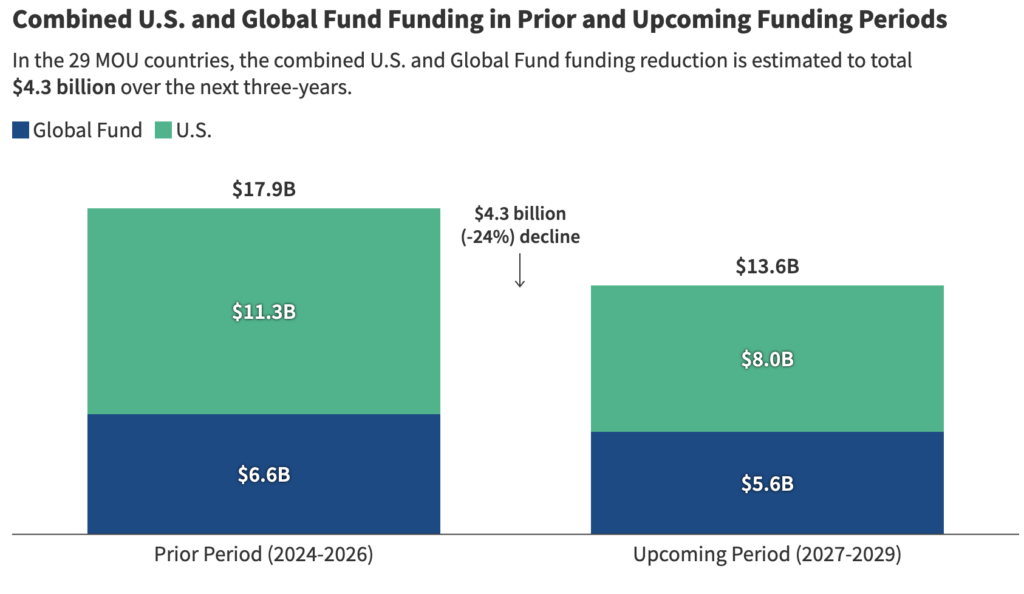
A wider analysis of 29 countries points to a decline in combined aid from the US and the Global Fund of some $4.3 billion (24%) through 2029, according to KFF. The US will reduce its aid by 29% and the Global Fund by 15%, respectively.
KFF’s figures are based largely on the Memorandums of Agreement (MOU) signed between the Trump administration and 29 countries in terms of the America First Global Health Strategy.
Funding in these 29 countries is estimated to decline from $11.3 billion (2024-2026) to $8 billion between 2027 and 2029 (a 29% decline).
Countries facing the biggest cuts are Uganda ($370 million), Mozambique ($356 million), Nigeria ($280 million), and Malawi ($252 million), according to KFF.
Reductions range from 1% in Honduras (off a very low base) to 82% in Senegal, with 12 countries experiencing reductions of 50% or more, KFF notes.
“In addition to these funding reductions, countries also face co-financing requirements, which could intensify fiscal impacts while offsetting some of the effects of the reductions on global health programs,” KFF notes.
Strain on domestic budgets
CHAI points out that in some of the 11 countries it engaged with, the combined co-financing requirements in their five-year MOUs with the US “exceed projected domestic health spending”.
Some areas of the HIV response face “major reductions”. Funding for frontline healthcare workers is projected to decline by 27-96% by 2028, and laboratory services funding declines by up to 66% over five years, depending on the country.
“Governments are expected to absorb these costs over time, raising urgent questions about whether countries have the fiscal capacity to sustain essential HIV services,” CHAI notes.
Almost 41 million people are living with HIV, and 1.3 million people were infected with HIV in 2024, according to UNAIDS, which will release comprehensive global figures on Friday.
Impact on services
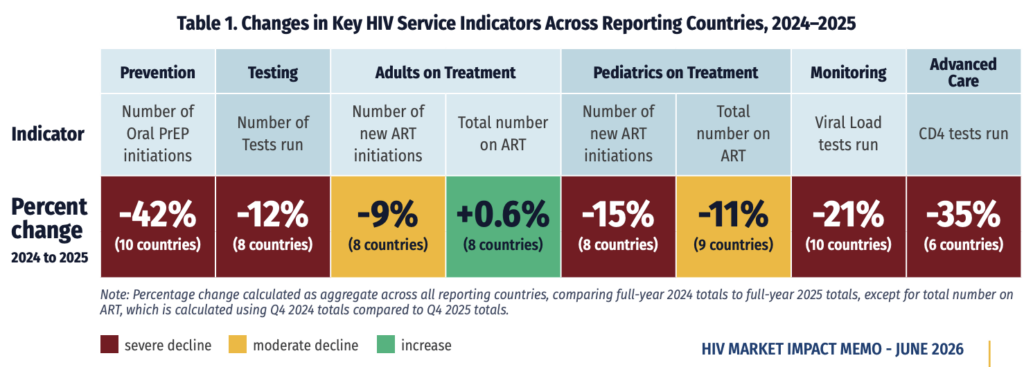
HIV testing has dropped 12%, there are 15% fewer babies being initiated on antiretroviral (ARV) treatment and the total number of children on ARVs fell 11%, with 26,000 fewer children on treatment across nine countries, according to CHAI.
In addition, the number of people initiating pre-exposure prophylaxis (PrEP) – ARVs taken by people at high risk of HIV to prevent transmission – has dropped by 42%.
“National-level data show declines across most key HIV service indicators, with little to no recovery to date,” the CHAI memo notes, contradicting upbeat claims of progress against HIV made by US State Department officials.
This follows the closure of the US Agency for International Development (USAID), a key implementer of HIV support, and the reorganisation of the US President’s Emergency Plan for AIDS Relief (PEPFAR) under the State Department.
“Following the initial disruption, the US introduced short-term bridge funding to keep essential HIV programs running through early 2026, but at roughly 40% less than the same period in 2024,” CHAI reports.
Silver lining: Lenacapavir
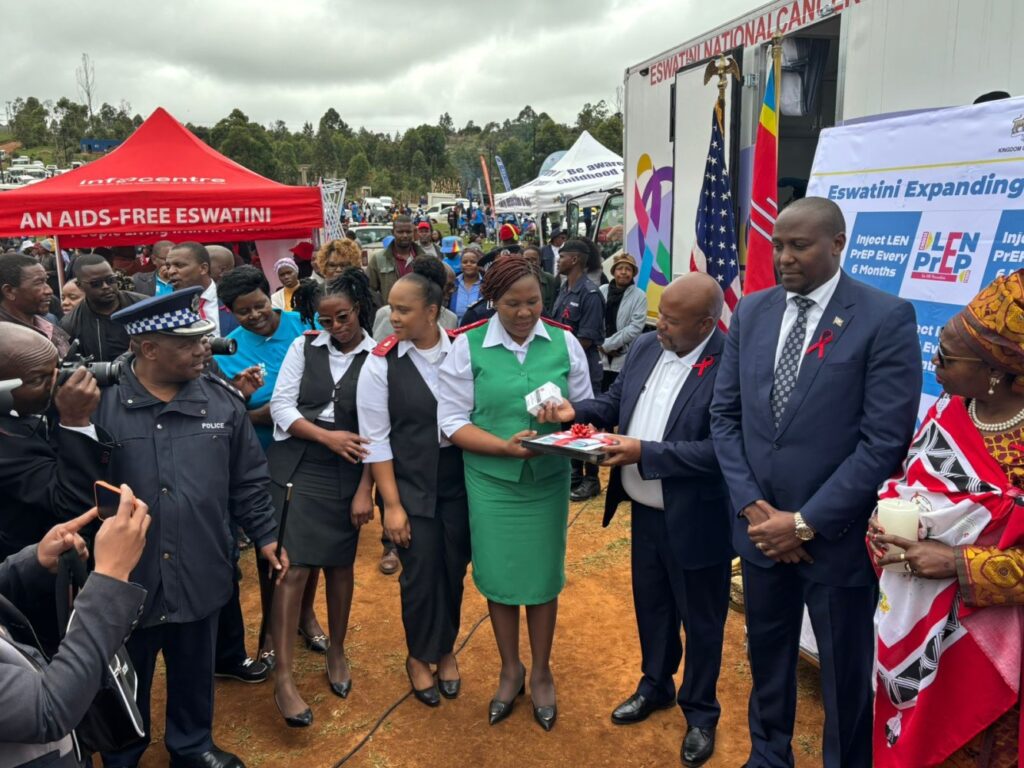
Despite the grim financial outlook, HIV advocates view the rollout of Lenacapavir, an injection given twice a year that almost completely prevents HIV transmission, as the most hopeful tool to end HIV.
“The innovations to transform prevention are within reach at the very moment they are needed most,” said Carolyn Amole, CHAI’s vice president for HIV, Hepatitis, and TB.
“The first [lenacapavir] injections were given in December and more than 20,000 people have now received their first injection. Last Friday in South Africa, the country with the largest global burden of HIV, President Cyril Ramaphosa officially launched lenacapavir to a nation fervently anticipating its arrival.
“Generic entry is expected by early 2027, and pricing agreements have brought the cost to $40 per person per year. The US government and Global Fund have raised their combined procurement commitment to three million person-years.”
Image Credits: Sydelle Willow Smith/ UNAIDS, Flickr, KFF, Karin Hatzold /PSI..
Combat the infodemic in health information and support health policy reporting from the global South. Our growing network of journalists in Africa, Asia, Geneva and New York connect the dots between regional realities and the big global debates, with evidence-based, open access news and analysis. To make a personal or organisational contribution click the donate button below.