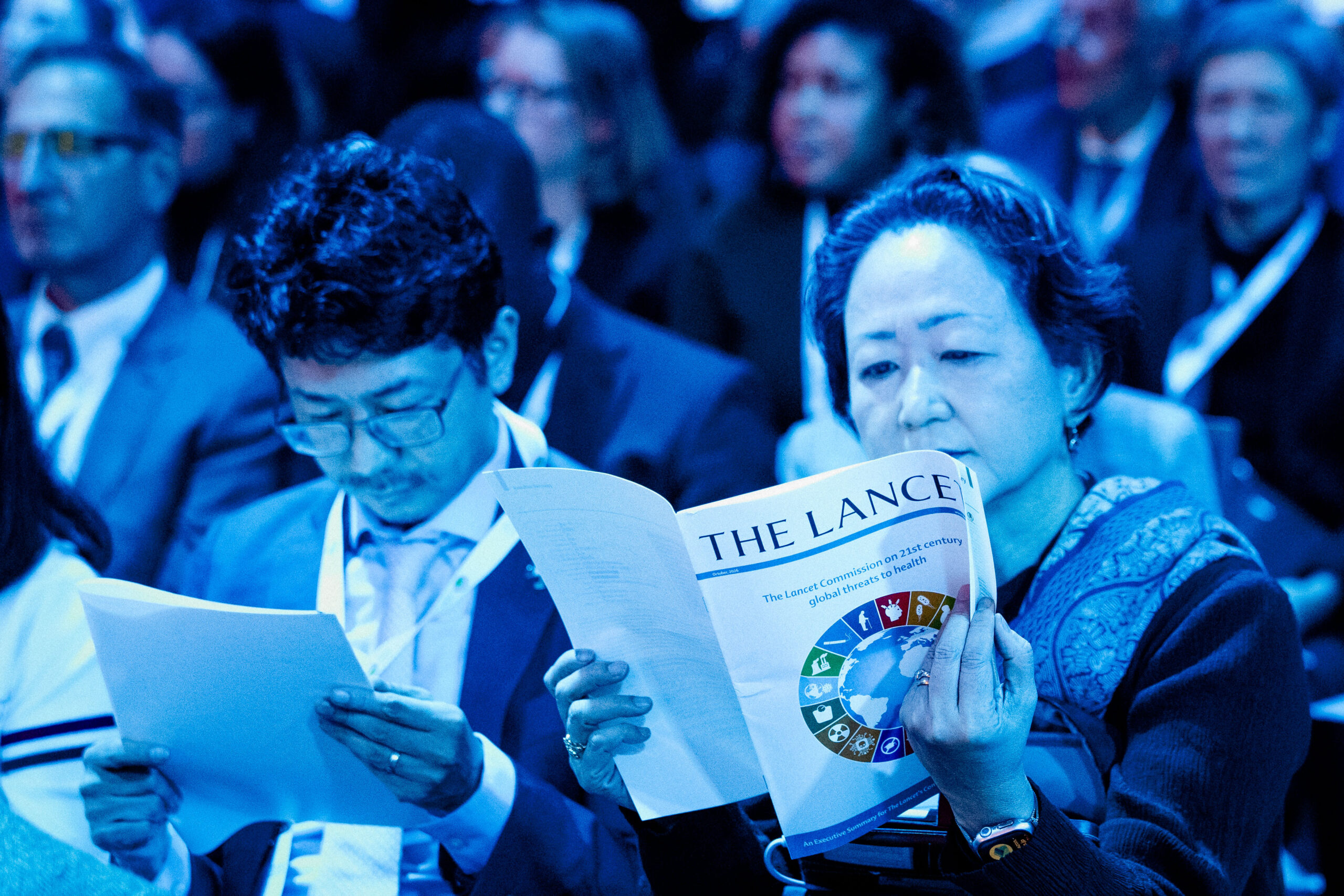
BERLIN – As candidates to become WHO director-general squabbled in the halls of the InterContinental, a three-year effort by the Lancet on future health threats delivered a sombre if uncertain warning: There is a chance, however small, that humanity will not survive this century – and we may all die.
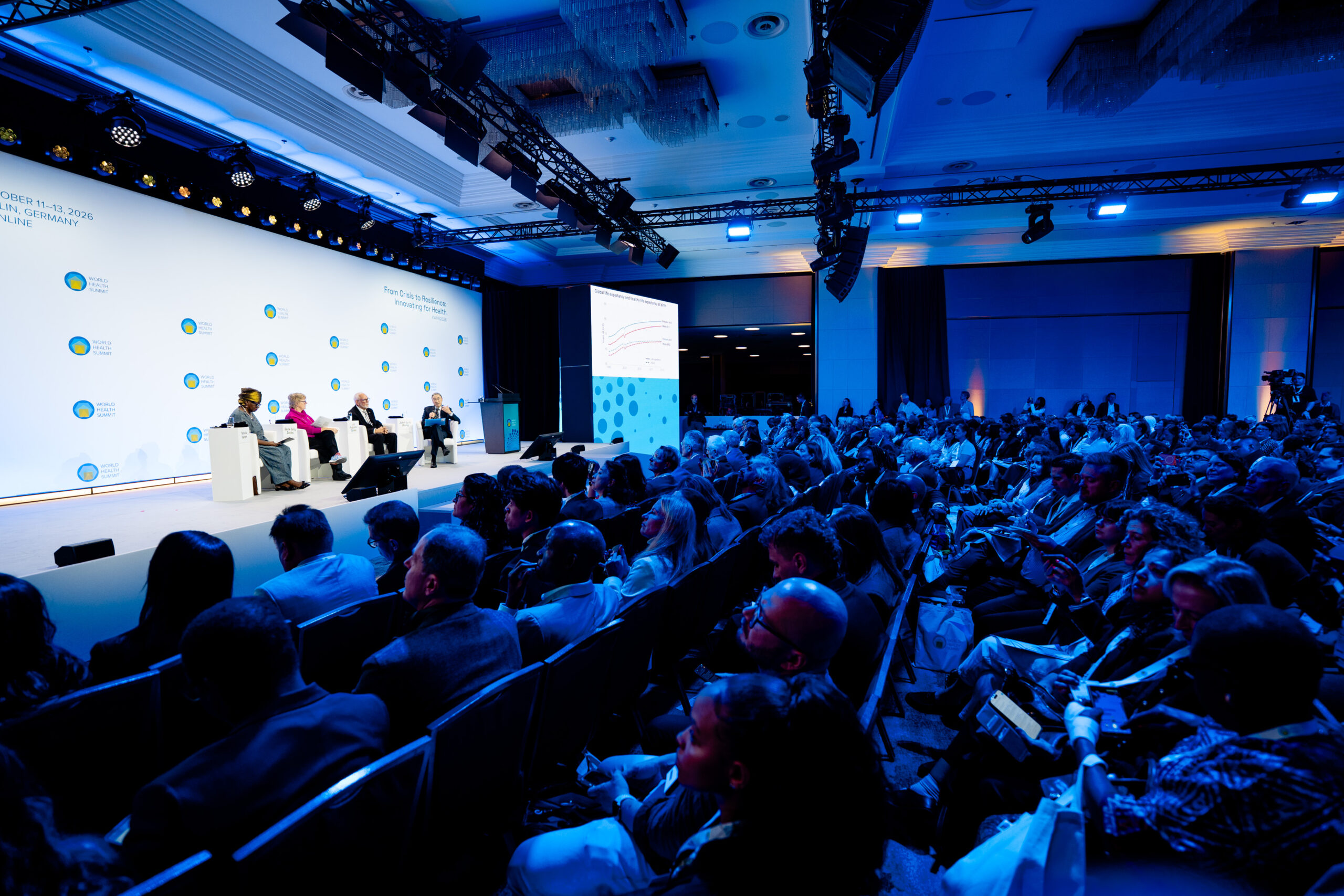
Two of the extinction threats it identifies – nuclear war leading to global famine, and the malicious use of artificial intelligence, including to build biological weapons – carry a “non-zero risk of human extinction during this very century,” said Natalia Kanem, a former head of the UN Population Fund who co-chairs the Lancet Commission on 21st Century Global Threats to Health, launching its report at the World Health Summit on Sunday.
“The devastation that could result from nuclear war cannot be overstated,” the report says, noting 22 nuclear weapon accidents and 21 close calls between 1948 and 2010. AI’s potential to improve health is enormous, it adds, but “the risk of catastrophic harm is equally profound.”
With no historical record to model projections for artificial intelligence, the commission leaned on expert opinion and on “superforecasters,” people judged by the Commission to “consistently make unusually accurate predictions about future events.” The report does not name them.
The superforecasters put the odds of AI-driven human extinction by 2100 at 0.4%, while AI specialists put them at 3%, according to the report. AI companies themselves acknowledge this risk, too. Anthropic chief executive Dario Amodei said last year there was a 25% chance that things go “really, really badly” with AI. Elon Musk has put the odds of “annihilation” at 20%.
Asteroid strikes and supervolcanoes – which the report deemed “can, in theory, cause human extinction” – were left off the list altogether, judged too unlikely to matter before 2100. So that’s good news.
The other 15 threats
The report highlights a total of 17 threats to human health, each forecast to cost at least one billion disability-adjusted life years (DALYs) between now and 2100. DALYs represent years of healthy life lost to illness, disability and early death.
Most of the other 15, such as obesity, mental health, lack of access to education, climate change, pandemics and antimicrobial resistance (AMR), are well known. Panellists at the launch described them as “among the less dramatic major catastrophes.”
“The other 15 are major catastrophic threats, each forecast to receive 1 billion cumulative DALYs, disability-adjusted life years, by the year 2100 in the reference scenario,” Kanem said. “For scale, COVID-19 caused roughly 500 million full healthy life years lost. Every one of the 17 threats we identified is measured in billions of DALYs.”
The commission’s definition of a threat was “deliberately inclusive,” she said, covering the largest causes of future health loss that policy can still change. “That’s why obesity and low educational attainment sit squarely and surprisingly on the same list as nuclear war.”
Obesity alone accounts for an estimated 23 billion “amenable” DALYs – the health loss the commission judges policy could still prevent, measured as the gap between the best and worst plausible futures it modelled. “Yesterday was certainly a milestone day for obesity,” Johanna Ralston, CEO of the World Obesity Federation, said of the Lancet commission’s findings. “It is that bad. But also, guess what? There’s a lot we can do.”
Low educational attainment accounts for 16 billion and income inequality for nearly 14 billion. AMR, a growing threat that remains under-addressed in the global health and national governance spheres, accounts for another 3.44 billion.
“Let’s admit there is a big, uncomfortable elephant in this room,” Kanem said. “These are threats that, frankly, we’ve known about for decades. Yet they’ve been systematically underprioritised.”
Obesity outweighs the apocalypse?
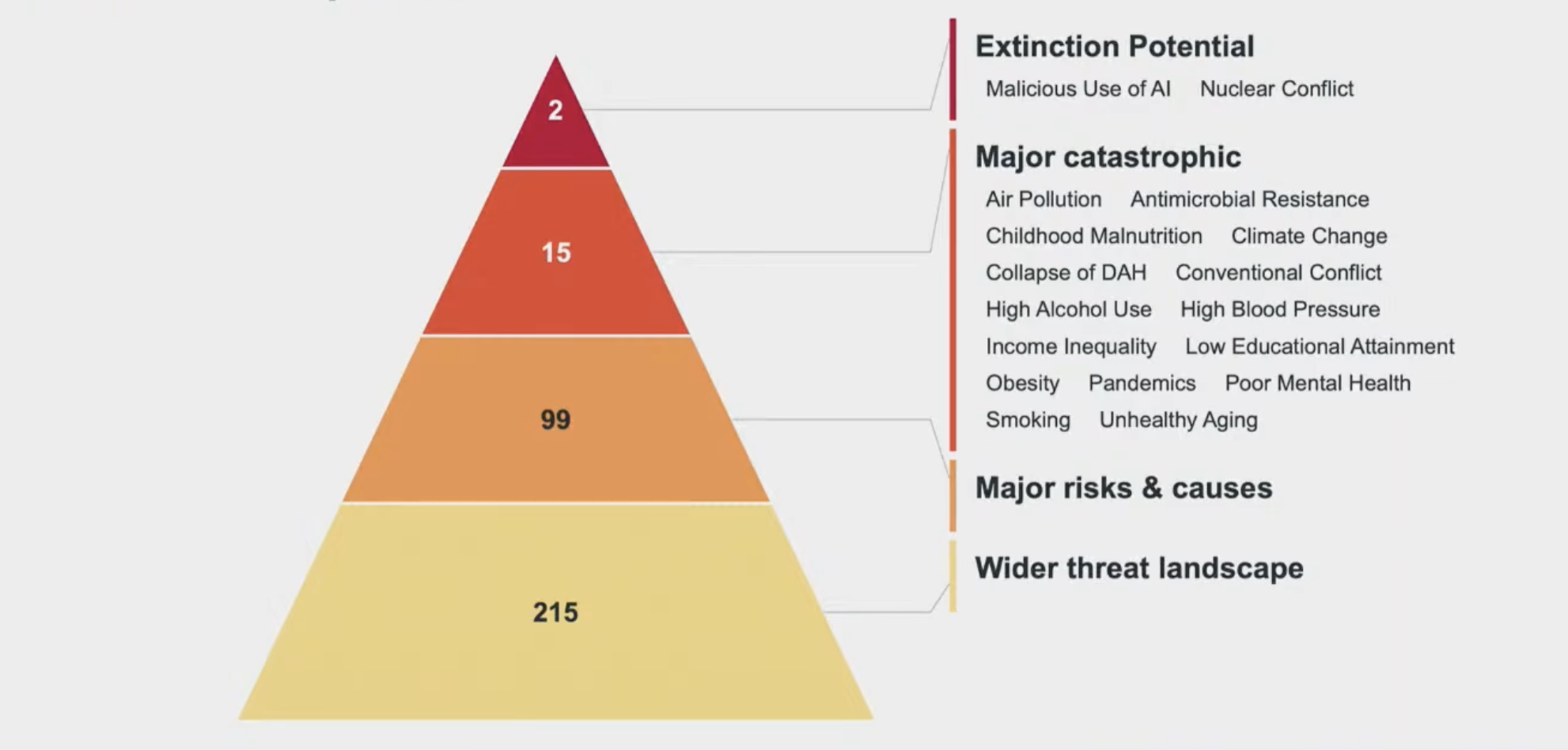
After obesity, low education and income inequality, the next-largest burdens belong to the two extinction threats: malicious AI, at 10.4 billion amenable DALYs, and nuclear conflict, at 9.35 billion. Both rest on expert judgment rather than data, and the commission’s uncertainty ranges for each run from zero, meaning no harm at all, up to 15.6 billion and 24.5 billion, respectively.
The commission scores each threat by multiplying the healthy life it would destroy by the odds of it happening. In the report’s own example, a 1% chance of losing 10 billion healthy years counts the same as a 10% chance of losing one billion.
Extinction would erase every remaining healthy year of everyone alive, but the forecasters put its odds at a fraction of a per cent. Obesity is already here and almost certain to grow; while it rarely kills outright, it shortens lives through diabetes, heart and kidney disease and cancer, and adds years lived in poor health along the way. DALYs count both, across billions of people.
The count also stops in 2100. And because DALYs only measure healthy years lost by people who are alive, the future generations who would never be born after an extinction do not register at all in the Commission’s calculations. The report itself warns the comparison “should not be read as placing these threats low among priorities.”
Poor mental health, unhealthy ageing, conventional conflict and smoking each top 7 billion, while childhood malnutrition sits at the bottom with 1.02 billion. The commission insists the figures are not a ranking of priorities. Still, obesity comes out as the leading threat in 154 of the 204 countries and territories analysed, and low educational attainment leads in sub-Saharan Africa.
“These 17 threats to future health are greater in scope, they’re greater in magnitude, they’re greater in complexity than previously understood,” Kanem said of the findings. “Each has the potential to place unsustainable pressure on societies and economies, and the harms fall unequally.”
Growing population and poverty in sub-Saharan Africa
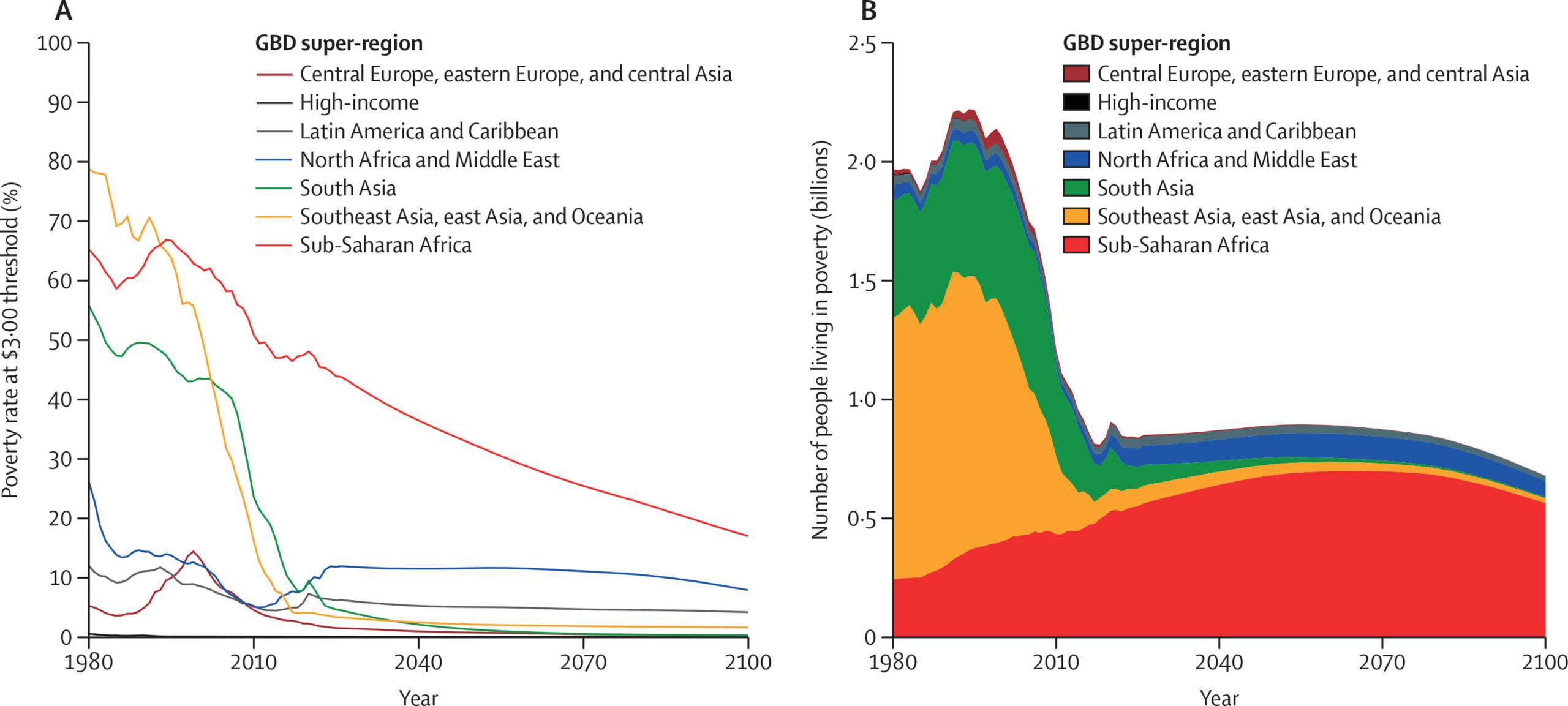
The other big subsection of the report’s threat indicators is the effect of income inequality and growing extreme poverty on the potential to live healthy lives.
“What came out of the data was that there are some profound headwinds for us in the next 25 to 50 years or more. The first is what’s happening to poverty,” Murray told the launch.
After “an extraordinary period of reduction in extreme poverty,” progress has flatlined since around 2015, he said, and “the number in extreme poverty in sub-Saharan Africa will actually go up.”
In the commission’s reference scenario, which projects what happens if current trends hold, the global number of people living on less than $3 a day stays flat for decades. In sub-Saharan Africa, slow economic growth and a fast-growing population push it up until late in the century.
The trajectory of global health is “profoundly affected by what happens to economic growth in sub-Saharan Africa, particularly in the Sahel,” the report says.
The sub-Saharan African region’s share of the world’s population is projected to rise from 15.3% today to 36.7% by 2100, as global population peaks at about 9.5 billion in 2064 and then declines, the report projects.
The commission’s growth forecasts for the region are also much lower than those used in climate modelling. Some Intergovernmental Panel on Climate Change scenarios have income per person there growing twelvefold by 2100, after minimal growth over the past 75 years. On the commission’s numbers, the gap between rich and poor countries widens.
Even nuclear war would hit sub-Saharan Africa hardest, accounting for 2.97 billion of its 9.35 billion amenable DALYs, even if no bombs fell on the region. Nuclear famine “would affect all regions of the world, including those far from the conflict itself,” the report says, and the region bears the heaviest burden “despite having no nuclear weapons, owing to nuclear extinction probability and its young age structure.”
‘Lives were lost’ in collapse of development assistance
Income inequality, which the commission measured through median household consumption rather than average income, accounts for 13.8 billion amenable DALYs, the equivalent of more than 25 COVID-19 pandemics. More than half of that, 7.31 billion, is in sub-Saharan Africa.
Low educational attainment, at 16.1 billion, is the largest threat in sub-Saharan Africa, which holds more than two-thirds of its amenable burden. Most of that burden falls on children and adolescents, the Commission said.
“Low education attainment is a chronic and many times a silent threat,” said Juan Pablo Uribe, the World Bank’s director for Mexico, Central America and the Dominican Republic. “In a way, we live with it.”
The collapse of development assistance for health counts as a threat of its own, worth 1.5 billion amenable DALYs, 70% of them – again – in sub-Saharan Africa. IHME estimates health aid fell 9.7% between 2024 and 2025, with official development assistance sliding to 0.26% of donors’ gross national income in 2025, from 0.33% a year earlier.
The report finds little evidence that finance ministries in poorer countries fill such gaps, with debt payments squeezing their budgets.
“The cuts had a direct impact almost overnight. Lives were lost. Individuals died,” Izukanji Sikazwe, head of HIV at the Global Fund, said at the launch. Recipient countries should spend more, she said, “but domestic financing is not going to bump up overnight.”
Is climate an existential threat?
The Commission’s decision to focus headlines on the world-ending potential of AI and nuclear war did not come without controversy.
Sources close to the Lancet Countdown on Health and Climate Change – the annual report published by the journal quantifying the health threats posed by the climate crisis, which will come out this month – told Health Policy Watch the categorisation of obesity, alcohol use, and smoking on the same scale as catastrophic climate impacts was, at best, unhelpful.
“It is a bit misleading, I would say,” said Melissa Jiménez Gómez Tagle, a planetary health scientist and UNFCCC advocate for climate and health who has collaborated with the Countdown. “I’m not saying that it is reporting the wrong thing, but maybe it is the way they are phrasing it that is confusing for people who are not knowledgeable of the whole report.”
The report stresses that its figures are not a ranking, she said, “but then do not number it.” When she raised the point with one of the authors, she was told the list did not imply an order of importance. “I told them, okay, you’re telling me this as a scientist, but for the people who are not in touch with scientific publications, the first thing they will say is this is in order,” she said.
On the commission’s own yardstick, climate change accounts for 1.89 billion amenable DALYs over the century. That is less than high alcohol use, at 2.35 billion, and roughly a twelfth of obesity’s burden. Only air pollution, which kills nearly 8 million people a year, the collapse of health aid – which separate Lancet projections estimate could cause 14 million additional deaths by 2030 for US aid cuts alone – and childhood malnutrition, which affects at least 150.2 million children under five around the world, come in lower.
“I do not deny that these are public health problems, for example obesity, or also smoking, alcohol,” Jiménez Gómez Tagle said. “But I do believe that these numbers are skewed.”
“The report identifies a relatively smaller quantified burden for climate change, but climate is not necessarily a smaller systemic threat,” Vanessa Kerry, CEO of Seed Global Health and the WHO director-general’s special envoy for health resilience, wrote on LinkedIn. “It makes other threats worse, from disease outbreaks to food shortages, while driving up demand for care and damaging the clinics and health workers that provide it.”
What the climate estimate leaves out
The report’s climate estimate leaves out migration, biodiversity loss, drought and sea-level rise. It also excludes some of the tipping points climate scientists fear most, including a full collapse of the Atlantic Meridional Overturning Circulation (AMOC), the system of ocean currents that carries heat north to Europe, abrupt shifts in Arctic and Antarctic sea ice, and the melting of the Greenland ice sheet, which it judges extremely unlikely this century.
“The doctors of the planet are saying that the planet, which is the patient, is sick,” Jiménez Gómez Tagle said. Seven of the nine “planetary boundaries” that scientists say keep Earth’s systems stable have already been breached, according to the Potsdam Institute for Climate Impact Research’s 2025 Planetary Health Check.
“They are putting the [tipping points] aside,” she added of the report’s methodology. “It’s like, oh yes, it is happening, but it’s not important. If we do not look at them as objectively and urgently as it’s needed, then what are scientists for?”
Last year’s Lancet Countdown report put heat-related deaths at an average of 546,000 a year, up 23% since the 1990s. It linked droughts and heatwaves to an extra 124 million people facing moderate or severe food insecurity in 2023.
The commission treats a collapse in global food production as the route by which nuclear war could end humanity. Yet it leaves drought-driven famine out of its climate estimate, arguing that famine “is a sociopolitical phenomenon” that depends more on governance than on weather.
Its uncertainty range for climate, 1.32 billion to 2.48 billion DALYs, covers only the pathways it modelled. The authors concede that the uncertainty “runs in both directions,” and that the climate figure “could reasonably increase in future evaluations.”
The same parts of sub-Saharan Africa where extreme poverty is set to rise also face the most damaging increases in temperature, the report notes. “Rising extreme poverty in a world with declining [development assistance for health] will create populations that might be under severe duress,” it warns.
Beyond 2100, the report concedes, climate change “could escalate into an extinction threat in subsequent centuries if emissions are not curtailed.”
“This is not an attack against them,” Jiménez Gómez Tagle said. “It’s just a request for clarification.” An open discussion between the authors and other scientists would help, she said, “so then we avoid, as they say, fatalism among people.”
The criticism crystallised the unconventional scope of the report, venturing far outside the prestigious medical journal’s specialist remit. Asked about the reasoning behind the report, Julio Frenk, chancellor of UCLA and a former Mexican health minister, recalled the commission’s first meeting, in Berlin at the World Health Summit in 2023.
“We all felt that we were in one of those periods in history where you sense that an era is coming to an end,” he said. He pointed to the end of the pandemic, when billions of people in the Global South were “wanting and needing and being willing to pay for vaccines that were being hoarded by rich countries, many of whose citizens were refusing to take the vaccines.”
“Today, among all the forms of erosion of trust,” Frenk said, “the most serious one is the erosion of trust in the future.”
Combat the infodemic in health information and support health policy reporting from the global South. Our growing network of journalists in Africa, Asia, Geneva and New York connect the dots between regional realities and the big global debates, with evidence-based, open access news and analysis. To make a personal or organisational contribution click the donate button below.