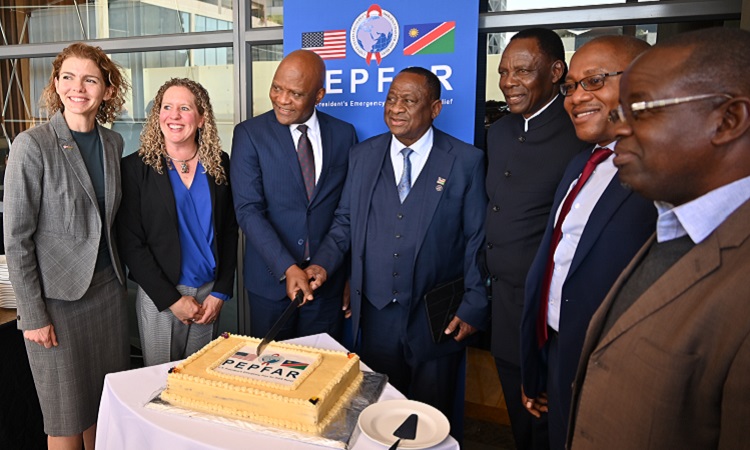
The United States will no longer fund Namibia’s HIV programme after 2027, following an impasse over data- and information-sharing terms required by the US for a longer aid package.
The joint US-Namibia announcement frames the one-year aid phase-out as “recognition of Namibia’s historic achievement in reaching HIV epidemic control and surpassing global targets”.
The US will provide $45 million for the 2027 fiscal year to enable the transition to technical support, and thereafter Namibia will fund its own response, according to the statement released last Friday.
Namibia already covers most of the costs of its antiretroviral treatment programme with its domestic budget, providing free treatment to around 220,000 people.
It has surpassed the global HIV “90-90-90 targets” – 90% of citizens with HIV aware of their status, 90% of those with HIV on treatment, and 90% of those on treatment virally suppressed – achieving 96-98-98.
Namibia has also almost eliminated mother-to-child HIV transmission, with 97% of babies born to mothers with HIV testing negative.
However, it emerged earlier that Namibia had rejected the United States’ demands for sharing health data and pathogen information during negotiations for renewed US support for its health and HIV programme.
Over the past 22 years, Namibia has received some $1.1 billion in support from the US President’s Emergency Plan for AIDS Relief (PEPFAR).
However, the Trump administration is replacing PEPFAR and other health grants with new bilateral agreements in terms of its America First Global Health Strategy. These focus on countries’ ability to contain disease outbreaks as well as support for HIV and other key health programmes.
Undermining PABS talks
US demands for data and sharing of pathogen information have also been rejected by other African countries.
Zimbabwe and Ghana have also rejected the US data- and pathogen-sharing demands, while the memorandums of understanding (MOUs) that the US has reached with Kenya and the Democratic Republic of Congo (DRC) both face legal challenges from civil society groups.
World Health Organization (WHO) member states are currently in sensitive talks about how to share information about dangerous pathogens, and any medical products that arise from this sharing.
The pathogen access and benefit-sharing (PABS) system is the last outstanding piece of the Pandemic Agreement. Namibia has played a central role in representing the African region at the talks.
As the US withdrew from the WHO when Donald Trump became president in January 2025, it will not be included in the PABS system.
However, the US bilateral health agreements demand that countries provide it with full access to information about dangerous pathogens within 10 days of an outbreak. In addition, the US wants to be able to share this information with companies and groups of its choice without any restrictions. This is a direct challenge to a WHO PABS system.
Meanwhile, the Namibian government is concerned that the data- and pathogen-sharing demands do not comply with its laws, infringing both constitutional privacy rights and national sovereignty over biological resources, according to The Namibian newspaper.
Combat the infodemic in health information and support health policy reporting from the global South. Our growing network of journalists in Africa, Asia, Geneva and New York connect the dots between regional realities and the big global debates, with evidence-based, open access news and analysis. To make a personal or organisational contribution click the donate button below.