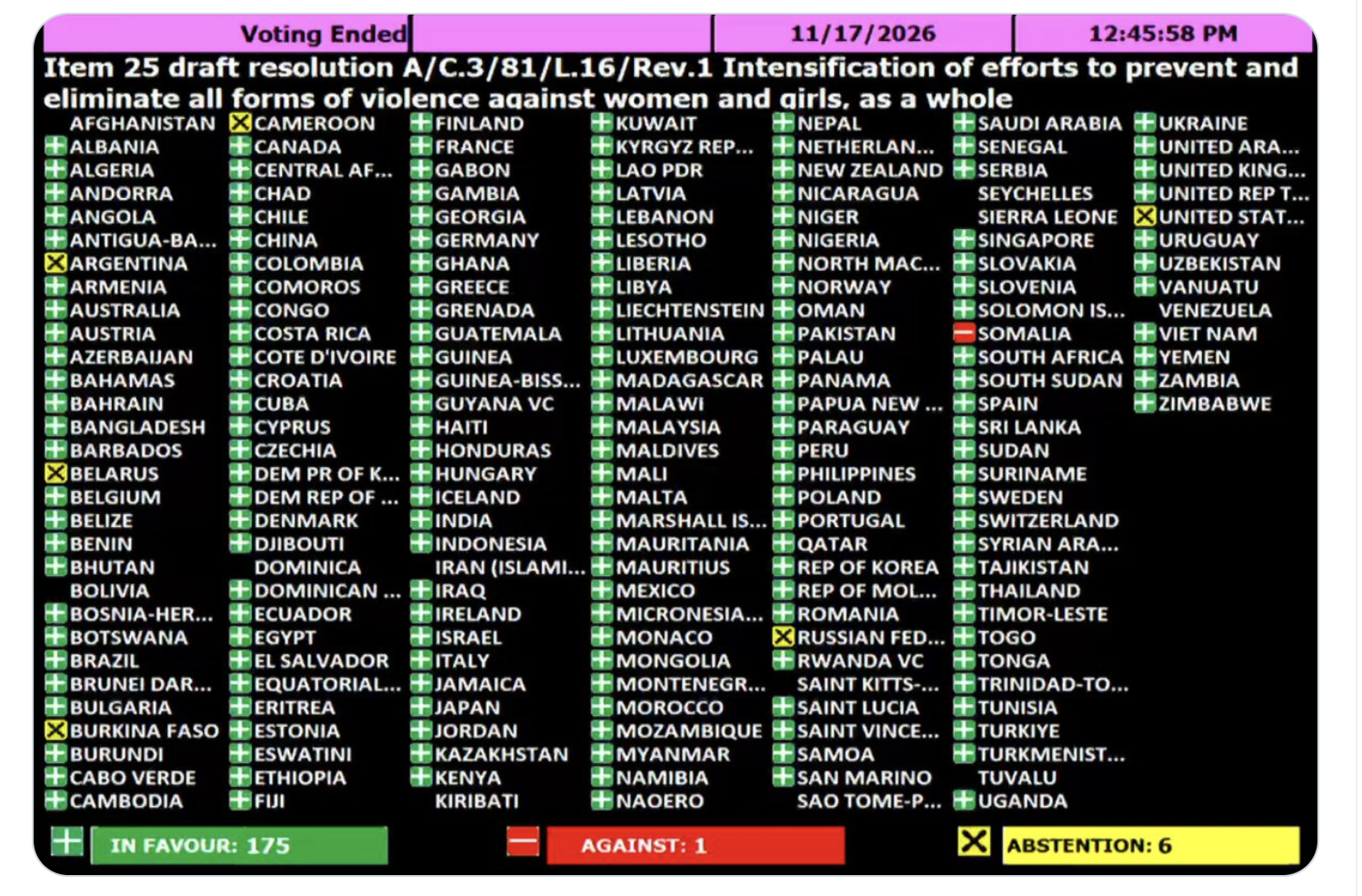
Somalia was the lone country voting against a United Nations (UN) resolution on “intensifying efforts to prevent and eliminate violence against women and girls” on Tuesday, while the United States and Russia were among the six countries that abstained.
The resolution urges member states to “take comprehensive and gender-responsive measures” to prevent and eliminate all forms of “violence, intimidation and attacks” against all women and girls, and to address risk factors by implementing legislation and policies.
Its definition of violence extends to online and digital technologies, and urges countries to adopt laws and policies to protect women and girls from defamation and hate speech in online spaces.
Digital violence
Introducing the draft, France stressed the importance of the resolution’s focus on the digital landscape, noting that over half of women in some parts of the world have been affected by online violence.
In August, a report from the UN Secretary-General on progress made to eliminate gender-based violence noted that almost 50,000 women and girls were killed by their partners or another family member in 2024.
“Technology has extended the continuum of violence against women and girls into the digital sphere, where online harms increasingly function as precursors to and instruments of lethal violence,” noted the report.
“Online stalking, digital surveillance and harassment extend coercive control beyond the physical environment,” it added, singling out “GPS tracking, spyware and monitoring applications” which enabled perpetrators to locate victims.
The resolution, sponsored by France and the UK, had been the subject of lengthy debate – as has been the case for most UN resolutions concerning women, girls and gender in the past few years.
Various member states contested terminology such as “sexual and reproductive health” and “safe abortion”.
Argentina, Burkina Faso, Belarus and Cameroon also abstained.
Sovereignty opt-out defeated
A proposed amendment, which was defeated by , wanted the entire resolution to be subjected to “national sovereignty”.
Nine civil society groups warned that this would undermine multilateralism by adding “a general sovereignty caveat” that would undermine “the process, the international human rights framework and the agreements on which this text rests”.
“If accepted here, the same approach could be applied to any resolution in the future,” noted the groups, which include Amnesty International, the Center for Reproductive Rights, Human Rights Watch, International Planned Parenthood Federation and the International Service for Human Rights.
“This is not how sovereignty has been understood in the human rights system,” they pointed out.
“The Vienna Declaration and Programme of Action addressed this question directly: while the significance of national and regional particularities and of various historical, cultural and religious backgrounds must be borne in mind, it is the duty of States, regardless of their political, economic and cultural systems, to promote and protect all human rights.”
Other member states sought to remove “non-consensual language”, including references to “multiple and intersecting forms of discrimination,” “intimate partner violence” and “marital rape”.
However, several delegations said that the amendments represented “backsliding,” harming the substance of the resolution.
‘Global scourge’
“Every 10 minutes, a woman is killed by her partner or a family member. This is appalling. And it must end,” said the UK, which co-sponsored the resolution.
Welcoming the resolution, the European Union at the UN noted: “Gender-related killings are a global scourge. Today’s vote: 175 to 1 marks the international community’s commitment to end violence against women and girls worldwide.”
The US explained in a statement that was disappointed to see the “controversial terminology” of ‘sexual and reproductive health’ and ‘safe abortion’ in the resolution.
“There is no international ‘right to abortion,’ whether under that name or under other terms like ‘sexual and reproductive health’,” it added.
As the resolution has only been approved at the committee level during the 81st session, it still needs to be formally adopted in December by the General Assembly.
Combat the infodemic in health information and support health policy reporting from the global South. Our growing network of journalists in Africa, Asia, Geneva and New York connect the dots between regional realities and the big global debates, with evidence-based, open access news and analysis. To make a personal or organisational contribution click the donate button below.