
Over 800 million children have unsafe lead levels in their blood, according to the latest estimates of the World Health Organization (WHO).
A toxic metal found in the Earth’s crust, humans are increasingly exposed to lead contained in a range of everyday products, including paint, cookware, cosmetics and spices. Informal recycling and contaminated environments can also contain lead.
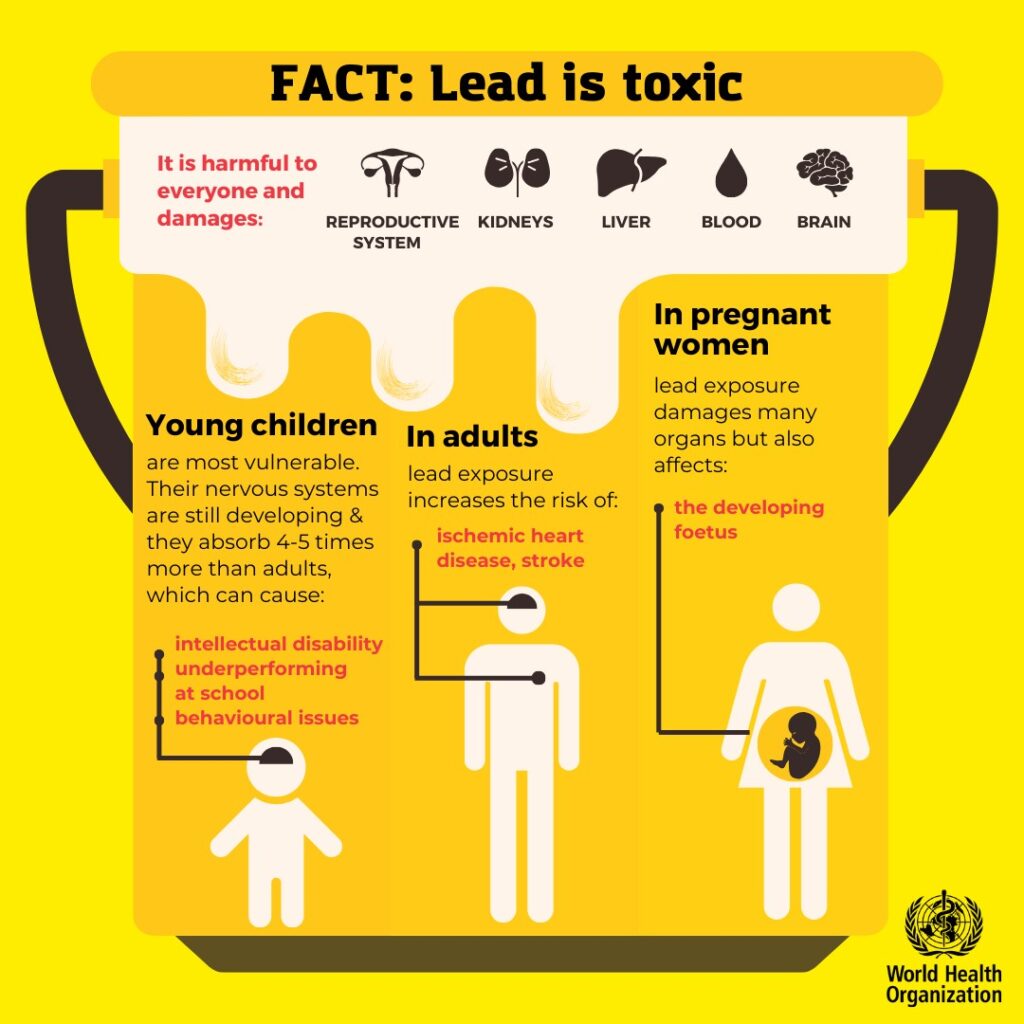
Lead exposure affects multiple organs – brain, liver, kidney and bones – and often accumulates in teeth and bones.
“This is a health threat that is largely invisible. A child can be exposed without showing any obvious symptoms. The damage to their developing brain and nervous system may be already taking place,” said Bruce Gordon, WHO director a.i., Department of Environment, Climate Change, One Health and Migration.
WHO has launched a week-long campaign starting 18 October to raise awareness among public health professionals, governments and industry.
“We’re calling on governments to strengthen regulations and enforcement, remove lead hazards from products and environments, invest in surveillance and safer industrial practices, and prioritize the protection of children and other vulnerable populations,” said Gordon.
This year’s theme is “From Detection to Prevention” to emphasize that exposure can come from multiple and often invisible sources like food and water.
The damage lead can cause

No level of exposure to lead is considered safe by the WHO. In 2023, an estimated 3.5 million deaths were attributed to lead poisoning by the US-based Institute for Health Metrics and Evaluation (IHME). It also estimated that lead exposure accounted for more than 71.5 million years lost to disability (disability-adjusted life years, or DALYs) worldwide in 2023.
Another study done in 2022, and led by researchers at China’s Southeast University, estimated that the most number of deaths by lead poisoning were in concentrated in three countries – China, India and Bangladesh.
Young children and women of childbearing age are particularly vulnerable to the harmful effects of lead poisoning, as lead can affect the development of the central nervous system.
Exposure during pregnancy can cause reduced fetal growth and preterm birth. In adults, lead poisoning can cause long-term effects like increased risk of high blood pressure, cardiovascular problems and kidney damage.
“Lead does not belong in the body. It disrupts, it gets incorporated, and it really interferes with brain development,” explained Gordon.
Much of the damage caused by lead is largely preventable.
Phasing out lead in cosmetics: A case study from Nigeria
Nigeria is raising awareness about the use of toxic chemicals like lead and mercury in cosmetics with the assistance of global non-profit Resolve to Save Lives.
“That was a policy win that gave the government sort of the strength and the mandate to work on leaded cosmetics without having to go through a very long policy process,” said David Berendes, Resolve senior technical advisor on lead poisoning prevention.
Resolve is also supporting greater dialogue between the government and industry bodies to find solutions to phase out lead at source. They are also building capacity by training enforcement environment officials to test products to check the presence of lead and seize them.
Also read: Phasing Out Mercury in Cosmetics Requires ‘Detoxifying’ Perceptions of Beauty
Why lead poisoning remains undetected

A key reason why lead poisoning continues is because most countries currently do not have the required testing capacity, national regulations and surveillance in place to respond appropriately.
WHO is hoping to fill this gap soon. In the coming year, the world health body is set to release a Global Action Plan on Lead Mitigation. The aim is to help countries prevent, detect and manage lead exposure and poisoning better.
“This builds on a successful history of WHO technical packages in a number of areas like tobacco control, cardiovascular disease, reducing salt in food, etc. And they aim to be a package of effective, evidence-based measures, actions that governments can take to move from identifying the problem to actually taking action to address,” said Richard Brown, Technical Officer in the Chemicals, Radiation and Health Unit, WHO.
Image Credits: WHO/Yoshi Shimizu, WHO/Yoshi Shimizu, WHO, EPA/L. Koula.
Combat the infodemic in health information and support health policy reporting from the global South. Our growing network of journalists in Africa, Asia, Geneva and New York connect the dots between regional realities and the big global debates, with evidence-based, open access news and analysis. To make a personal or organisational contribution click the donate button below.