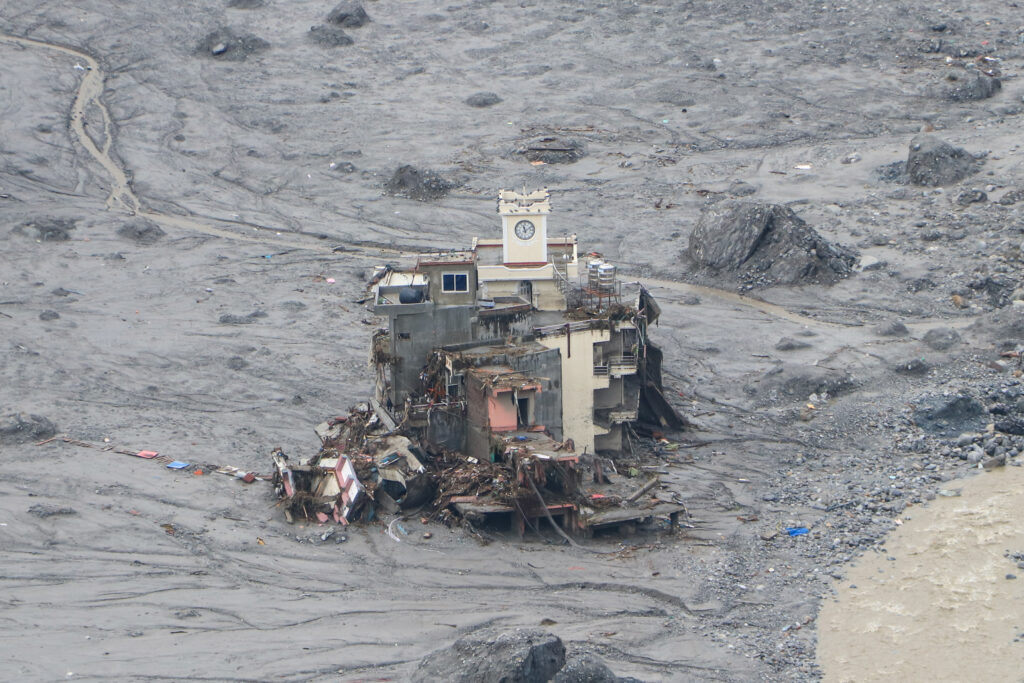
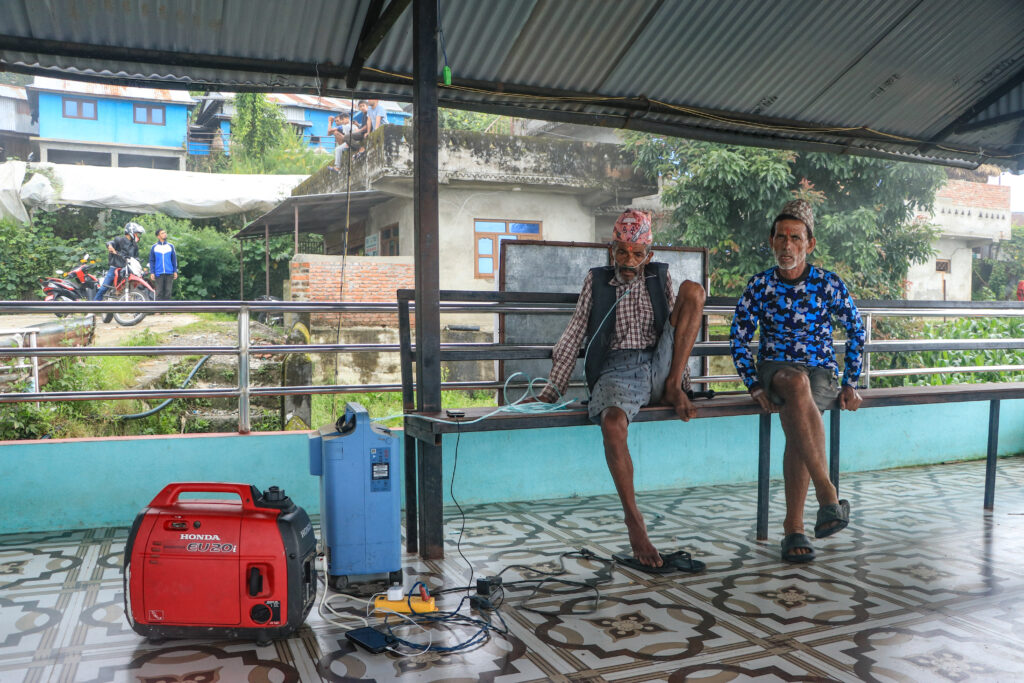
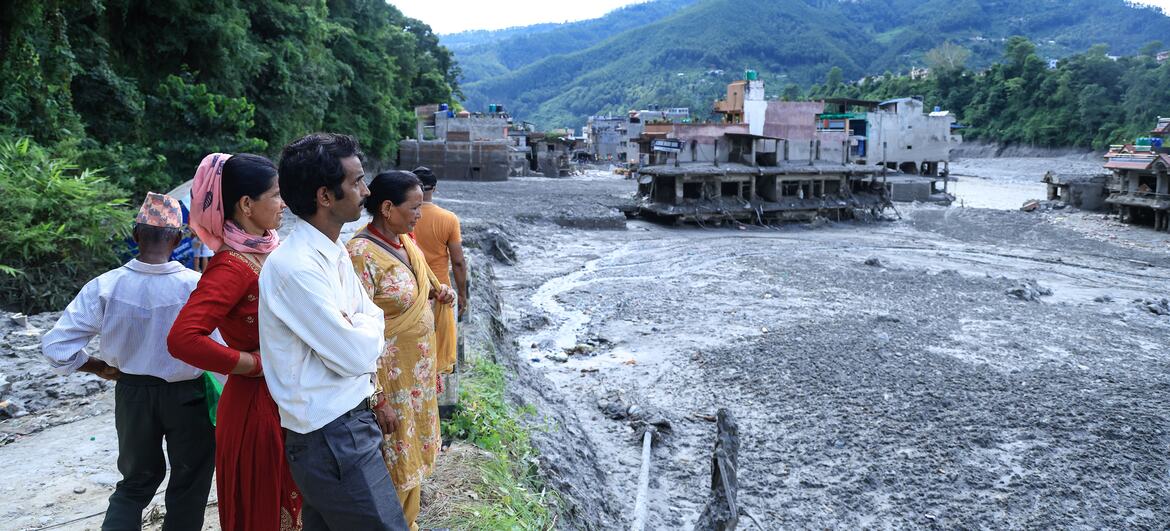
KATHMANDU – Shekhar Lamichhane is grieving even as he struggles to breathe. The 65-year-old asthma patient needs oxygen support. Some of his family members, including siblings, were swept away in Nepal’s flash flood on 26 August when glacial ice and rock slammed into the valley below near the Nepal–China border.
“I am on oxygen support. I have severe asthma and the electricity has been gone since the flood. I am struggling to breathe without support,” Lamichhane said.
The flash flood carrying rocks and debris gushed through the Nepal–Tibet border into northern Nepal. By Tuesday (1 September), over 1003 people were reported dead, and nearly 4,000 were missing.
“The sudden glacial collapse and flash flood is a devastating reminder of how fragile these mountain environments can be, particularly in the Hindu Kush Himalayas. For years, scientists and local communities have been warning that the Hindu Kush Himalayas are at huge risk from climate change,” said Simon Stiell, executive secretary of UN Climate Change, in the aftermath of the floods.
Nepal – a classic example of what developing nations face
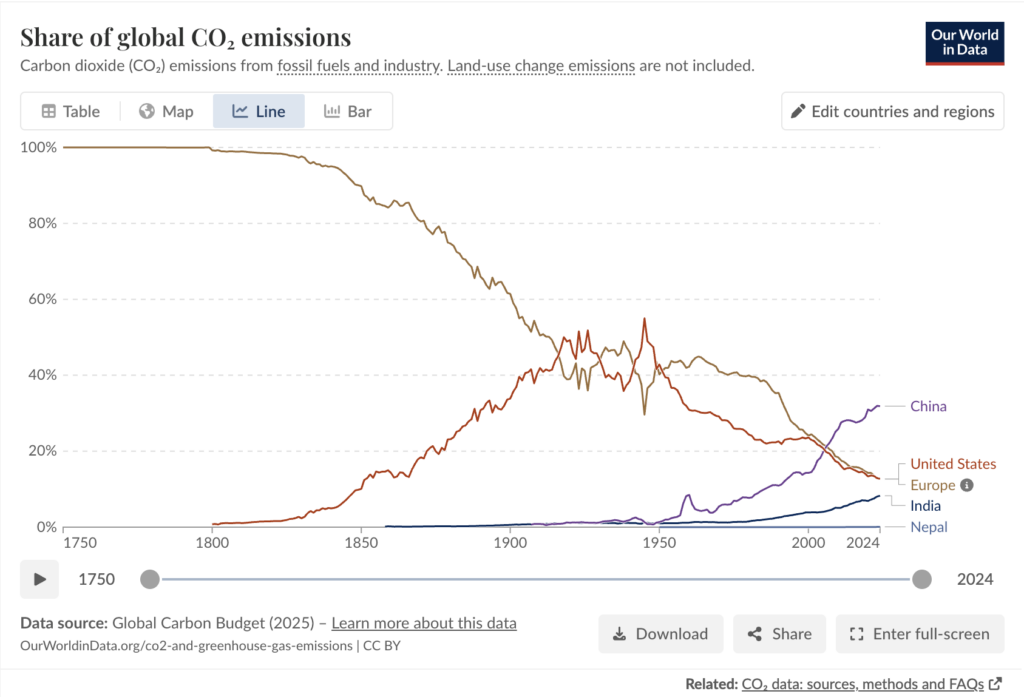
Nepal is the classic example of what climate scientists have been warning of: small nations facing disproportionate climate impacts despite contributing the least to climate change.
In 2024, Nepal emitted around 0.05% of the world’s CO2 emissions, according to Our World in Data, based at Oxford University.
Nestled in the pristine and fragile Himalayas, Nepal gets nearly all of its electricity from hydropower, and a fraction from solar and wind.
Black carbon, the fine particles that remain after incomplete combustion of fuels, is a regional problem, though. Black carbon concentrations have increased by approximately 7.74% since 2000, according to a report by Climate Trends. This has contributed to faster warming of the Himalayan glaciers.
A trail of destruction
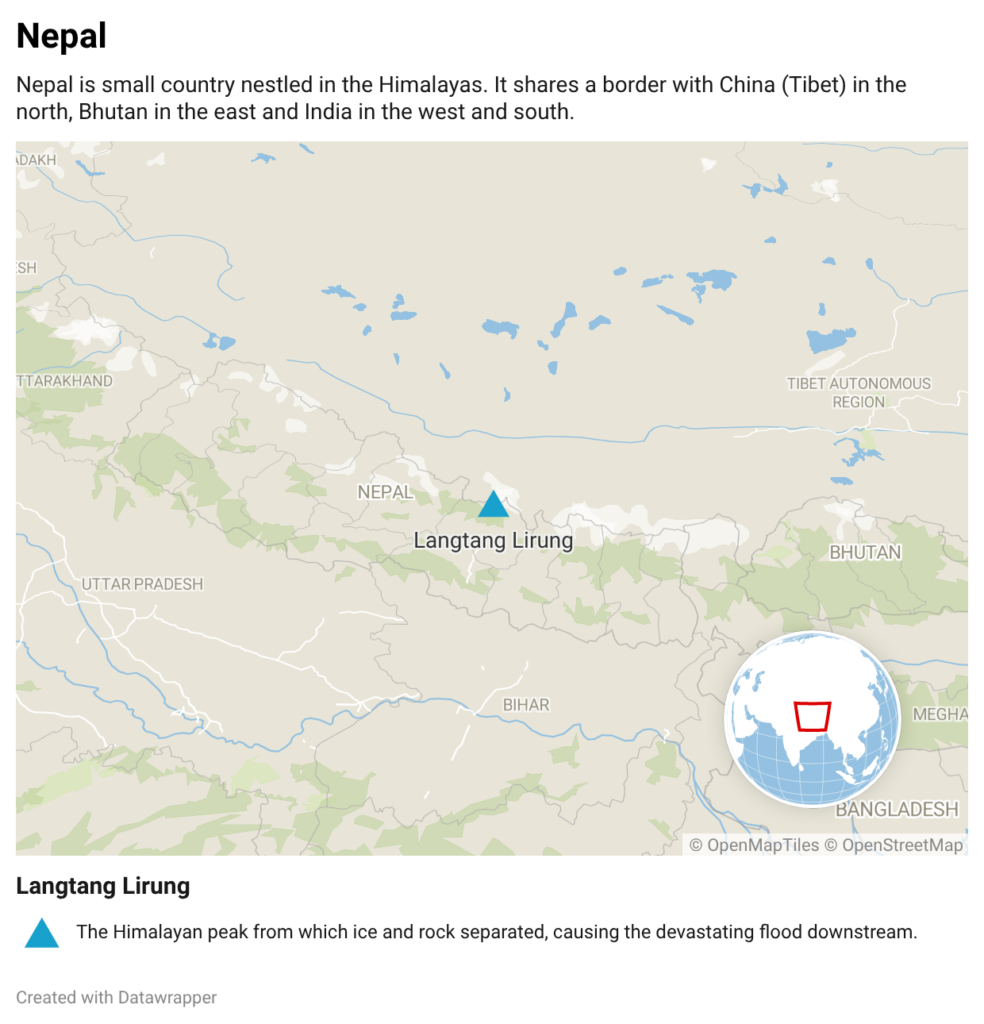
Preliminary estimates by scientists suggest that the enormous mass of bedrock and glacier ice broke off a slope north of Langtang Lirung and slammed into the valley about 4,000 feet (1,200 meters) below – a distance roughly three times the height of the Eiffel Tower.
The debris fell into the Lhende River, which flows from Tibet into Nepal, sending floodwater and debris surging downstream.
“This was an unprecedented and unexpected disaster. There was simply no detection and no time to issue a warning. The event was a sudden-onset hazard that could not be captured by conventional warning systems,” said Dr Farooq Azam, Senior Cryosphere Specialist and Intervention Manager at Nepal-based ICIMOD, a Nepal-based regional research organisation.
A rapid assessment of the disaster by a group of International scientists, published by HiRisk, agrees that, given the “rapid speed of the initial avalanche, warning time from conventional in-channel systems would have been minimal and likely insufficient for successful evacuation at the Nepal-China border checkpoint at Rasuwagadhi”.
However, they assert that further downstream, “with warning times of 10 minutes or more, comprehensive and well-capacitated systems could have saved a significant number of lives”.
The HiRisk report notes that, while early warning systems (EWS) focused on several glacial lakes in China were recently set up, no operational EWS were set up “for glacier-related hazards”.
They also point to “some pre-event indications that the ice surface sped up just prior to the event”, including that “meltwater had turned visibly brown by 24 August” and “some indication of a crack propagating into the surrounding bedrock slope in the days before the event”.
Seismic event
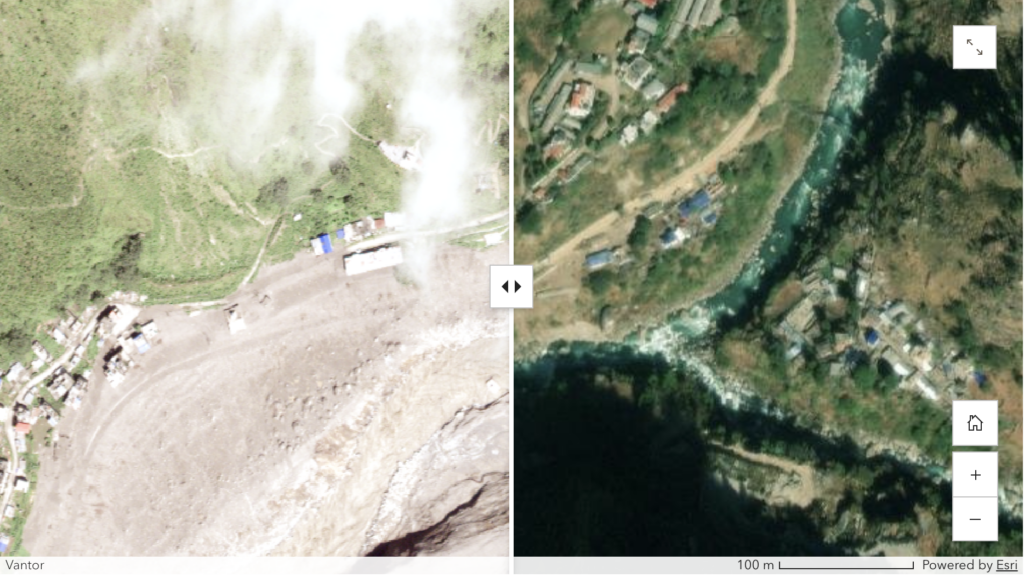
The ice and rock collapse from the glacier was so powerful that it caused seismic activity equivalent to a 5.2‑magnitude earthquake, according to the US Geological Survey at 8.37 am local time. Sediment and boulders moved rapidly through the Bhote Koshi and Trishuli river systems, flattening everything in its path.
According to the HiRisk report, satellite-based preliminary flood assessments show that “at least 68 bridges were hit, including 33 suspension bridges and 35 motorable bridges and 40 km of highway were washed away”.
“Open-access datasets indicate that 12,944 buildings are located within the floodplain, with structural heights up to 9 meters.”
Nepal struggles to coordinate relief efforts
Nepal’s government is facing criticism for not accepting international assistance quickly enough – a delay some say hindered early rescue operations.
Government spokesperson Sasmit Pokharel rejected the claim. “We are in contact and discussion with countries through the Ministry of Foreign Affairs, and we are constantly assessing the situation in the affected area,” Pokharel said during a press briefing on Monday.
He added that rescue teams from India, China, South Korea, and other countries are already on the ground supporting search-and-rescue operations.
“To avoid possible epidemics, a special medical team has been deployed with necessary medicines,” he said. “Children, women, and people with pre-existing health issues are prioritized.”
He also addressed public criticism over the handling of dead bodies. Due to limited space and technology, some unaccounted or unidentified bodies have been buried in Chitwan, which has drawn concern from families and community members.
“We are only managing the body as per the law and science; the body is not destroyed,” Pokhrel said. “In the future, if relatives come forward to claim it, all doors are open, and either the body or its remains will be handed over through DNA matching.”
Before burial, DNA samples, fingerprints, and other necessary details are documented and securely stored, he added.
“But the solutions to global heating are equally clear, especially a faster global shift from fossil fuels to renewables and more investment in climate resilience,” he added.
Nepal disaster – a reminder for regional collaboration
The Hindu Kush Himalayan system spans multiple countries, many of them with ongoing border disputes, such as Pakistan-India and China-India. The flooding in Nepal highlights the need for regional collaboration that is currently missing.
Over the past five decades, the glaciers here have recorded negative mass for 89% of the observed years, according to data from ICIMOD, a Nepal-based regional research organisation.
Melting glaciers do not just have devastating consequences for mountain communities, but also for the downstream countries.
Early warning systems can save lives but have limits
Stories are emerging of communities downstream where even the 15-minute warning from those hit hard upstream saved hundreds of lives. But scientists are sceptical.
“Early warning systems are being sold as the fix, but no siren can outrun a mountainside collapsing in seconds. The real failure sits upstream, in land-use decisions that pushed settlements and infrastructure onto riverbanks our ancestors deliberately avoided, and in a global economy still burning the fossil fuels that are cooking these glaciers from the inside out,” said Professor Anjal Prakash of FLAME University in India and an IPCC author.
“Every villager who watched that valley disappear paid for emissions decisions made thousands of kilometres away,” he added.
The UN’s Stiell also echoed a similar sentiment. “The solutions to global heating are equally clear, especially a faster global shift from fossil fuels to renewables and more investment in climate resilience.”
Back in Nepal, Lamichhane shelters on the terrace of a house just above Betrawati, one of the flooded towns. He has managed to charge his electric oxygen concentrator device with the help of relief workers who brought generator‑powered charging devices as the power is out.
Remembering how it felt when the floodwaters came, he said, “It was making a sound like a helicopter makes. It was like all clouds and dust running high in the sky. The river climbed up the mountains on both sides and took everything in its way.”
Image Credits: Manish Aryal, Copernicus Emergency Management Service (CEMS) situation report, UNICEF/Laxmi Prasad Ngakhusi, Our World in Data, WMO.
Combat the infodemic in health information and support health policy reporting from the global South. Our growing network of journalists in Africa, Asia, Geneva and New York connect the dots between regional realities and the big global debates, with evidence-based, open access news and analysis. To make a personal or organisational contribution click the donate button below.