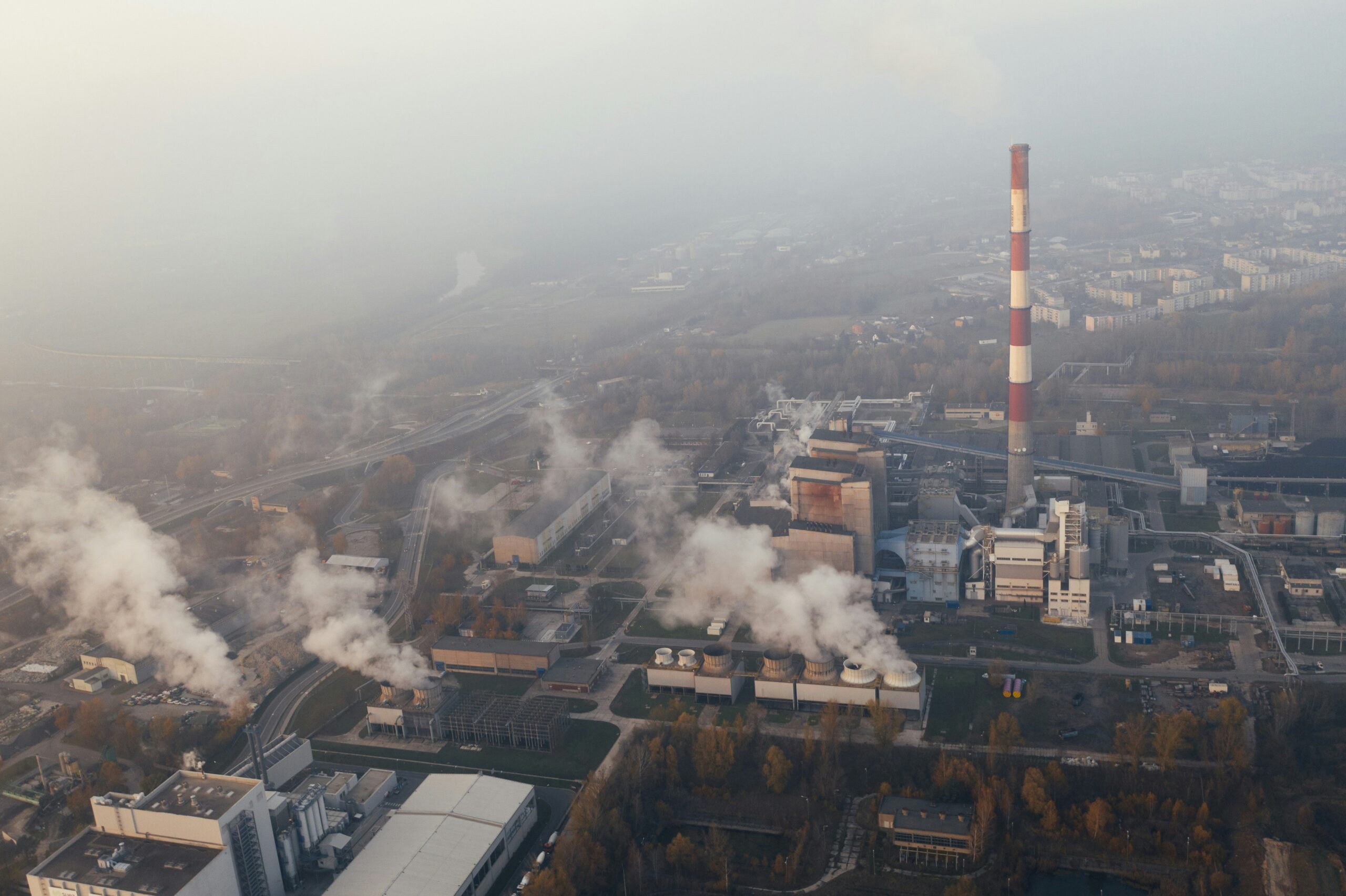
The window to hold global warming below 1.5ºC has closed, and greenhouse gas emissions must nearly halve within a decade to keep the chance of limiting peak warming to 1.8C within reach, the UN Environment Programme (UNEP) declared on Wednesday.
In its annual Emissions Gap Report, which tracks the gap between where countries’ pledges put global emissions and the levels needed to stay below certain warming thresholds, UNEP for the first time dropped the premise that staying below 1.5ºC of warming was possible if deep and rapid emissions cuts took place.
With fossil fuel emissions and infrastructure both still expanding as the US exits the Paris Agreement, and the 67 new climate pledges submitted over the past year having a “near-zero impact” on expected warming in the face of the nearly 6% annual cuts required, the agency has flipped its framing to attaining the “lowest possible” overshoot.
“The chance of holding global warming to below 1.5ºC with no or limited overshoot is gone,” UNEP chief Inger Andersen said. “We climate procrastinated, and accordingly, we are now saying that this window has closed.”
“Nations must understand that the point of return begins now. Not later – now,” she added.
The report finds that cuts of 18% by 2030, 45% by 2035, and 69% by 2040 – all from 2025 levels – and the removal of some 320 billion tonnes of CO2 from the atmosphere by 2100 are required to limit peak warming to 1.7-1.8ºC around 2050, before returning to 1.5ºC by the end of the century.
In their current state, fully delivered national climate plans (NDCs) – the emissions targets each country must update every five years – submitted by nations under the Paris Agreement would cut emissions just 5-8% by 2030 and 11-15% by 2035.
Under current policies, warming is tracking towards 2.8ºC, UNEP said. This emissions trajectory leaves the world with a 6% chance to hold warming below 2ºC this century and a one-in-four chance of exceeding 3ºC.
"The world can no longer avoid overshooting the 1.5º limit. And the consequences are already devastating," UN Secretary-General António Guterres said in his final remarks on UNEP's flagship report before his term ends in December. "Deadly floods. Brutal heatwaves. Raging wildfires. Lost lives. Crippled economies.”
"Those least responsible are suffering first and worst," Guterres added. "The emissions gap is now a leadership gap. And the world is running out of time and excuses to close it."
Emissions outlook worsens as US exits Paris
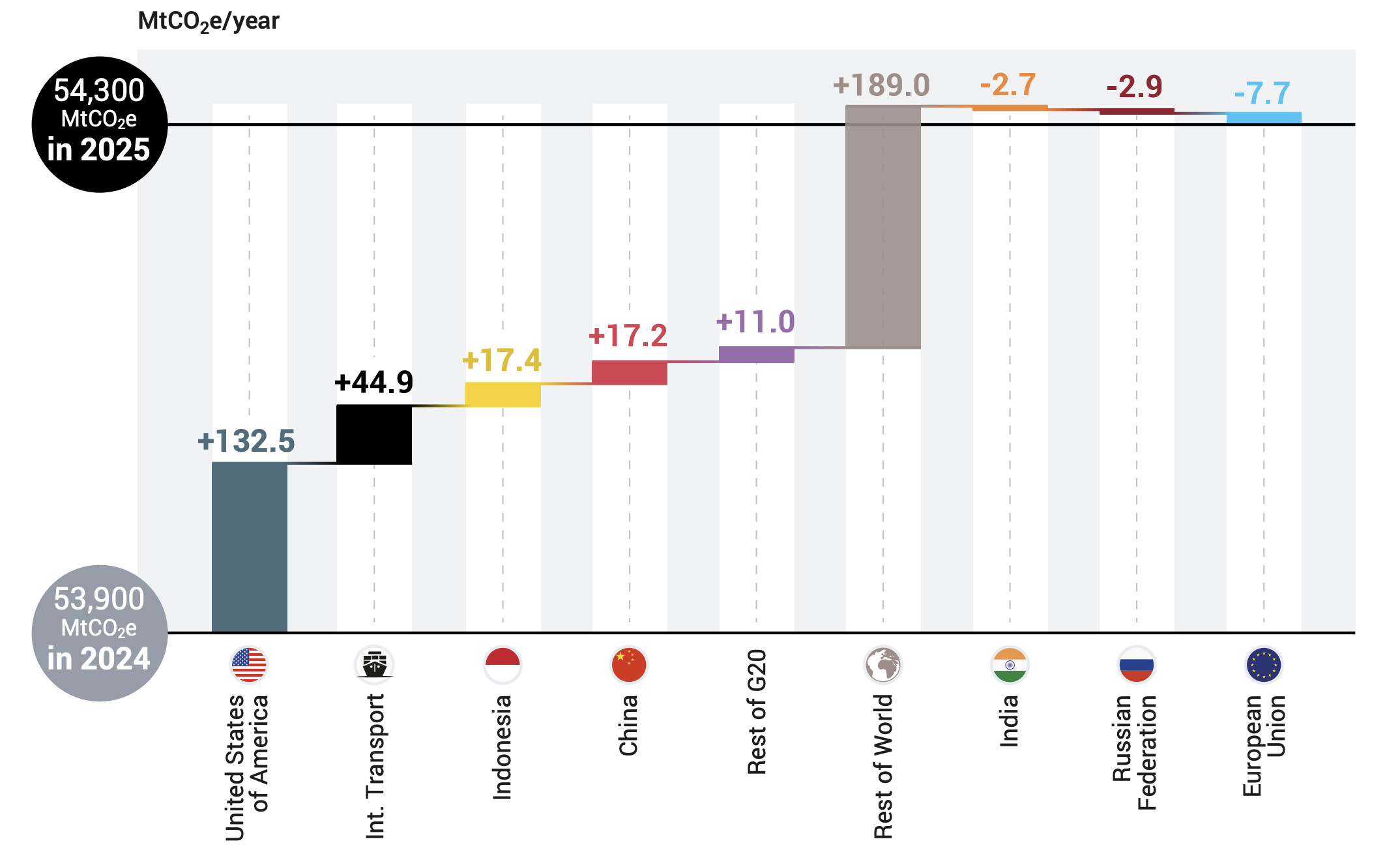
Projected warming under the full delivery of NDCs scenario is up 0.2-0.3ºC from last year's report, to 2.6-2.7ºC. The scenario assuming the full delivery of net-zero pledges also increased to 2.1ºC, up from 1.9ºC.
Both rises are driven largely by a wholesale deletion of US commitments to climate action under Trump, who has described climate change as "the greatest con job ever perpetrated on the world".
The US climate plan and Washington's former net-zero target were both struck from the calculations, accounting for about half of the rise under the NDC scenario, with revised historical emissions data making up the rest.
"We completely scrapped the NDC emissions scenario projections and assumed that the US will follow the current policy projections under the current administration's policies," Takeshi Kuramochi of the University of Tokyo, a lead author of the report, told reporters.
The US State Department, noting that its country’s exit from the UN climate convention will take formal effect in February 2027, inserted a disclaimer – as it did last year – that the US "does not support the Emissions Gap Report, does not endorse or agree with its analysis or conclusions, and has not provided comments to this report."
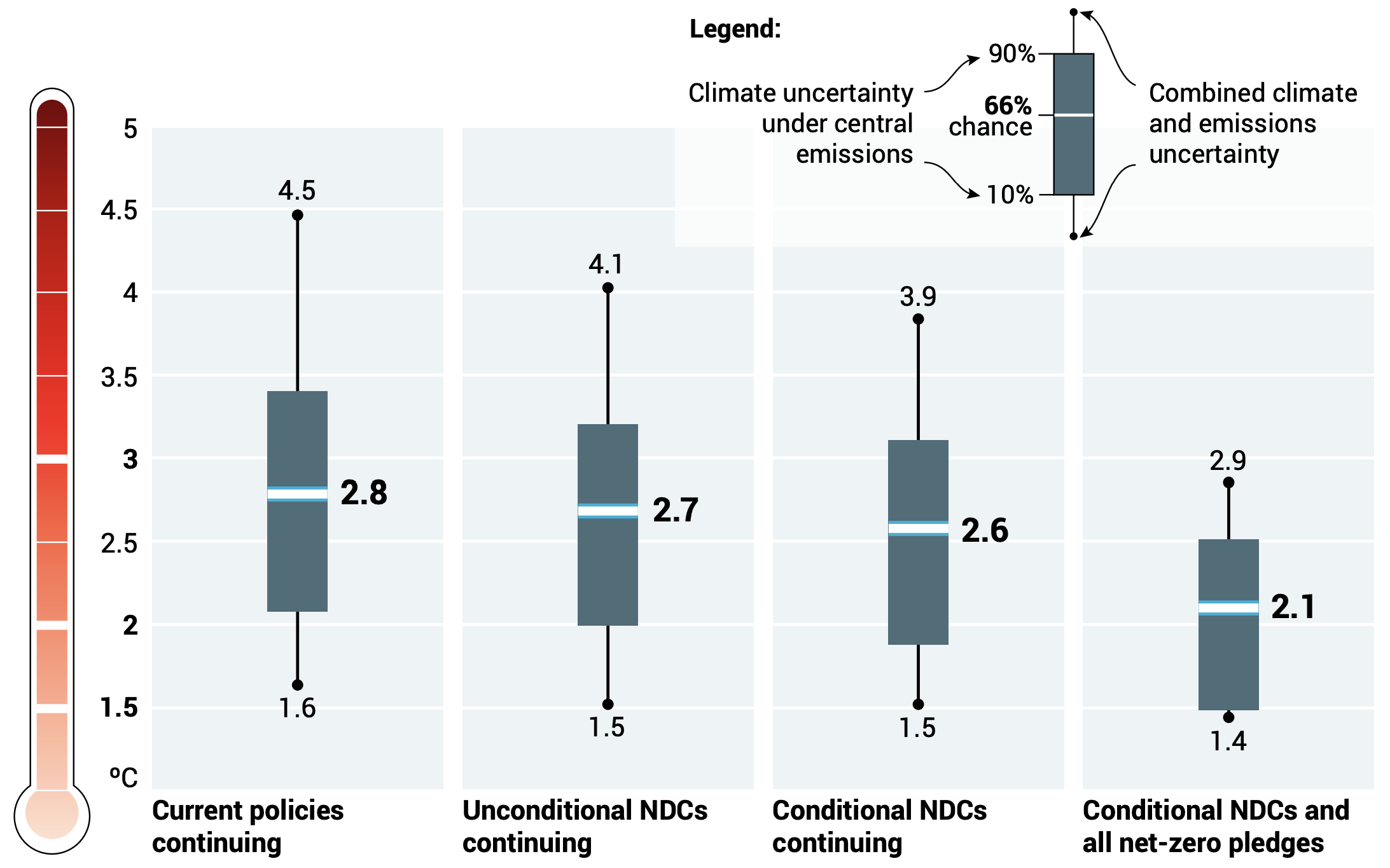
The US also posted the largest emissions increase of any country in 2025, adding 133 million tonnes of CO2 equivalent as electricity demand, driven in part by mass data centre expansion to fuel the AI boom, rose and coal power rebounded, with the Trump administration using emergency orders to delay coal plant closures.
"The climate impacts will not shield anyone," Andersen said when asked for her message to Washington. "We are seeing and will continue to see impacts on every nation on the planet, including the US."
Türkiye, host of next month's COP31 summit in Antalya, recorded the second-largest increase at 24.4 million tonnes, followed by Iran (18.9 million) and Indonesia (17.4 million). China's emissions rose by 17.2 million tonnes. International shipping and aviation together added 44.9 million tonnes, more than any country except the US.
Every five years of delay adds 0.1ºC to peak warming
Overall, global emissions held roughly flat in 2025, as lower wildfire and land-use emissions masked the continued growth in fossil fuel CO2.
"This is similar to the level in 2024, which is a welcome divergence from a growth trend of past decades," said Anne Olhoff, the report's chief scientific editor. "However, it's too soon to conclude anything about plateauing or peaking of global emissions."
While a plateau may appear positive news, UNEP data show it is far from enough. Five years of emissions at current levels adds around 200 billion tonnes of CO2 to the atmosphere, locking in an increase in peak warming of about 0.1ºC.
"Continued insufficient emission reductions over the next decades could make warming of 2ºC inevitable, putting the Paris Agreement at risk of failure," the report warns.
This rate of increase is visible in the literature. When the IPCC last assessed emissions pathways in 2022, assuming deep cuts would begin in 2020, the lowest peak still within reach was about 1.6ºC. Those cuts never came. With action now assumed to start in 2025, the best achievable peak has risen to around 1.7ºC.
"This is a historic failure of political leadership. The science has been clear for decades, but governments have chosen delay over action," said Mohamed Adow, director of the Nairobi-based think tank Power Shift Africa. "The consequences will be measured in lives lost, not just degrees of warming."
'On track' to weak targets
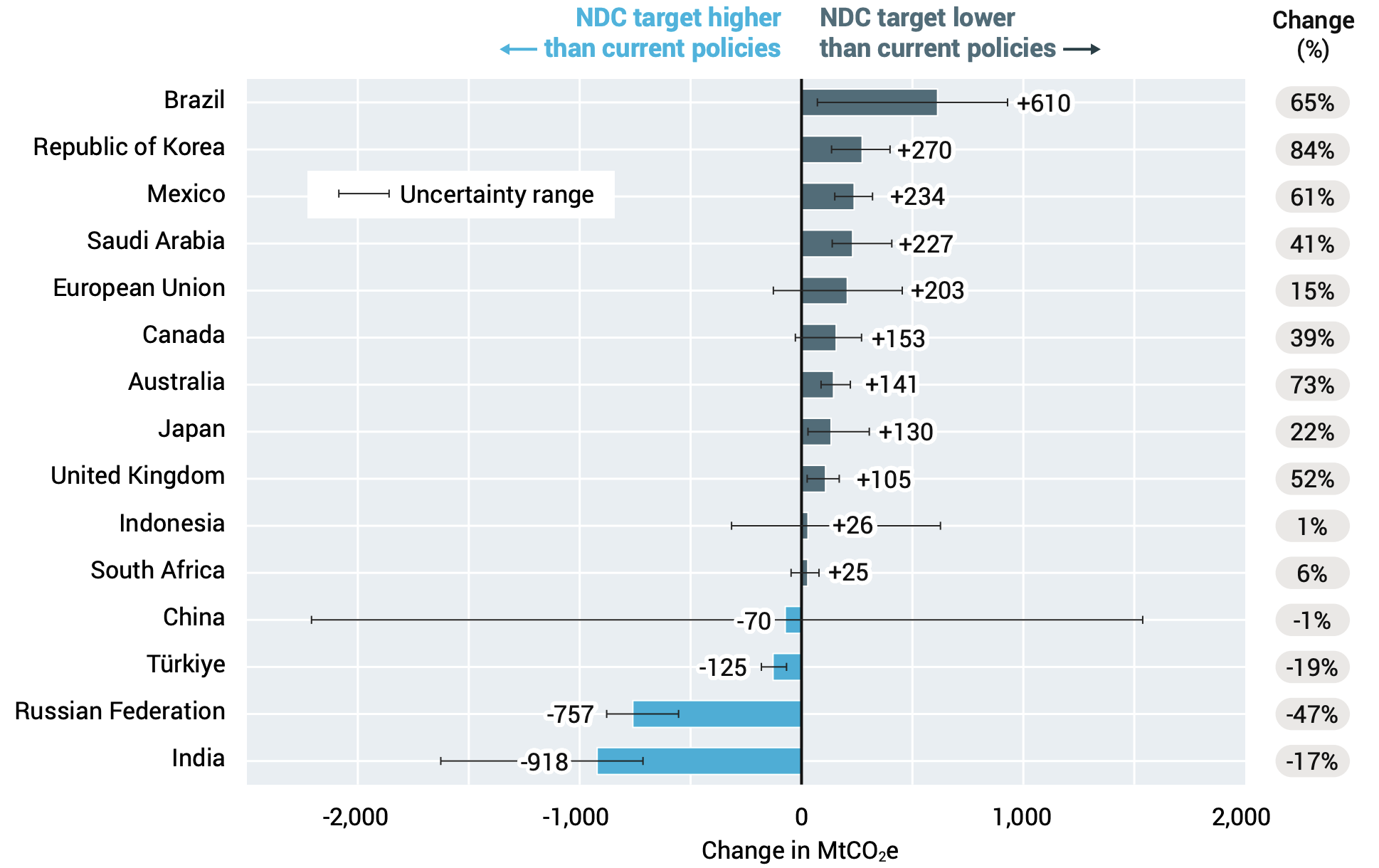
Only six G20 members – China, India, Indonesia, Russia, South Africa and Türkiye – are "on track" to meet their 2030 emissions targets. Together, G20 members account for 76% of global emissions.
That may seem an odd list – because it is. In fact, as nations set their own pledges, in turn reflecting varying ambition to curb emissions, the list of "on track" nations is better read, in several cases, as a list of those with low-ambition targets.
Russia and Türkiye's projected emissions already sit more than 20% below their 2030 emissions targets, providing headroom for major emissions increases from their current baseline without technically breaching their commitments. Both have "historically always set NDC target emission levels that are considerably above the current policy scenario projections," the report notes.
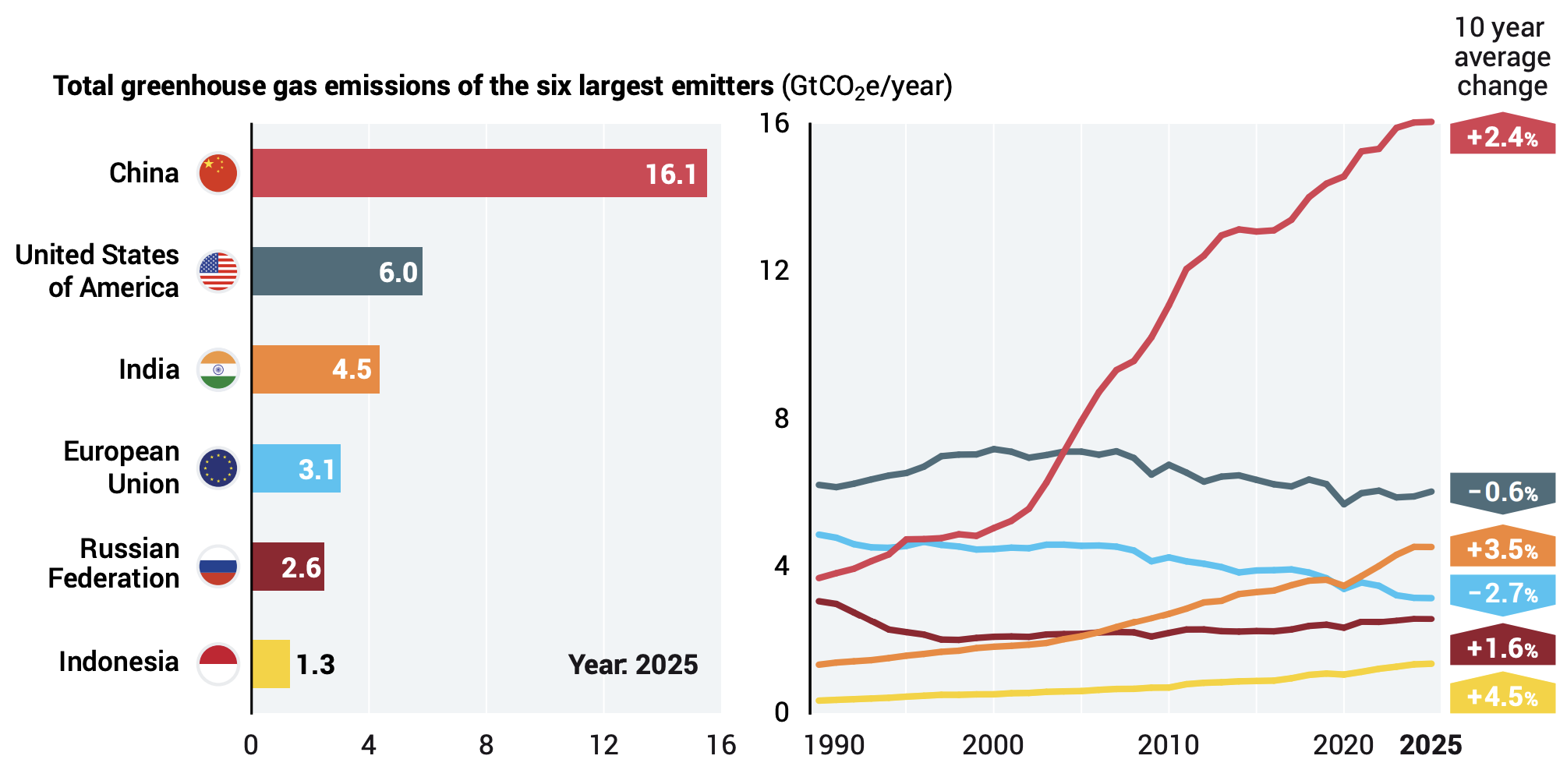
India – the world's third-largest emitter – is also likely to meet its target. This is explained by the unusual formulation of India's NDC, which sets an emissions-intensity target tied to its GDP, meaning an expanding economy also allows for expanding emissions.
India's pledge allows its emissions to rise about 1.25 billion tonnes between 2030 and 2035, though at 3.1 tonnes per person, its per capita emissions remain under half the world average.
The nine G20 members judged off track include the UK, Japan, Canada, Australia, and South Korea. Mexico – previously on track for its 2030 goals – fell off the list after strengthening its emissions targets.
The European Union, committed to the largest absolute cut of any G20 member between 2030 and 2035, at about 630 million tonnes, may narrowly miss its 2030 goal, according to two of the three studies the report reviewed.
Still building, still burning
Clean energy investment is set to reach $2.2 trillion in 2026, almost double investments in fossil fuels, the report says, citing the International Energy Agency. But as renewables gain an ever-growing foothold on traditional energy markets, governments continue to lock in new fossil fuel infrastructure and keep drilling.
Governments plan to produce 120% more fossil fuels in 2030 than a 1.5C pathway allows, up from 110% two years ago, according to the 2025 Production Gap Report, which measures the gap between governments' planned fossil fuel production and levels consistent with the Paris Agreement's warming limits. Some 96% of upstream oil and gas companies are still developing new reserves, according to campaign group Urgewald.
Fossil fuel subsidies climbed from $660 billion in 2018 to $920 billion in 2024, after hitting a record during the 2021-22 energy crisis, and could rise again as governments shield consumers from the ongoing energy shocks of the US-Israeli war on Iran, the report said.
Counting the unpriced costs of the pollution and climate damage fossil fuels cause, the International Monetary Fund puts implicit subsidies at a further $6.7 trillion in 2024, three-quarters of it from air pollution and climate change.
As governments subsidise oil and gas to stave off inflation, fossil fuel giants are reaping massive windfalls. The five largest Western oil majors earned $48 billion in the second quarter, or $535 million a day, according to Global Witness analysis.
Saudi Aramco reported $104.7 billion in adjusted net income for 2025 and paid out $85.5 billion to shareholders, more than three times the $26 billion in international public finance that reached developing countries for climate adaptation in 2023.
The world's 65 largest banks, meanwhile, continued to provide nearly $1 trillion in fossil fuel financing in 2025.
"It is time for major fossil fuel producers such as the US and Saudi Arabia (which produce 20-25% of fossil fuels globally) to stop playing politics and face the scientific reality," said Bill Hare, chief executive of Climate Analytics. "Right now, they are looking at the fire, denying it exists and pouring more petrol on it."
"Do the governments and fossil fuel producers of the world really want seven metres of sea level rise and the demise of many entire island countries as their legacy?"
Image Credits: Marcin Jozwiak.
Combat the infodemic in health information and support health policy reporting from the global South. Our growing network of journalists in Africa, Asia, Geneva and New York connect the dots between regional realities and the big global debates, with evidence-based, open access news and analysis. To make a personal or organisational contribution click the donate button below.