Low- and middle-income countries that contribute little to global warming have done the most to plan for its toll on health, while the major economies behind more than half the world’s emissions barely consider it in their latest climate commitments, filed with the UN ahead of next month’s COP31 summit.
The findings come from a global scorecard released this week by the Global Climate and Health Alliance (GCHA), a network of more than 300 health organisations. It graded 117 national climate plans, including a joint plan covering the European Union’s 27 member states, on how seriously they address health, from heatstroke and malaria to whether governments set aside money to protect clinics from floods and heatwaves.
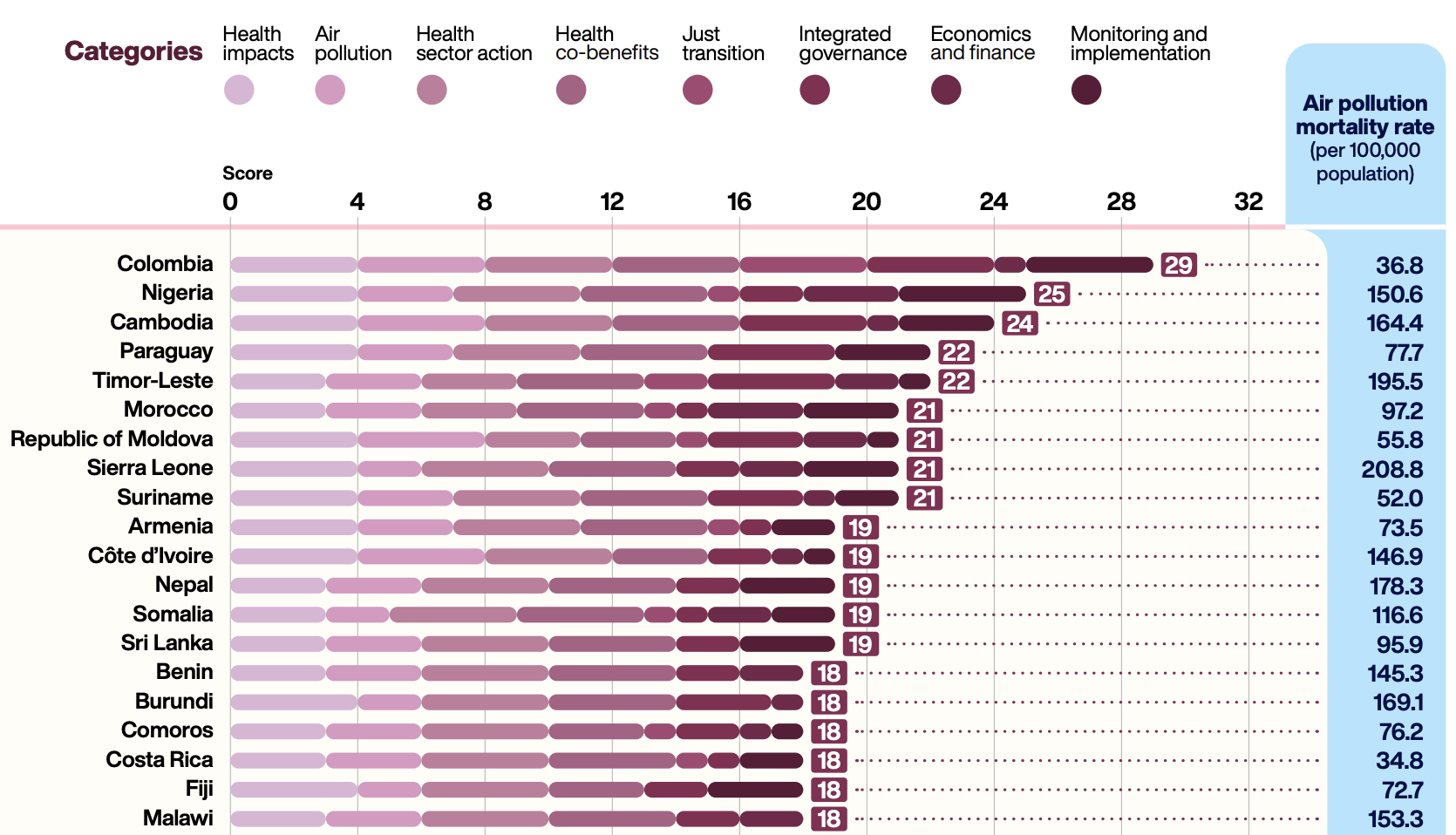
The 10 best-scoring countries produce about 1.5% of global greenhouse gas emissions, according to EU data. Ten large economies that scored fewer than 10 of a possible 32 points, among them China, the United States, India, Russia and Saudi Arabia, produce more than 60%.
India, the world’s third-largest emitter, scored two points. Its plan does not name a single air pollutant, despite one of the world’s heaviest death tolls from dirty air.
Jess Beagley, GCHA’s policy lead, said in a statement that the ranking reflects “lived realities” in countries that “do not have the luxury of pretending that climate change and health can be separated.”
The plans, known as Nationally Determined Contributions (NDCs), are the climate commitments countries make under the 2015 Paris Agreement. Their content is voluntary, but governments must update them every five years. This round sets out how each country will cut emissions and protect its people from a hotter world through 2035.
Those commitments offer the clearest preview of what governments will bring to COP31, which opens in Antalya, Türkiye, on 9 November.
The UN climate body’s most recent tally, covering the first 64 new plans, submitted by September 2025, found they would cut emissions 17% below 2019 levels by 2035. Holding warming to 1.5C requires a cut of about 60%.
In September, the UN Environment Programme concluded that overshooting the 1.5C limit is now unavoidable.
“Climate change is not a forecast”
Sylvain Kalsakau, Vanuatu’s ambassador to the UN in Geneva, gave the keynote at the scorecard’s launch at the Geneva Graduate Institute on Wednesday. “I come to you from a country of 83 islands, where climate change is not a forecast,” he said. “It is a clinical reality.”
“Vanuatu cannot adapt its way out of a crisis that others continue to fuel,” he added. “No seawall, however tall, and no health system, however resilient, can keep pace with unchecked warming.”
The task before Antalya, said Suerie Moon, director of the institute’s Global Health Centre, is to make sure health is “not only mentioned in NDCs, but actually integrated” into policy, financing and action on the ground.
Top scorers count the lives at stake
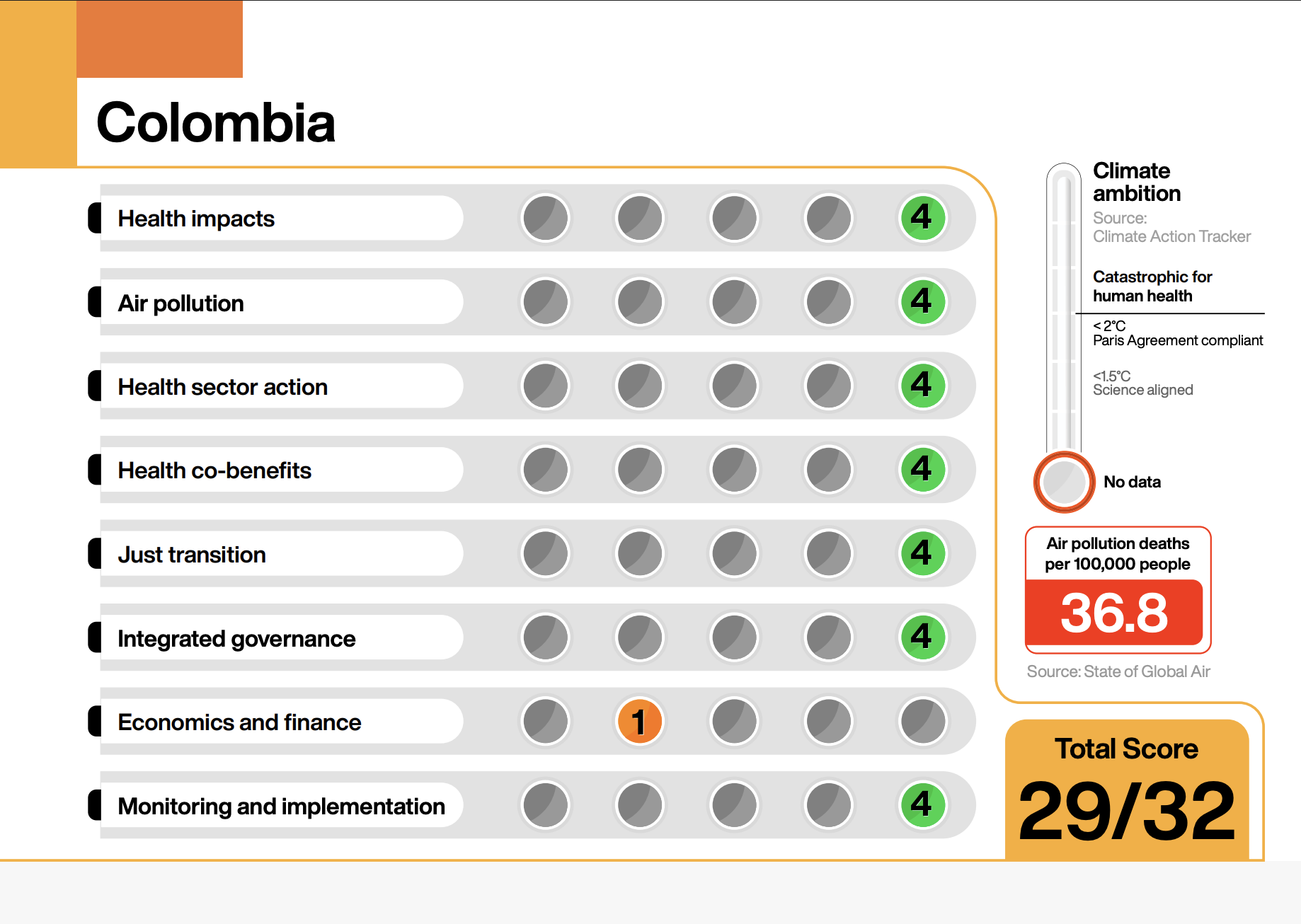
Colombia topped the ranking with 29 points, taking full marks in every category but one. Its plan recognises the right to health, ties climate action to the defence of life and sets a target to cut black carbon, a soot pollutant that both warms the planet and damages lungs.
Nigeria came second with 25 points. Its emissions target is also one the independent Climate Action Tracker judges consistent with the country’s fair share of the effort to limit warming to 1.5C.
Nigeria’s Health Ministry modelled what the plan could deliver. Cleaner air could prevent more than 20,000 deaths from respiratory infections, heart disease, stroke and lung cancer, and save about $7.8 billion, said Dr Zakariya Mohammed, who heads the ministry’s Climate Change and Environmental Health division.
A working group of more than 40 members, drawn from across government, donors, academia and civil society, drafted the plan’s health component. “We are discussing together, making decisions together,” Mohammed said.
Cambodia, in third place with 24 points, commits to training 21,000 health workers and upgrading 100 health facilities to withstand climate shocks.
“Health comes up in many different areas, and it’s not just one category, and that’s why they’re scoring high,” said Nova Tebbe, the GCHA post-doctoral researcher who led the analysis and graded many of the plans herself. The top scorers, she said, are “thinking about health in a cross-cutting fashion and not just in one area.”
Major emitters near the bottom
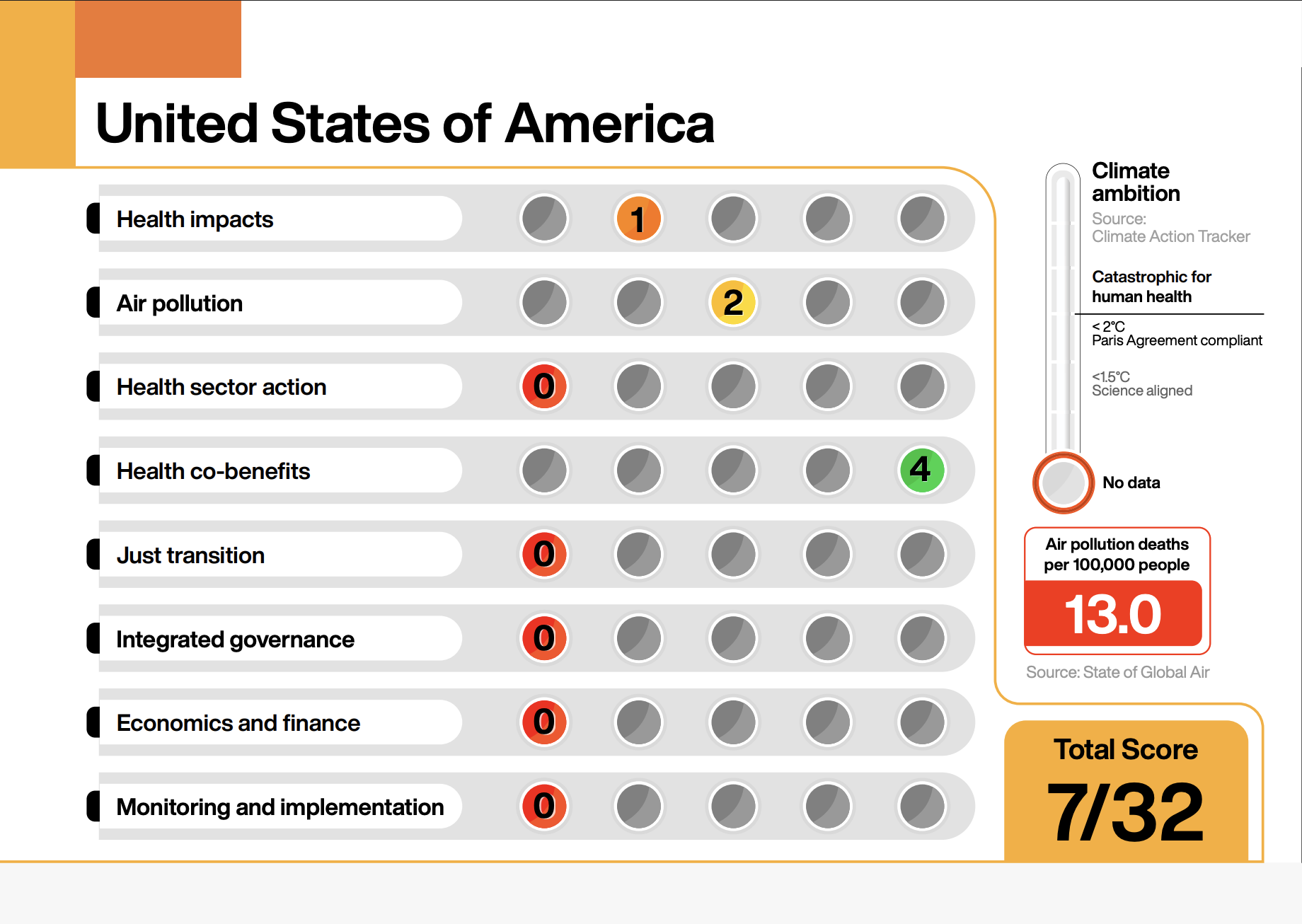
Japan and New Zealand also scored two points, among the lowest in the ranking. Japan’s plan earned points only for listing three greenhouse gases it intends to cut. Tokyo went on to endorse a voluntary plan to prepare health systems for climate change at COP30 in Belém, Brazil, months after filing its national plan.
Among other major emitters, South Korea scored four points, Russia six and Brazil seven. Saudi Arabia, the world’s biggest oil exporter, also scored seven. China and the UK scored nine each, as did Australia, which will preside over the negotiations at COP31.
The United States scored seven, though its plan is no longer active after Washington quit the Paris Agreement.
“What we do at home only matters if it is matched at a global scale, above all by the largest emitters,” Kalsakau said. Governments, he added, “still spend enormous sums subsidizing fossil fuels, the very products that make our people sick.”
Health on paper, not in emissions targets

Canada scored 16 and the European Union 12, above the average of 11.8. Even so, Climate Action Tracker finds both of their emissions targets consistent with warming of up to 3C, double the Paris Agreement’s 1.5C limit.
The scorecard measures how a plan treats health, not how hard it cuts emissions. GCHA set its scores beside the tracker’s ratings to see whether the two line up. They did not.
The tracker’s ratings cover only 17 of the 117 plans. Among those, the plans it judged “critically insufficient”, consistent with more than 4C of warming if every country followed suit, scored higher on health, on average, than those it judged “insufficient”, consistent with 2C to 3C.
The sample is small, the report notes, but greater attention to health “does not translate to increased climate action.”
The United Arab Emirates, which the tracker counts among the world’s leading fossil fuel producers and exporters, placed in the top fifth of the ranking. It was one of only eight countries to earn full marks on air pollution. The tracker rates its overall climate effort “insufficient” and says it plans to keep expanding its oil and gas activities.
“I think this really just shows that though you may score quite well on the scorecard, the level of ambition may not be there and must be improved as well,” Tebbe said.
“Often, health is considered to primarily be an issue associated with adaptation considerations,” said Tola Klabough, a GCHA project analyst. Governments that ignore its links to emissions cuts risk “charting a course to a world where health systems are overwhelmed,” Klabough said.
Türkiye, the COP31 host, scored 14. The tracker rates its target “critically insufficient” and says it would let the country’s emissions plateau or rise over the next decade.
Costing plans is hard, financing them harder
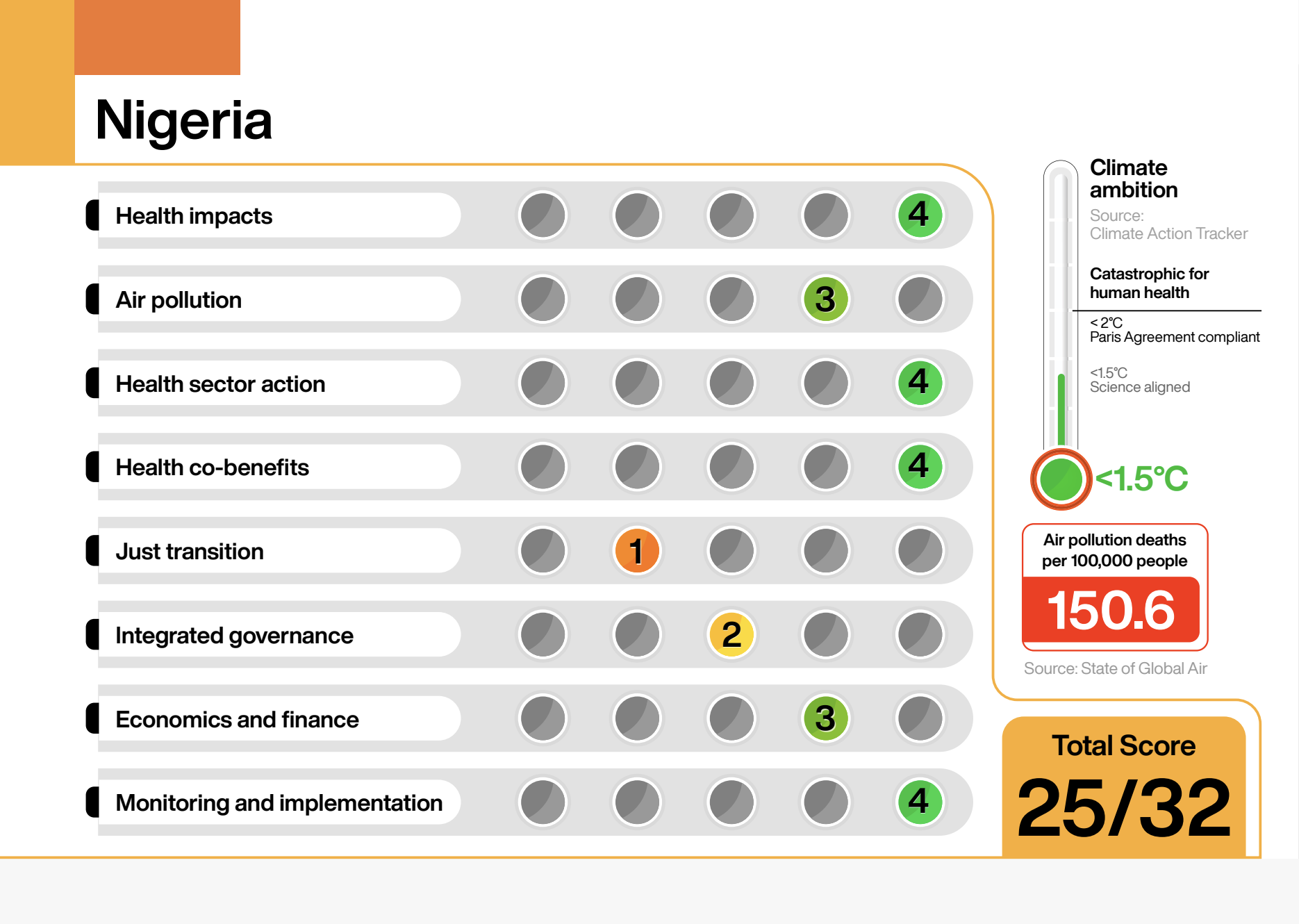
Even Nigeria, among the most ambitious, is running up against the cost of delivering its plan.
“It requires a lot of resources to implement the healthy NDC,” Mohammed said. “Quite a number of the interventions are costly.”
Much of that work falls to other ministries, he added, because the health gains the plan counts on come from action in sectors such as energy and agriculture. “Most of the determinants of health lie outside the health sector,” he said.
Nigeria’s deeper emissions cut is also conditional. Climate Action Tracker says the country needs international finance and support to bring that target in line with 1.5C.
Only nine of the 117 plans put a figure on what climate change will cost in lost health, the scorecard found. Just two, Nigeria’s and Timor-Leste’s, calculate what protecting health would return.
“Put a price tag in your NDC,” Kalsakau told health ministries. “A costed health component is an investment proposal. An uncosted one is a wish.”
WHO review finds health mentioned, rarely funded
The World Health Organization’s own review of the plans, due next week, points to the same gap. Nine in 10 of the 140 plans it examined mention health, the same share WHO counted in 2022, said Amy Savage, a technical officer in WHO’s climate change, energy and air quality unit, who also spoke at the launch.
Only 32 estimate what their health measures would cost. Just 10 say they would pay for any part without outside help.
“We consistently hear from countries that the greatest barrier to implementation of their climate change and health plans and priorities is a lack of finance,” Savage said. “And yet health still remains chronically underfunded within climate finance mechanisms.”
Fine particles and nitrogen dioxide, the fossil fuel pollutants most harmful to health, are largely missing from the plans. Only five countries set targets for black carbon. Outdoor air quality receives less than 1% of development funding, according to the Clean Air Fund.
“Governments must grasp that air quality action is a vital part of effective climate action,” said Jeni Miller, GCHA’s executive director, “and that people’s health and lives are at stake with both.”
Outside the negotiating room
For now, health has no formal negotiating track in Antalya. Türkiye’s presidency has placed “dynamic and resilient health systems” on its action agenda, a voluntary programme that runs alongside the talks, and will hold a Health Day on 9 November.
“For governments specifically going to COP31, we would also call for health to be included in the negotiated outcomes,” Savage said.
The Belém health plan has gathered at least 33 country endorsements since its launch at COP30. “But momentum is not delivery,” Kalsakau said. Countries pledged no new funding for the plan at its launch, Health Policy Watch reported at the time.
Less than 0.5% of multilateral climate finance reaches health, according to WHO estimates. Brazil has proposed a new COP31 agenda item on climate finance, expected to focus on what developed countries owe developing ones under the Paris Agreement.
“Without finance to enable lifesaving adaptation across sectors, the burden on the healthcare sector will be overwhelming,” Beagley said.
“Many of the countries where we work today are repeatedly asking for climate funding, but they’re not receiving it,” said Alexandra Malm, who coordinates climate, environment and health advocacy for Médecins Sans Frontières (MSF). “It’s just too little, too slow.”
The situation is “profoundly unjust,” Malm said later in the discussion, because “the people that are the most affected are the ones that have contributed the least to what is happening.”
Image Credits: Peter Mammitzsch, Alexandre P. Junior via Pexels, INGImage.
Combat the infodemic in health information and support health policy reporting from the global South. Our growing network of journalists in Africa, Asia, Geneva and New York connect the dots between regional realities and the big global debates, with evidence-based, open access news and analysis. To make a personal or organisational contribution click the donate button below.