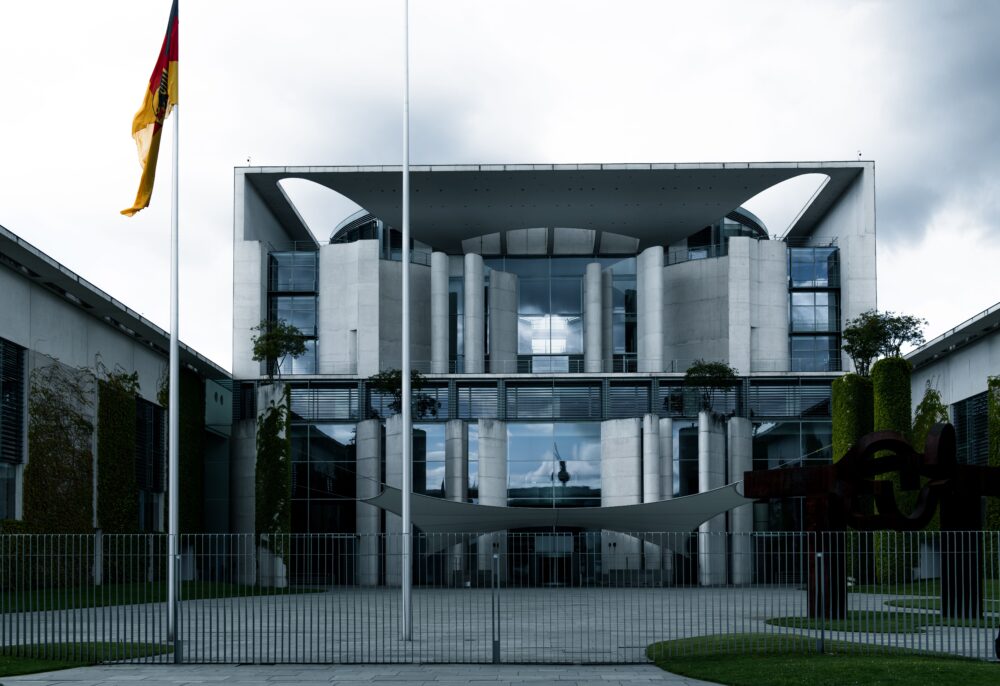
Germany has declined to put forward a candidate for the election of the next WHO Director-General. With Spain also reportedly ruling out a bid, the global field of candidates has only four official nominees just a few weeks before the deadline.
Germany will not nominate a candidate for the post of WHO Director-General, Health Policy Watch has learned from the Federal Foreign Office.
The Foreign Office declined to comment on the reasons behind the decision, as did the Federal Ministry of Health (BMG), which leads on the issue. “As a matter of principle, we do not comment on personnel matters,” a BMG spokesperson stated in response to an enquiry.
Previously, the former Head of the Federal Chancellery, Helge Braun, had been discussed as a likely nominee in Berlin. Former Health Minister Karl Lauterbach and health diplomat Paul Zubeil had also been mentioned as possible candidates.
The move comes as a surprise, given that Germany has become the largest state contributor to the WHO following the withdrawal of the United States. Leading German health policymakers had called for the Federal Republic to play a stronger role on the global stage.
Spain likely to pass on a candidacy
Signals are also emerging from Madrid that further thin out the potential field of candidates. According to informed sources, Spain is also ruling out a candidacy.
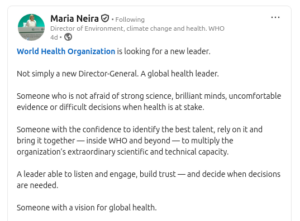
Earlier, speculation over a Spanish candidacy for Maria Neira, the former WHO Director for Environment, Climate Change and Health, arose after she called for a strong candidate in a LinkedIn post.
She wrote that the WHO does not need a mere “personality to manage,” but a “scientifically fearless” leader brave enough to say “what the evidence demands.”
To date, Paris has also remained silent, even though France could theoretically field three high-profile candidates.
Sania Nishtar, CEO of Gavi, the Vaccine Alliance, has also not yet commented on her possible candidacy.
Former WHO Chief Scientist Jeremy Farrar and PAHO Director Jarbas Barbosa have confirmed they have no intention to run in the WHO Director-General election after being mentioned as possible candidates.
Field taking shape, German positioning remains open
The field is slowly taking shape ahead of the 24 September deadline, with four listed “prospective candidates” on the WHO website.
Alongside Belgian candidate Hans Kluge, the official candidates so far are the two EMRO candidates, Hanan Balkhy (Saudi Arabia) and Hanan Al-Kuwari (Qatar), and Indonesian Health Minister Budi Gunadi Sadikin.
It remains unclear for now which of the nominees the Federal Republic of Germany will support in the upcoming election. Both the Foreign Office and the Ministry of Health declined to comment further.
German global health policymaker and Member of Parliament (MP) Sascha van Beek emphasised that Germany should not automatically back a European or established candidate.
“I have always advocated looking more closely for leaders from the ‘engine room’. At the same time, I believe that, after the past few years, the WHO could also benefit from an outside perspective,” he said, referring to Sadikin, the Indonesian Health Minister and former banker.
The decision not to nominate a candidate comes after the German government recently announced plans to further cut funding to global health under its tightly constrained draft budget proposal for 2027. While mandatory assessed contributions to the WHO will rise slightly, flexible budgets for pandemic preparedness are planned to be cut by 15.3%.
How Germany will use its leverage in the upcoming elections remains to be seen in the coming months.
See related story:
Image Credits: Wolfgang Weiser via Pexels, Felix Sassmannshausen/HPW.
Combat the infodemic in health information and support health policy reporting from the global South. Our growing network of journalists in Africa, Asia, Geneva and New York connect the dots between regional realities and the big global debates, with evidence-based, open access news and analysis. To make a personal or organisational contribution click the donate button below.