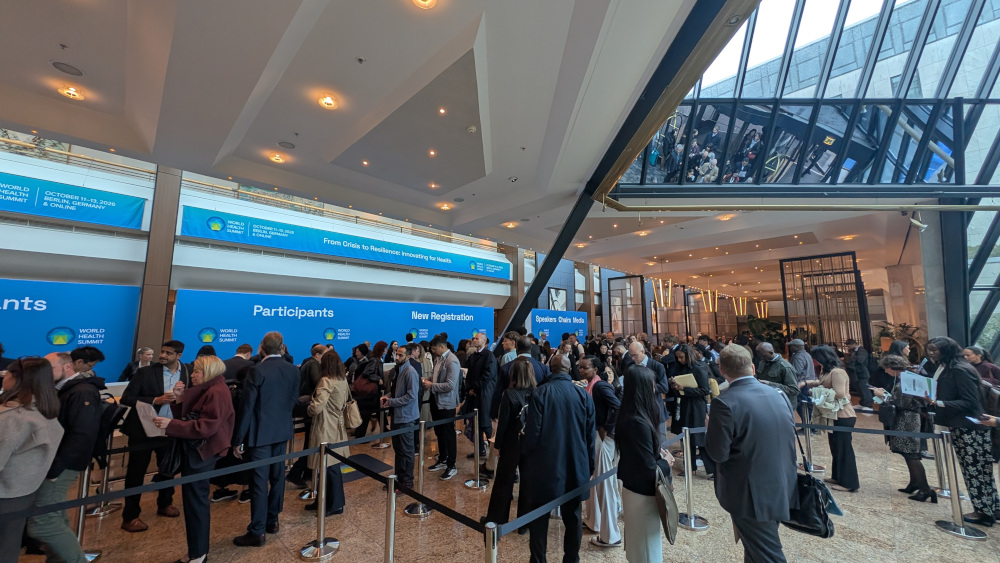
BERLIN – The WHO Director-General election process ignited its first public candidate conversation on Sunday (11 October) at the 2026 World Health Summit in Berlin, as four of the race’s seven declared contenders tackled the thorny question of how to make global health institutions more responsive and fit for purpose.
The opening day’s flagship event on ‘global health architecture reform’ packed the auditorium to capacity – in a session widely perceived as the most significant of this year’s conference events. But even if the candidates were prepared with ready prescriptions of ‘what’ reforms are needed – the ‘how’ to implement proved to be much more elusive, critics observed.
“The election of the next Director-General will take place at a pivotal moment for the World Health Organization and for global health more broadly,” declared World Health Summit President Dr Axel Pries at an opening press briefing Sunday, just ahead of the event.
“We are meeting at a moment when health around the world is under pressure from several directions – conflict and geopolitical tensions, economic strains, climate crisis, and increasing inequities,” Pries said at the opening of this year’s summit Sunday, just ahead of the panel event.
Held from 11-13 October this year under the theme “From Crisis to Resilience: Innovating for Health,” the summit has drawn over 4,000 in-person delegates to Germany’s capital as well as tens of thousands of online participants. Representing two-thirds of the world’s nations across more than 75 thematic sessions, delegates gather to debate pressing global health challenges and, crucially, the upcoming WHO Director-General election.
High stakes WHO Director-General election contest and empty chairs
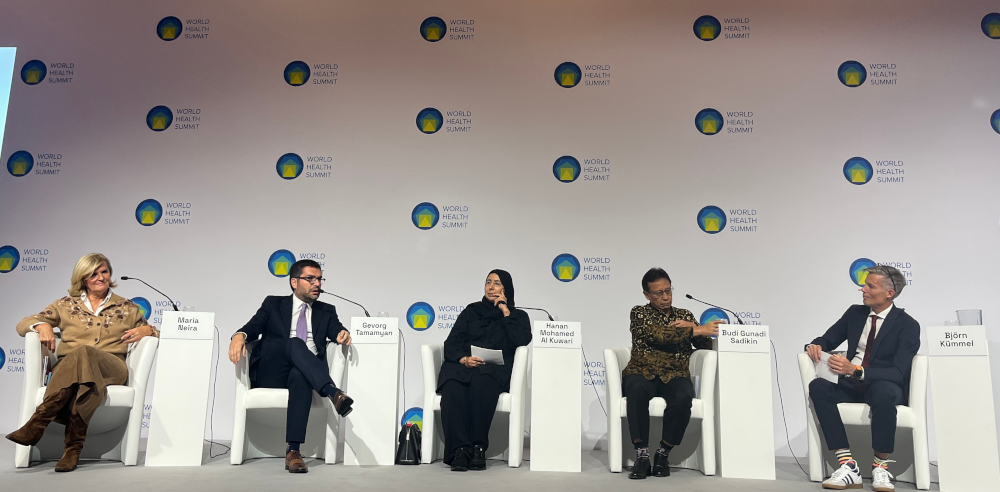
Responding to questions assigned by randomised lot by Björn Kümmel, a senior German Health Ministry advisor on global health and co-chair of the WHO-hosted task force on global health architecture reform, four prospective contestants took the stage to confront pressure to overhaul the world’s premier health agency: former Qatari Health Minister Dr Hanan Al-Kuwari, Indonesian Health Minister Budi Gunadi Sadikin, Spanish public health veteran Dr María Neira, and Armenian paediatric oncologist Dr Gevorg Tamamyan (nominated by Botswana).
Notably, three candidates were absent, including Saudi Arabia’s Dr Hanan Balkhy, stranded in Panama after an earthquake grounded her flight. Also missing – with no clear explanation as to why – was Belgium’s Dr Hans Kluge, and China’s Dr Song Li, whose nomination was only publicly confirmed last week.
The contestants directly addressed the high-stakes elephant in the room: an agency reeling from severe budget cuts and a 25 per cent workforce reduction following the withdrawal of the United States and member states’ demands for a restructured global health architecture that elevates country sovereignty and eliminates institutional overlap.
While senior observers pointed out that the exchange lacked deep specifics – cautioning that only four of the seven candidates were present to face scrutiny – the session nonetheless produced sharp contrasts. The contenders put forward distinct positions outlining how they intend to steer the organisation during their first 100 days in office.
Al Kuwari pledges executive review and functional reform
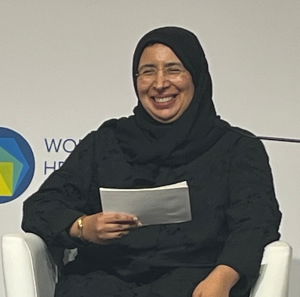
Former Qatari Health Minister Al-Kuwari offered a structured executive management approach to the WHO Director-General post, promising to eliminate administrative duplication across headquarters, regional offices, and country missions.
“Within my first 100 days, I will commission an independent functional review of the three levels of the organization and publish the findings,” she said.
She advocated for raising mandatory assessed contributions to 50 per cent of the base budget, securing flexible funding through the WHO Foundation, and establishing independent oversight over WHO’s scientific advice.
Neira focusses on primary prevention and environmental threats
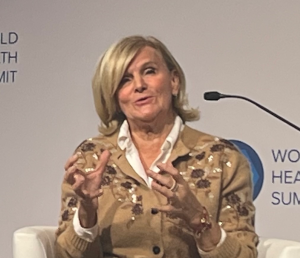
Former Director of WHO’s Department of Environment, Climate Change and Health Dr María Neira advocated for a strategic pivot toward primary prevention, calling on governments to direct sovereign capital into clean water, air pollution abatement, and climate resilience to prevent illness before patients require hospitalization.
“We need a massive shift towards primary prevention -acting on the causes of disease before people become patients,” said Neira.
During her first 100 days in office, she pledged to motivate WHO staff and establish an early-warning “antenna” to detect emerging environmental and health risks, including microplastics, endocrine-disrupting chemicals, and declining global fertility rates. Underscoring that WHO’s authority rests on evidence rather than budget size, she maintained that the agency must serve as a scientifically fearless voice capable of influencing upstream investments across agriculture, energy, and urban planning – as well as better preparing health systems to address unavoidable disease burden.
Sadikin opts for unlocking financing for member state plans
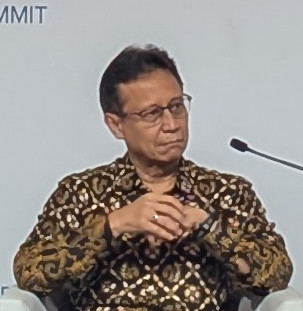
Former commercial banker and Indonesian health minister Sadikin argued that WHO must shed some of its broader operational functions to refocus strictly on its two constitutional mandates: scientific norm-setting and its unearmarked convening authority.
“When I talked to almost 100 health ministers across the world, the main message they gave me is to bring WHO back to its core mandate of setting norms and guidelines based on science,” he said.
Drawing on his experience co-chairing the Accra Reset High-Level Panel, he urged WHO to assist health ministries in converting national health plans into costed compacts that unlock development bank capital, while consolidating overlapping functions across global health initiatives. He emphasised that restoring internal credibility is an essential task for the next WHO Director-General to earn back flexible donor trust, maintaining that global health security ultimately requires keeping diplomatic doors open to all states.
Tamamyan puts patient outcomes over diplomatic protocol
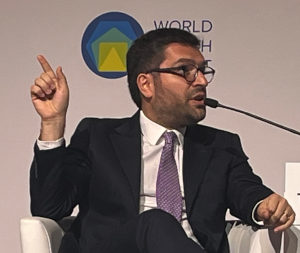
Paediatric oncologist Tamamyan brought a clinician’s perspective to the stage, challenging conventional diplomatic protocol and demanding that WHO measure performance by patient health outcomes rather than process documents. He argued that WHO must never allow bureaucratic boundaries to obscure its ultimate moral purpose.
“We should be the place where anyone can call, can say, ‘Okay, I have this problem,’ even if it is not within our mandate, but we are able to help. We should not hesitate to take the call, to call someone we know and help,” he said.
Addressing the elephant in the room
Pledging to bring the United States and Argentina, which withdrew from the WHO in 2025, back into the fold of the UN specialized agency – Tamanyan said he would travel personally to Washington and Buenos Aires within his first 100 days to ask both member states to return. He insisted that WHO must do whatever it takes to protect health, even if it means stepping beyond formal constitutional boundaries to engage disaffected capitals.
Al-Kuwari, asked by Kümmel about how to maintain WHO’s credibility as a universal norm-setting body when major member states have retreated, took a more measured stance, saying: “WHO is richer with everybody being in the organisation and everyone having an equal voice.”
She argued that departed capitals “have more to gain than to lose by staying in the organisation,” noting that the structural changes they demand – such as eliminating duplication, increasing transparency, and enforcing accountability – are identical to the reforms requested by remaining member states. Instead of offering any particular set of concessions.
Analysts have cautioned that bold personal diplomacy alone cannot resolve deep geopolitical divides. “Bringing back departed Member States requires building an environment for genuine dialogue rather than making unilateral promises,” pointed out Michel Kazatchkine, former Global Fund Executive Director and senior fellow at the Geneva Graduate Institute, in an interview with Health Policy Watch.
Rebooting WHO after cutbacks
Asked how the candidate would remotivate WHO staff internally following a devastating year of cutbacks, Neira called for a fosteríng “a more creative internal environment” as well as ensuring that staff recruitment was “high quality” and independent.
Tamamyan said he’d focus on bringing more young professionals into the organization – the same group that bore the brunt of the recent, deep cuts in WHO staff over the past year.
Measuring success
Asked to summarize in just a sentence what success would look like by the end of the DG’s five-year term in 2032, Sadikin also referred to the US and Argentinian withdrawal saying, “what I envisioned is that all 194 countries will be back, and they will happily pay the assessment fee, and then they will proudly say that ‘Hey, WHO, you make our people live long and healthy.’”
For Al-Kuwari a successful team would mean that: “the world is healthier, it’s better prepared for emergencies, and it’s a fairer one.”
And for Neira, it would be “global health at the centre of government policy” while Tamanyan said “for me the best achievement would again be about people” – adding that he wanted to also see a 90% satisfaction rating amongst the staff of WHO itself – as a reflection of success.
Candidate conversation was ‘high-level warm-up’
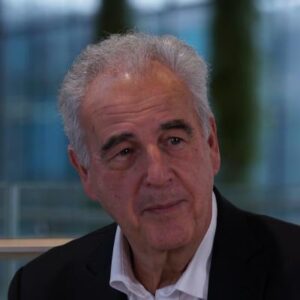
While praising the unscripted, randomised format, Kazatchkine stressed that candidates avoided debating the hard institutional trade-offs facing the agency, leaving the conversation high-level and mostly non-contentious.
“Everyone agrees that WHO should be normative. That means it should put science at the heart of everything it does, undisputable, unchallengeable science. Yet, they did not speak about science,” said Kazatchkine.
He pointed out that contenders sidestepped critical structural issues, including who should appoint Regional Directors, how regional offices interact with headquarters, and how WHO coordinates with regional bodies. He noted that while Regional Directors sit closer to Member States, the candidates offered no clarity on resolving structural friction across these tiers.
Many details of WHO’s own institutional reform will depend on how Assistant Directors-General are chosen.
“There was maybe a little too much pressure on the Director-General rather than on the team surrounding him,” said Kazatchkine.
Framing the Berlin WHO Director-General election panel as a good warm-up, he emphasised that observers must remain cautious in drawing conclusions at this stage.
Following the first stop in Berlin, the candidate field turns to the official WHO Candidates’ Forum in Geneva this November. The 34-member Executive Board will subsequently shortlist and nominate three finalists during its session in January 2027, ahead of the decisive World Health Assembly vote in May.
Image Credits: Felix Sassmannshausen/HPW, Elaine Ruth Fletcher/HPW, Graduate Institute.
Combat the infodemic in health information and support health policy reporting from the global South. Our growing network of journalists in Africa, Asia, Geneva and New York connect the dots between regional realities and the big global debates, with evidence-based, open access news and analysis. To make a personal or organisational contribution click the donate button below.