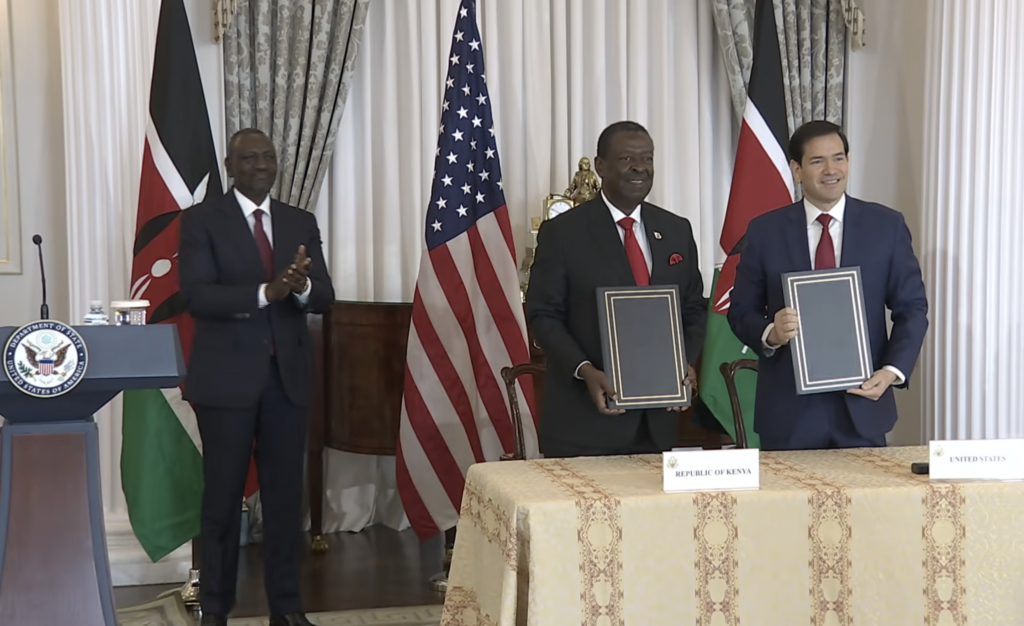
The United States plans to cut its health funding to 18 countries by 59% of pre-2025 levels by 2030, according to a Public Citizen and Partners In Health analysis of the bilateral agreements the US has signed with these countries.
The bilateral Memorandums of Understanding (MOUs) were signed as part of the ‘America First Global Health Strategy’ adopted by the Trump administration in 2025, and are intended to rapidly wean countries off US aid by 2030.
The reduction amounts to a cut of some $2 billion to US aid dispensed before 2025, according to Public Citizen, which analysed the MOUs – some of which it initially obtained via a Freedom of Information Act (FOIA) lawsuit against the Trump administration.
Countries facing the steepest cuts are Rwanda (97% reduction), Liberia (84%), Burundi (78%), Madagascar (77%), and Sierra Leone (71%).
All MOUs require countries to make substantial co-financing commitments. These are for activities identified as priorities by the US, and do not necessarily align with the countries’ priorities. For example, the US wants all countries to improve their ability to identify disease outbreaks, so it requires substantial investment in epidemiologists and data capturers. But many recipient countries may prefer to prioritise employing health workers.
In 11 out of the 18 countries, the co-financing commitments fail to cover the US cuts over five years compared to pre-2025 government funding.
“Countries may also struggle to meet these funding expectations,” says the analysis. “For example, Malawi would have to mobilize new funding equal to 56% of the country’s total health expenditure to meet its annualized co-financing commitment.”
Co-financing ‘punishment’
The US government also reserves the right to reduce or cease funding if countries don’t meet their co-financing commitments. In addition, the MOUs stipulate that the co-investments “may not include funding from other donors or multilateral organizations, but must be funds ‘raised directly’ by the country”, says Public Citizen and Partners In Health.
“There is no transparent logic guiding the application of penalties across countries,” their analysis notes.
If Ethiopia, Kenya, Mozambique, Cameroon, and Malawi fail to meet co-financing commitments, the US will reduce its funding by $1 for every $1 shortfall.
Uganda and Côte d’Ivoire face a 2:1 reduction. However, no penalties are specified in the MOUs with Rwanda, Liberia, Lesotho, Eswatini, Sierra Leone, Madagascar, Burundi, Botswana, and South Sudan.
Many of the MOUs also include “performance incentives” for meeting process and outbreak response metrics, but quantifying them is vague.
Seven African countries will have fewer health workers by 2030, thanks to reduced US and partner government commitments. These are Burundi, Cameroon, Eswatini, Kenya, Lesotho, Madagascar and Malawi.
“This is a major concern since the African region currently has only 46% of the health workers it needs, and by 2030 it is projected to face a health workforce shortage of 5.85 million workers,” the analysis notes.
Burundi will lose all US-funded community health workers (CHW). Malawi will lose 3,436 CHWs (72% of its total), and Madagascar, 8,200 (39%).
Cameroon faces a 20% reduction in CHW and nurses despite already facing “a severe shortage” of both.
The one piece of good news is that the MOUs reduce the duration of controversial data-sharing and pathogen specimen-sharing agreements, which were initially for up to 25 years – despite the MOUs only lasting up to five years.
But “these agreements stand apart from the MOU itself, and most are not available in wider circulation, making a full assessment of final terms impossible in most cases”.
Some countries have baulked at the data-sharing requirements, with Zimbabwe deciding not to pursue an MOU with the US.
Several countries point out that these data-sharing agreements, usually appendices to the MOUs, directly undermine the pathogen access and benefit-sharing (PABS) system currently being negotiated at the World Health Organization (WHO).
“These documents suggest that the Trump administration is on course to underspend on global health by billions of dollars compared to what Congress has ordered, risking lives and allowing diseases to spread,” said Peter Maybarduk, Access to Medicines director for Public Citizen.
“The administration must answer how and when it intends to invest the missing billions for health.”
Combat the infodemic in health information and support health policy reporting from the global South. Our growing network of journalists in Africa, Asia, Geneva and New York connect the dots between regional realities and the big global debates, with evidence-based, open access news and analysis. To make a personal or organisational contribution click the donate button below.