The World Health Organization’s (WHO) Director General has called for an immediate ceasefire in the eastern DRC to enable officials to address the outbreak of a particularly deadly strain of Ebola, warning that stopping transmission “depends entirely on humanitarian access”.
The DRC’s Ituri province, the heart of the Ebola Bundibugyo virus outbreak, is facing “a catastrophic collision of disease and conflict”, Tedros warned on Wednesday.
The DRC army and the M23 rebel group are locked in combat, largely focused on control over the region’s minerals.
“Ongoing clashes are driving mass displacement, pushing exposed contacts into overcrowded camps and severing critical containment corridors. Frontline workers are risking everything, while attacks on health facilities make tracking cases and their contacts nearly impossible,” Tedros warned.
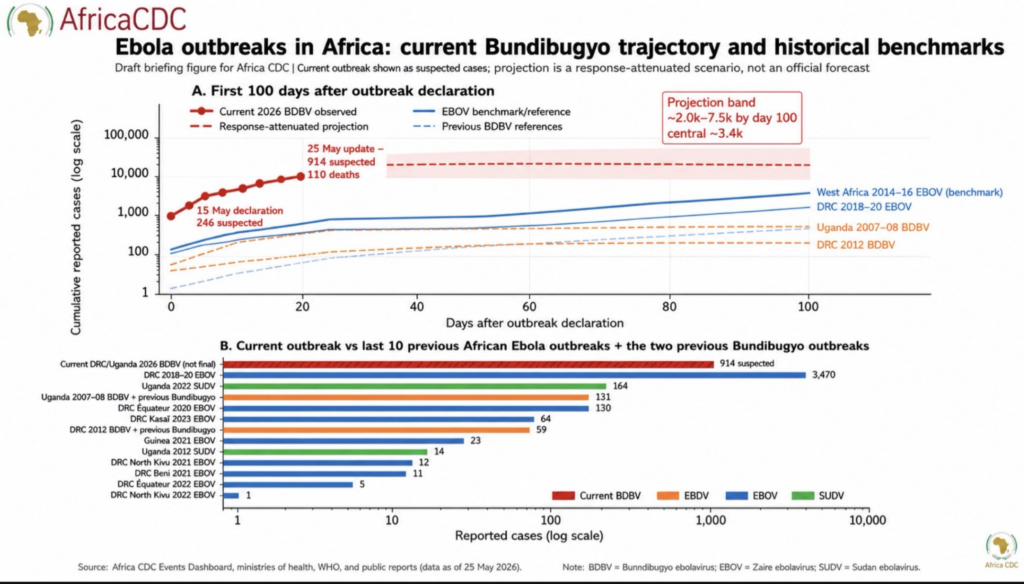
The Africa Centres for Disease Control and Prevention has warned that the outbreak could infect up to 7,500 people. On 23 May, it reported almost 1000 suspected cases and over 100 deaths.
However, it is difficult to confirm cases as samples from the outbreak zone must travel 1,700 kilometres – often on rudimentary roads – to reach the Institut National de Recherche Biomédicale in Kinshasa, the only facility in the country with the capacity to test for Bundibugyo.
The conflict has also made it difficult for health officials to provide residents with information about the outbreak, for which there are no approved vaccines or treatments, and a death rate of up to 50%.
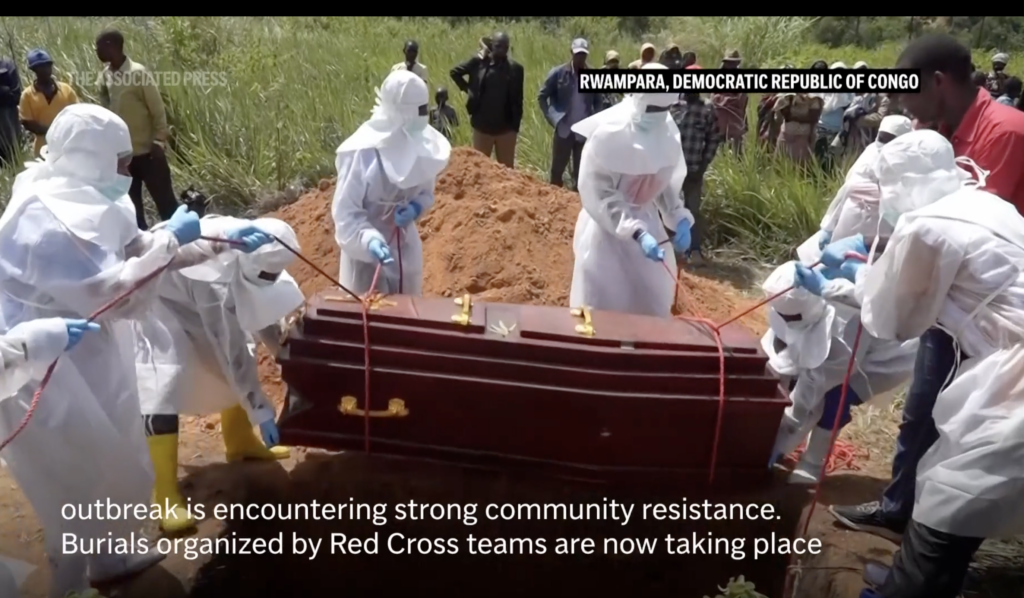
Community members have attacked and torched tents housing Ebola patients at Mongbwalu General Referral Hospital three times in the past week, demanding the bodies of their relatives for burials – unaware that their bodies remain infectious after death.
In the latest attack, a seriously ill patient died while trying to escape the burning tent and 18 others fled.
“We cannot build community trust or isolate the sick while bombs are falling,” said Tedros. “We urge all warring parties to agree to an immediate ceasefire to contain this outbreak. To allow us safe and sustained access for medical teams.”
Travel restrictions
Last week, the United States (US) closed its borders to citizens from the DRC, Uganda and South Sudan, and this week it emerged that US citizens exposed to the virus in these African countries will be quarantined in Kenya rather than flown home.
This week, Canada also closed its borders to the same three countries.
However, a spokesperson for the European Centre for Disease Prevention and Control (ECDC) said on Wednesday that “the risk of infection to the general population in Europe remains very low”, but stressed that it is “crucial to reduce risk by identifying travellers who are symptomatic”.
The ECDC is assisting the European Union and European Economic Area (EU/EEA) to “rapidly detect and isolate anyone infected who is arriving from the regions affected and carry out all necessary control measures”.
It has also deployed an ECDC expert to the Africa CDC to support its response.
Meanwhile, Uganda – which has confirmed 17 cases – has closed its border with the DRC. Within the DRC, flights to Bunia in Ituri have been suspended, both containing the outbreak and making humanitarian efforts more difficult.
Race for vaccines, treatment
 Meanwhile, scientists are racing to adapt current Ebola research, which is focused on the more widespread Zaire strain, to address the Bundibugyo outbreak.
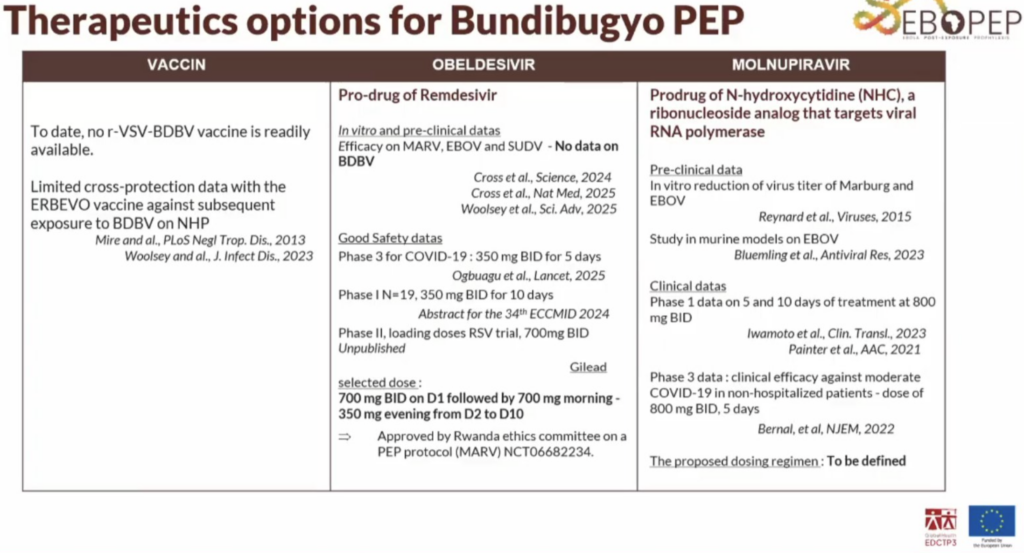
There are plans to extend a Phase 3 trial of the oral antiviral treatments, remdesivir (Obeldesivir) and Molnupiravir, to include the highest-risk contacts of people infected with Bundibugyo, testing whether they can stop or minimise infection within the 21-day infection period.
Dr Marie Jaspard, a French infectious disease researcher who heads the Ebola Post-Exposure Prophylaxis (EboPEP) research group, told a WHO scientific webinar earlier this week that scientists are redesigning the protocol as fast as they can, but that suitable high-risk contacts will be able to receive treatment immediately.
Obeldesivir is an oral form of remdesivir, which is suitable for remote settings, although its safety in children and pregnant women has not yet been established.
Molnupiravir, which proved effective against COVID‑19 experience, has shown some efficacy against Ebola in animal studies.
The most advanced treatment candidate for Bundibugyo is MBP134, “a cocktail of two broad-spectrum monoclonal antibodies, capable of neutralising several viral species of Orthoebolavirus”, which has already been tested on primates, according to the French scientific research agency, ANRS.
But this has to be injected, making it less suitable for remote areas such as Ituri.
Meanwhile, DRC Health Minister Roger Kamba said that his country has requested access to a monoclonal antibody tested against all three Ebola strains – Zaire, Sudan, and Bundibugyo – that has been developed in the US.
The DRC has officially requested access to this experimental treatment to launch a clinical trial for confirmed patients.
Image Credits: AP, Africa CDC.
Combat the infodemic in health information and support health policy reporting from the global South. Our growing network of journalists in Africa, Asia, Geneva and New York connect the dots between regional realities and the big global debates, with evidence-based, open access news and analysis. To make a personal or organisational contribution click the donate button below.