The World Health Organization (WHO) has pushed back against speculation that a critical review of the US measles elimination status was delayed until November for political reasons. Rather, the WHO said that there were strong technical reasons for postponing the review from April until November so that more data could be collected.
This came as US health officials asked an independent panel to delay its review of the country’s measles elimination status until later this year.
The review of the measles elimination status is now set to happen after the US midterm elections, reportedly sparking concerns over political motives. However, authorities strongly insist that the extensive delay is necessary to guarantee an uncompromising and exhaustive epidemiological review of recent circulation data.
It is essential that “all of the data, all of the evidence, all of the analysis has been done and scrupulously done,” noted Kate O’Brien, WHO director of the Department of Immunization, Vaccines, and Biologicals.
The review, which is to be led by the Pan American Health Organization (PAHO), WHO’s regional arm in the Americas, could lead to the embarrassing loss of the US status as a country that has eliminated measles, due to the multiple outbreaks that have occurred there over the past year.
It comes at a time when PAHO, a semi-autonomous entity, is keen to retain the US as a partner – even after the US pulled out of the WHO as a global entity.
Last November, PAHO’s Measles, Rubella, and Congenital Rubella Syndrome Elimination Regional Monitoring and Re-Verification Commission resolved that Canada had lost its measles elimination status after 12 months of continuous transmission.
The US has seen record-breaking outbreaks concentrated in Texas and South Carolina in the past year, with the most recent outbreak exceeding 1,000 cases. Experts point to waning vaccination rates and community transmission.
The US achieved elimination status in 2000, marking a victory over a disease that once infected nearly every child and claimed 500 deaths per year before widespread vaccination.
PAHO points to technical reasons for postponement
The WHO carries out routine elimination verification of its member states every year, assessing whether a country had no local transmission of the same strain within the past 12 months.
PAHO initially invited both Mexico and the US to meet in April to review their elimination statuses following recent outbreaks. Under the organization’s frameworks, the panel meets annually, but may “also convene at other times as needed to carry out its mandate.”
“The meeting date has been set to give national health authorities and national sustainability committees sufficient time to prepare comprehensive reports, including descriptions and analyses with detailed epidemiological and laboratory evidence, for review by the commission,” the announcement read.
Now, though, PAHO has said they want to “harmonize” the commission’s schedule.
The WHO defended the rationale for postponing the review: “The [status review] meeting normally takes place in the fourth quarter of the year,” said O’Brien, responding to questions during a WHO press briefing.
“That is when the review of the evidence will take place by that committee to determine whether [countries] retain or do not retain their elimination status.”
Another reason that the meeting wasn’t held earlier was to ensure all data and analysis were completed with the necessary rigor and depth, she explained. This preparation would ensure that external committee members have every piece of information required to reach their conclusions.
US could join UK, others, in losing elimination status
In January, the UK, Spain, Armenia, Azerbaijan, and Uzbekistan also lost their measles elimination status after the Europe and Central Asia regional committee met to review the status.
The Region of the Americas has historically maintained the most countries to reach elimination status.
But outbreaks across the region – notably the US, Canada, and Mexico – threaten the region’s reputation as the only group that has achieved total measles elimination.
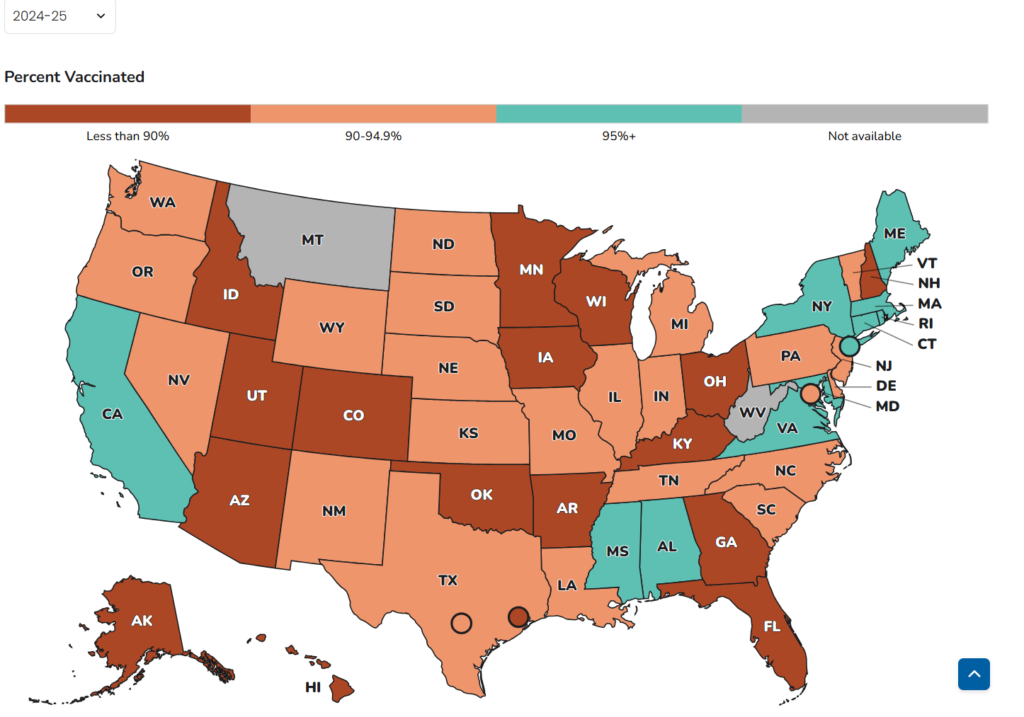
Slipping vaccination rates in higher-income countries help explain a resurgence of infections. In the last school year, 13 US states had vaccination rates below 90%. In 2010, only six states fell below 90%, according to CDC data.
And when using the WHO’s threshold for herd immunity – 95% – only 10 states currently meet that criteria.
Nearly 100,000 deaths a year among unvaccinated
Globally, 95,000 measles deaths occur each year, mostly among unvaccinated or under-vaccinated children under the age of five.
Cases and deaths are mostly concentrated in low- and middle-income countries and in low-resource or conflict settings.
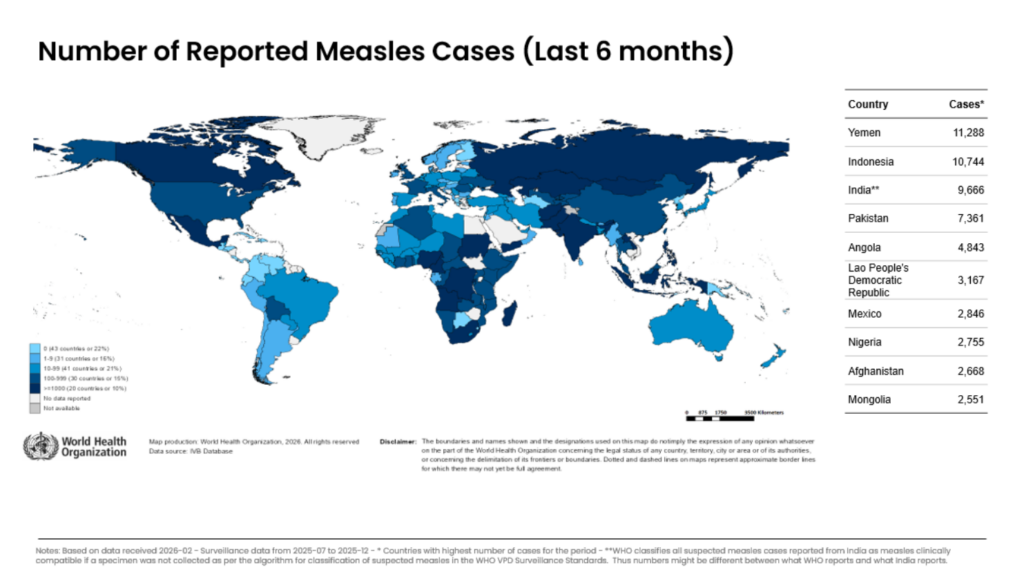
Yemen, Indonesia, India, Pakistan, and Angola accounted for the majority of the disease burden in 2025.
The disease is one of the most contagious viruses that can lead to severe complications and death, according to the WHO. Vaccination, though, averted nearly 59 million deaths in the past quarter-century.
The measles virus infects the respiratory tract and then spreads throughout the body. Symptoms include a high fever, cough, runny nose and a rash all over the body, per the WHO.
Combat the infodemic in health information and support health policy reporting from the global South. Our growing network of journalists in Africa, Asia, Geneva and New York connect the dots between regional realities and the big global debates, with evidence-based, open access news and analysis. To make a personal or organisational contribution click the donate button below.