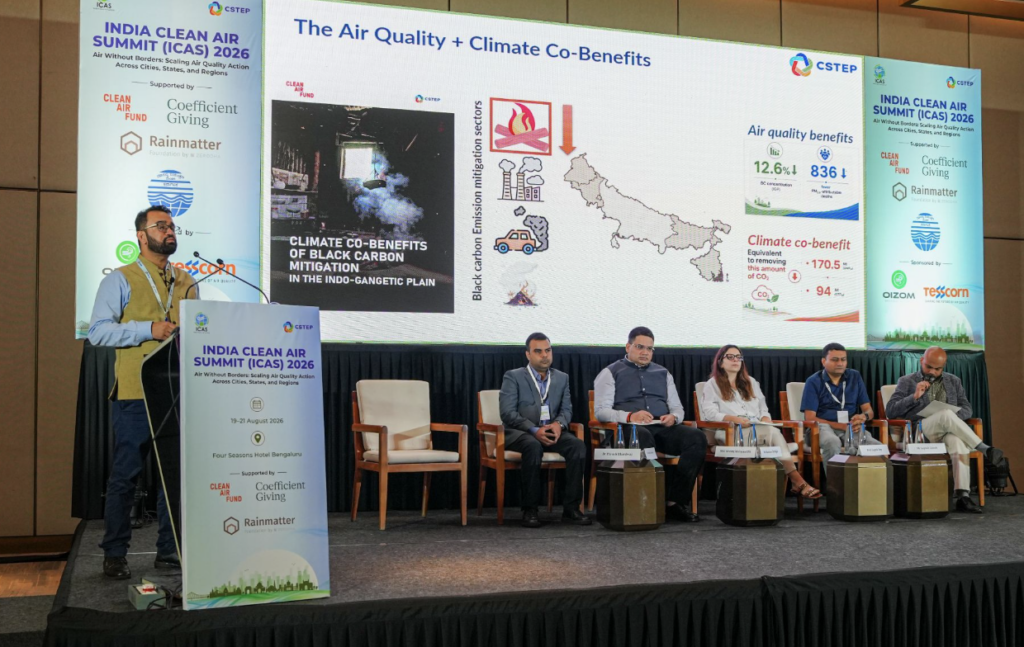
BENGALURU – India’s flagship air pollution action plan, the National Clean Air Programme (NCAP), has mostly failed to deliver, according to research presented at the eighth India Clean Air Summit.
Officials, scientists, and other experts highlighted the 2019 program’s severe shortcomings and red-flagged critical gaps. An “NCAP 2.0′ has been widely expected, but the central government has yet to announce a launch timeline.
Data shared by the summit organiser, the Center for Study of Science, Technology and Policy (CSTEP), showed that fewer than 7% of the 131 targeted cities met NCAP’s goal to reduce pollution by 40% by 2025-26, and 35% of cities showed an increase in coarse particulate matter (PM10). This failure comes despite the government releasing over INR 16,423 crore (approximately $1.5 billion) to support the program.
Speakers at the conference emphasized that future iterations of the programme must bridge air pollution control measures with climate action policies. Crucially, at least two government experts warned of emerging, interconnected feedback loops between climate change and air quality.
Structural flaws in programme
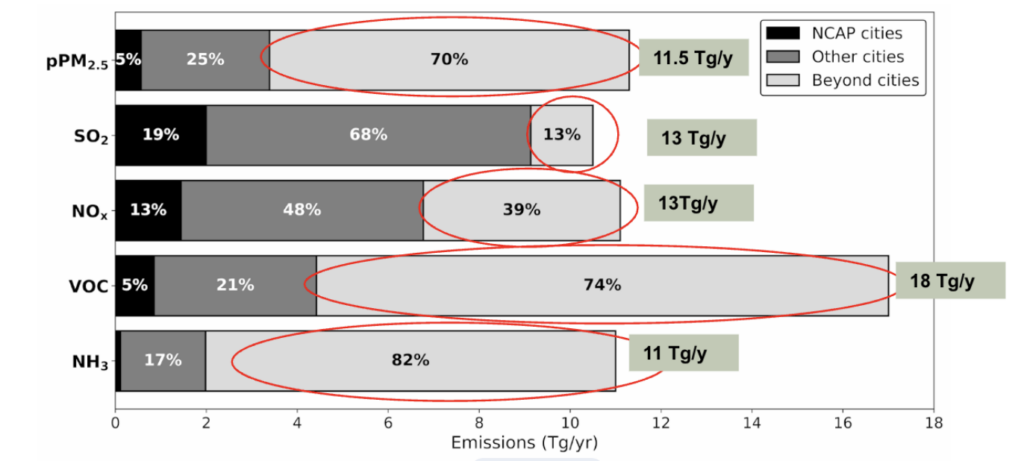
According to CSTEP, NCAP’s limited impact stems from several core design flaws. These include that it targets cities; focuses on PM 10 and dust mitigation measures not the finer, deadlier PM2.5 particulate matter pollutant; has no systemic assessment of interventions; and it covers short-term measures rather than long-term planning considering growth. There is also limited technical understanding of urban local bodies (ULBs).
About 95% of India’s PM2.5 pollution, a universally tracked pollutant, is emitted from cities and rural areas that are excluded from NCAP’s focus, which tracks 131 cities. Seventy percent of PM2.5 is from “non-urban areas” according to PAVITRA, an air quality management tool developed by IIT Bombay, CSTEP and two American universities.
Another limitation is the lack of funding for places where pollution is rising, such as the coastal state of Kerala.
“What I really want to request is that when NCAP 2.0 is happening, there should be some funds available to the cities which are not non-attainment, but are trying to prevent becoming a non-attainment city,” says Ratish Menon, a senior official of Kerala’s Pollution Control Board.
Non-attainment means cities that have consistently failed to attain air quality that meets the national ambient air quality standard of 40 micrograms/cubic metre of PM2.5.
Indo-Gangetic plain: India’s pollution hotspot
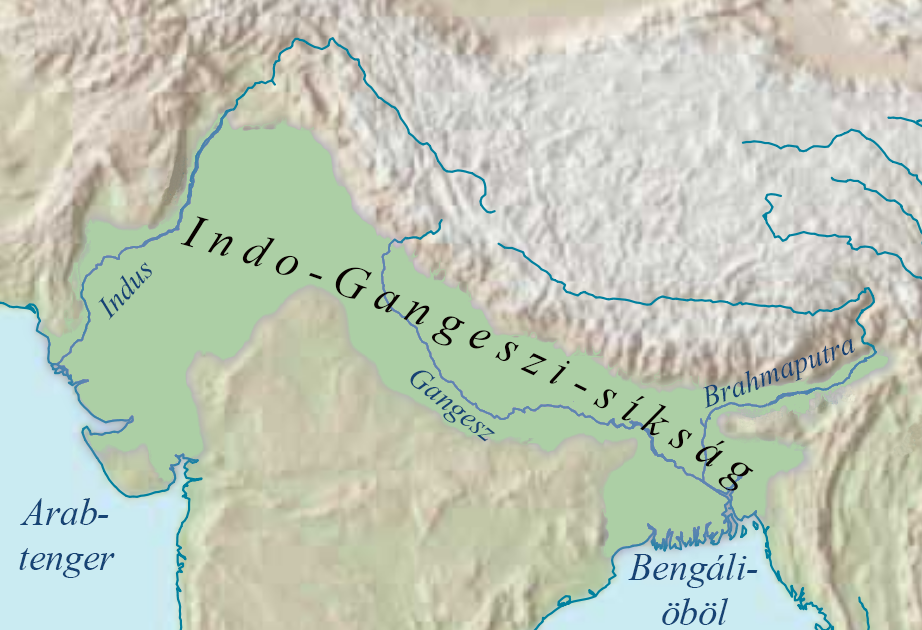
However, the most severe challenge remains concentrated in northern plains of India, described as an “emission hotspot” by SD Attri, a senior official and scientist of the Commission for Air Quality Management (CAQM). The CAQM is in-charge of reducing pollution in and around Delhi, which is situated in the plains.
“The Indo-Gangetic Plain (IGP) covers only 15% of India’s land but accommodates around 37% of its population and emits 35% of India’s total emissions, making it an emission hotspot,” Attri explained, which is why Delhi and other places here often make it to the list of the top, most polluted places in the world.
Residents across the northern plains are exposed to persistently high pollution levels year-round. On an annual basis, average concentrations of PM2.5 or smaller particulate matter reach 84 µg/m³ (micrograms/cubic metre), which is more than twice the permissible standard of 40 micrograms under India’s National Ambient Air Quality Standard and almost 17 times the WHO’s safety guideline of 5 µg/m³ .
Target mitigation: Black carbon in UP and Bihar
A sharper focus on just two states, Uttar Pradesh and Bihar, and one pollutant, black carbon or soot, has been recommended by a CSTEP report launched at the summit.
The largest source of black carbon is from homes burning biomass and other dirty fuels for cooking and heating. And more than 60% of this pollution is from the IGP states.
Uttar Pradesh and Bihar is where domestic emissions have the greatest regional spillover. These two states dominate India’s northern plains, with a combined area about the same as Finland but with a combined population larger than the US.
Reducing black carbon emissions can save lives, and the largest benefits are to be achieved through a multisectoral airshed approach. Reducing black carbon emissions from all major sources in the IGP results in a 37% reduction in black carbon concentration and prevents 2,290 PM2.5-attributable premature deaths.
This number is conservative, as the authors explain there is limited research on the health effects of black carbon, unlike that of PM2.5, which is linked to about a million deaths in the country.
“The mortality burden estimated in this study is conservative because the exposure–response function used is derived for ambient PM 2.5 mass concentration rather than for individual PM 2.5 components (Black carbon, organic carbon, sulphates, nitrates, etc).
“Consequently, the potential toxicity of black carbon is not explicitly captured in the mortality estimation,” Piyush Bharadwaj, head of the air quality observations and modelling group at CSTEP, told Health Policy Watch.
Climate change – air pollution link
The CSTEP report also highlights significant co-benefits between clean air initiatives and carbon mitigation.
In a best-case scenario, aggressive black carbon reduction in northern India would yield climate co-benefits equivalent to 639.3 MT CO2, roughly similar to Germany or South Korea’s annual emissions.
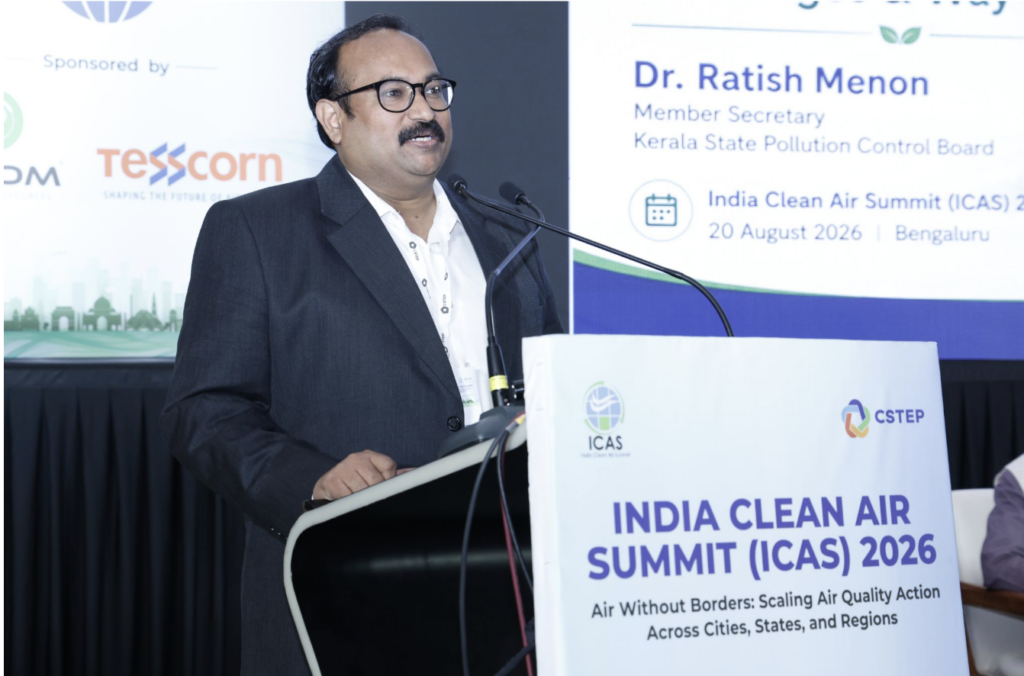
There were other warnings about the link between global warming and air pollution. Menon attributed part of the rise in Kerala’s air pollution levels to pollution from neighbouring states, but also to global warming.
Last winter’s peak in “all (air quality monitoring) stations” was more because there was lesser wind transport between the land and ocean, he says, “because the ocean temperatures are increasing and that exchange is getting affected. That causes a regional buildup.”
A separate climate link was flagged by a senior scientist at IIT Kanpur, SN Tripathi, whose team has overseen the deployment of almost 1,400 low-cost sensors in Uttar Pradesh and Bihar.
Based on this data, Tripathi said they have been able to create an index where “we have combined temperature and relative humidity to provide some kind of a universal climate index, and we are basically trying to give that how it looks during summer times when the temperatures are very high and the overall comfort level for human beings becomes very unmanageable.”
They are seeing that a good part of these two states have a “very high amount of this compound index.” When asked by Health Policy Watch, how this ‘universal climate index’ is to be used, Tripathi said it was work in progress and premature to comment.
Call to change air quality action plans
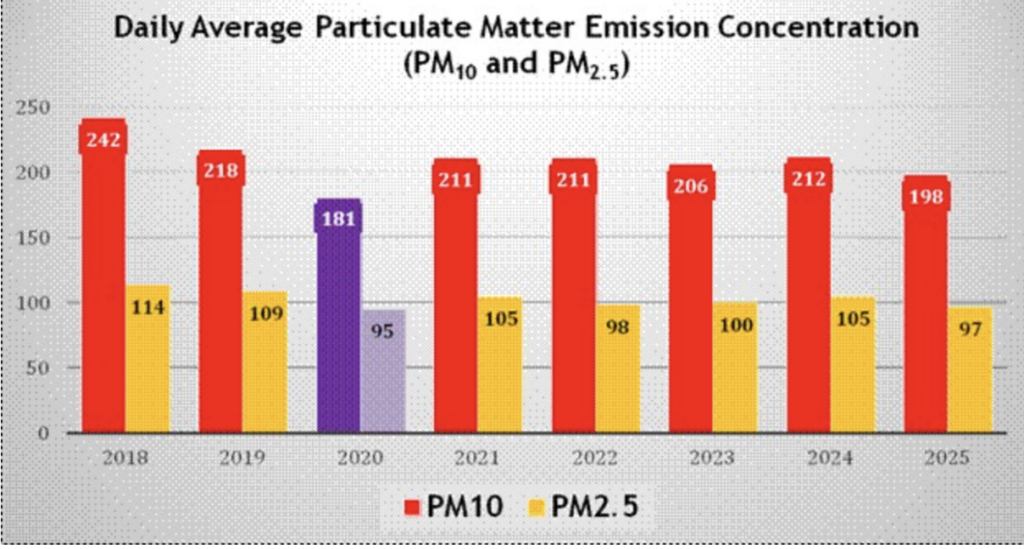
India’s peak pollution season begins in October and ahead of that, Attri, the most senior official from the government of India at the summit, listed several measures taken to reduce air pollution.
The latest include increasing the number of top grade air quality monitoring stations from about 90 currently to 157 in the next month as well a “new GRAP” system which he says will be open for the public’s comments and suggestions; GRAP is the Delhi region’s Graded Response Action Plan, a series of tighter curbs – on transport, construction, diesel generators, cooking fuels and even schools – as pollution levels rise
However, the larger messaging from ICAS 2026 is that urgent changes in air quality management are required. Pointing to a series of policy actions since the Air (Prevention and Control of Pollution) Act was cleared by Parliament 45 years ago, and the INR 16,423 crore in funding released by the government, Abinaya Sekar of Health Effects Institute underscored the need to assess the effectiveness of air pollution interventions, offering a framework on how to do this.
CSTEP researchers urged the government to integrate air quality targets into both NCAP 2.0 and India’s international commitments under the UN Nationally Determined Contributions (NDCs), that is, self-identified pledges for climate action by every country.
Aligning these policies would allow air quality improvement to be recognised as a critical element of near-term climate mitigation, particularly by targeting short-lived climate pollutants like black carbon.
In eight years of the India Clean Air Summit and similar gatherings, the one constant has been the demand for better implementation.
The other constant has been Delhi’s annual average PM2.5 pollution level stubbornly hovering around 100 micrograms, in the last eight years.
Image Credits: Source: Press Information Bureau, Indian Government.
Combat the infodemic in health information and support health policy reporting from the global South. Our growing network of journalists in Africa, Asia, Geneva and New York connect the dots between regional realities and the big global debates, with evidence-based, open access news and analysis. To make a personal or organisational contribution click the donate button below.