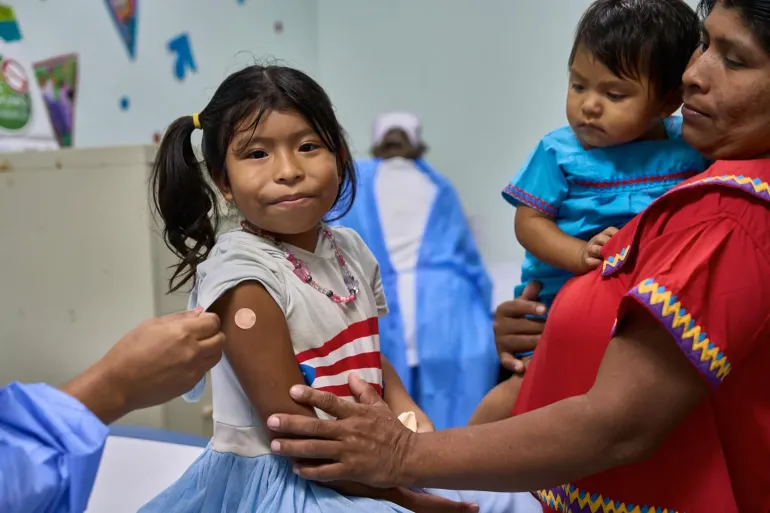
Nearly 90% of infants globally received at least one dose of a diphtheria, tetanus and pertussis (DTP) vaccine in 2025, while around one-third of girls globally received at least one dose of Human Papillomavirus (HPV) vaccine, which protects against cervical cancer.
This is according to the annual World Health Organization (WHO)-UNICEF Estimates of National Immunization Coverage (WUENIC) released on Wednesday, based on data from 195 countries and territories.
The number of children who have not received a single dose of vaccine ever, called zero-dose children, fell by 750,000 compared to the previous year.
But most countries are off track to meet the Immunization Agenda 2030, which requires them to reduce the number of zero-dose children by 50% compared to 2019 levels.
“Countries with significant improvement in their zero dose numbers include Sudan, India, Brazil, Ethiopia, and Mexico, who have made commendable progress,” said Dr Ephrem Lemango, UNICEF’s global head of immunization.
However, 13.5 million children were still without any vaccinations, and experts warned that the impact of funding shortfalls for Gavi, the global vaccine alliance, will only show up in the data in the coming years. There is also a rising cohort of drop-outs.
Nigeria, the Democratic Republic of Congo and Yemen have the highest numbers of zero-dose children, while the countries with the highest prevalence of zero-dose children are in Yemen, Papua New Guinea and Venezuela.
“Every child, whether born into wealth or poverty, peace or conflict, deserves the life-giving protection that vaccines provide. Immunization is one of the most cost-effective, most equitable, and most reliable interventions for protecting children’s health and well-being,” said WHO Director General Dr Tedros Adhanom Ghebreyesus.
Also read: GAVI Vaccine Alliance Secures More than $9 Billion from Donors – Despite US Ambush at Pledging Event
Challenges for immunization efforts
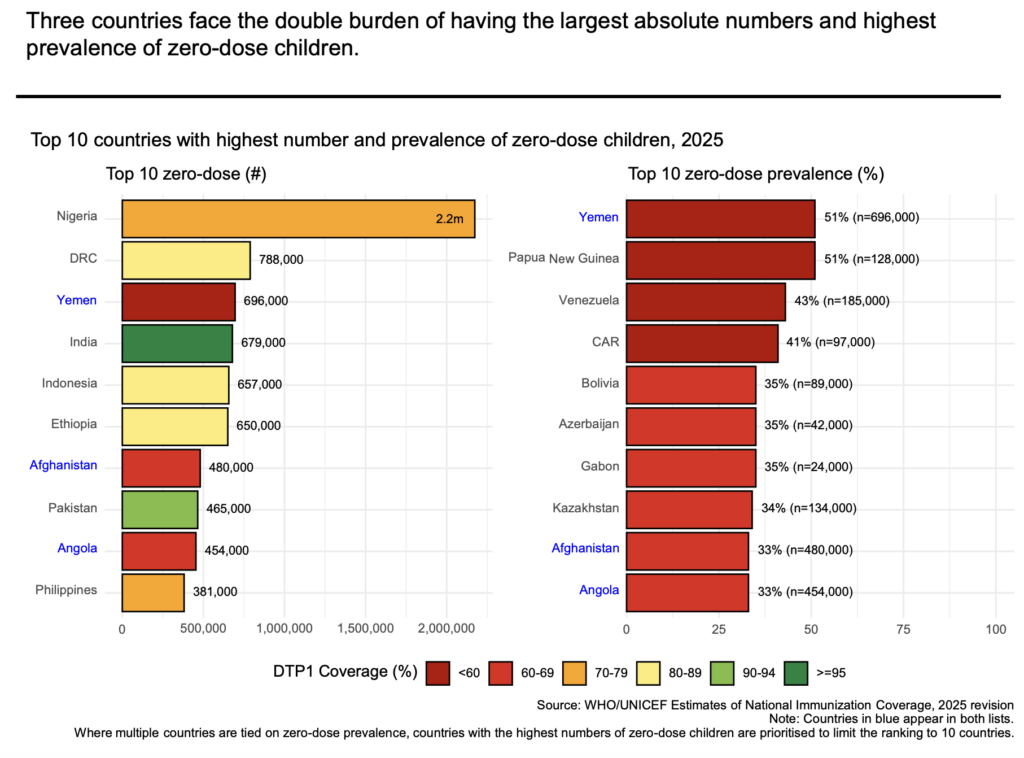
Immunization efforts are being challenged by several issues including rapidly growing populations, conflict, and structural and governance issues.
Drop-outs are another challenge. Globally, 7.3 million infants are estimated to have received their first DTP dose but dropped out before receiving their first measles dose.
This drop-out rate contributed to stalled measles coverage, with 84% of children receiving the first measles dose (MCV1) and 77% receiving the second dose (MCV2). A vaccination rate of 95% is required to maintain community immunity, and 57 countries reported large or disruptive measles outbreaks in 2025.
“We think that that is clearly related in some settings to false information, misinformation that is provided around measles vaccination, and this is of very significant concern because, as we know, measles is probably one of the most infectious viruses and is causing deaths in children around the world,” said Dr Kate O’Brien, WHO director of immunization, vaccines and biologicals.
The Americas and South-East Asia have fully recovered since COVID-19 and improved their performance, with the latter now the highest-performing region, compared to their 2019 baselines.
While Africa, the Eastern Mediterranean, and Europe saw gains last year, their coverage remains below pre-pandemic levels. In contrast, the Western Pacific experienced a decline, leaving it the region furthest below its 2019 baseline.
“Immunization programs in the least wealthy countries of the world are often closing vaccination gaps faster than wealthier ones, while also protecting what they already have achieved and continuing to do more,” Lemango said.
India, Sudan and South Africa – a story of gains and losses
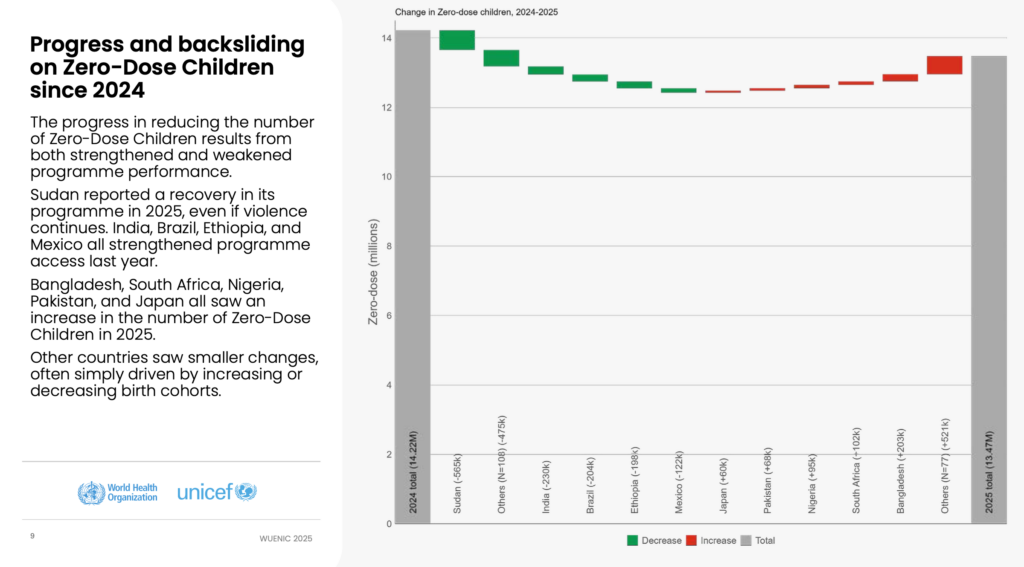
The reduction in zero-dose children is largely due to gains made by countries like Sudan, India and Brazil in very different circumstances.
While India, with its 1.4 billion people, has the largest population in the world, Sudan has managed to keep its gains despite conflict.
“Sudan shows what is possible when access is improved, even during conflicts. It gained about 35 points on the first dose of DTP and 22 points on measles. This is the largest single country improvement anywhere in the world we are reporting this year,” Lemango said.
But South Africa, which was doing well, has seen backsliding, as has Bangladesh.
“South Africa again has had a pretty strong program, and in recent years has had more challenges with their program from a structural perspective, and mostly from a fiscal perspective,” said O’Brien.
“Now we’re seeing some of the effects of the financial constraints that South Africa has in terms of a weakening program, and that’s showing up through weakening coverage,” she added.
Looming threat of funding shortfall
However, the 2025 data represent a snapshot of where global immunization stood before the funding cuts, driven largely by the US.
Around 85% of the drop in zero-dose children occurred in Gavi-supported countries, which also accounted for 95% of girls vaccinated against HPV
Last year, Gavi was only able to secure $9 billion out of its $11.9 billion goal – largely because the US refused to support it, with US Health Secretary Robert F Kennedy Jr. announcing that his country was halting support for the alliance until it could “re-earn” the public trust.
Gavi said its ability to survey outbreaks has been impacted by its funding shortage, and it is already having to make some hard choices.
“We believe that 600,000 lives that could have been saved will be impacted by this right-sizing and trying to fit to the wallet that we have,” said Thabani Maphosa, Gavi’s chief country delivery officer.
Meanwhile, O’Brien warned that more backsliding could lie ahead: “We don’t think that the impact of those funding cuts is showing up yet fully in the 2025 data. Our concerns are very much for what’s happening in programs in 2026 and what is yet to come.”
Reacting to the report, the International Federation of Pharmaceutical Manufacturers and Associations (IFPMA)’s Laetitia Bigger said that “routine childhood vaccination remains one of public health’s greatest success stories”.
“Today’s report highlights the potential of new vaccines to transform health outcomes – such as the expansion of HPV vaccination – but also serves as a reminder that too many children still remain unprotected against life-threatening diseases,” said Bigger, IFPMA’s director of vaccines policy.
“To respond to this challenge, governments and international organisations should invest in strong health systems and continue to prioritise the introduction of new vaccines.”
Image Credits: UNICEF, WHO and UNICEF , The White House.
Combat the infodemic in health information and support health policy reporting from the global South. Our growing network of journalists in Africa, Asia, Geneva and New York connect the dots between regional realities and the big global debates, with evidence-based, open access news and analysis. To make a personal or organisational contribution click the donate button below.