Yet another negotiating session on the outstanding annex of the Pandemic Agreement begins at the World Health Organization’s (WHO) headquarters on Monday (27 April) – and developed nations have presented a “hybrid” solution in an attempt to find consensus.
The “hybrid” proposal consists of a mix of mandatory and voluntary measures for sharing pathogen information and any benefits that flow from this information.
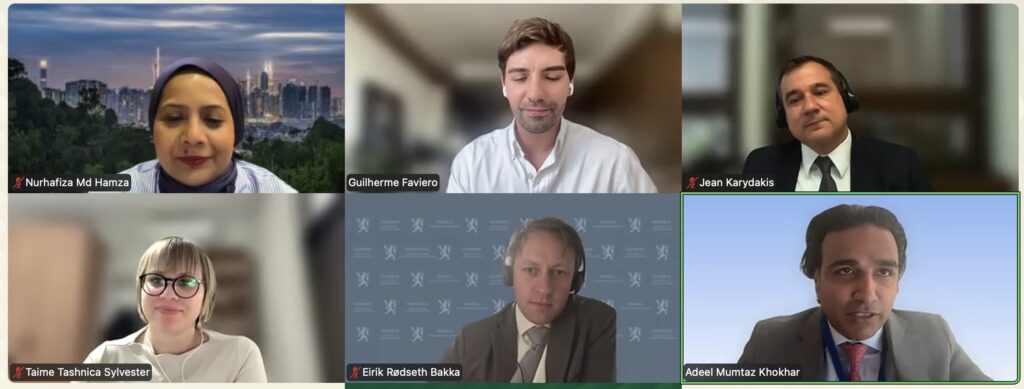
Adeel Mumtaz Khokhar, First Secretary to the Permanent Mission of Pakistan in Geneva, confirmed that a “hybrid” proposal had been presented to developing countries by some developed countries, but declined to name them.
WHO member states are negotiating how to share both information about dangerous pathogens and some of the “benefits” that manufacturers may develop from that information – namely, vaccines, therapeutics and diagnostics (VTDs).
The outstanding annex will set out terms for a pathogen access and benefit-sharing (PABS) system that ensures all countries have access to countermeasures to combat a pandemic or public health emergency of international concern (PHEIC) – unlike during COVID-19 when rich countries hoarded scarce vaccines.
“We have been hearing rumours about this hybrid system for the past two IGWG [Intergovernmental Working Group] meetings, and finally, some developed country negotiator took pity on us and presented it,” Khokhar told a high-level webinar hosted by the University of Miami’s Public Health Policy Lab and AIDS Healthcare Foundation (AHF) last week.
The proposal envisages two categories for biological material, Khokhar explained.
To access one category, countries and manufacturers will “have to follow certain terms and conditions”, and these will be included in the PABS system. No terms or conditions apply to the other category of material, including benefit-sharing obligations.
However, Third World Network (TWN), a civil society alliance tracking the negotiations, says that the hybrid system proposed by developed countries also envisages a split between information sharing and benefits.
“Developed countries expect developing countries to share pathogen samples and sequence information freely, while deferring benefit-sharing to future negotiations between WHO and pharmaceutical manufacturers,” writes TWN in a recent brief.
Maintains the status quo
For Khokhar, the hybrid proposal “is essentially the status quo” as it allows parties to “share the way they want to share”.
“So I’m not sure how fundamentally the needle is moved by this proposal. All I can understand from this proposal is that they want to retain and preserve the status quo, which, from a developing country negotiations perspective, is a disappointment.”
Nurhafiza Hamza, Minister Counsellor for Health at Malaysia’s Permanent Mission to Geneva, explained that developing countries want “a set of mandatory benefit-sharing that is acceptable to different categories of users of the PABS system” – member states and pharmaceutical companies – during health emergencies.
“If manufacturers have VTDs during a PHEIC or pandemic emergency, they should share,” said Hamza. “It is important to get some mandatory benefit sharing and not a menu of options, where manufacturers can pick and choose.”
Kicking the can down the road?
Jean Karydakis, Counsellor in Brazil’s Mission in Geneva, acknowledged that the positions of the different groups – primarily developed countries versus developing countries – are fairly entrenched.
“We won’t change other countries’ positions at this time,” he acknowledged. “The question now is whether we can find possible creative language, also bearing in mind that we will have a Conference of the Parties (COP) later on that will need to revisit and detail further what we cannot agree right now.”
Karydakis also asserted that “90% of of the text is already agreed in the Pandemic Agreement, and the Pandemic Agreement was already adopted. “
But the PABS system was a contentious issue that evaded negotiators, who packaged it into an annex and kicked it down the road to new negotiations. This enabled the World Health Assembly to adopt the Pandemic Agreement last year, described by some observers as the Pandemic Agreement Lite precisely because it dodged the detail about PABS.
Adopting a vague PABS annex and kicking further details down the road again – this time to the COP – might save face for multilateralism. But it simply delays the adoption of the Pandemic Agreement to yet another set of talks, leaving all member states vulnerable to public health emergencies in the meantime.
Standard contracts?
Developing countries want the annex to include a standard contract to govern access to biological material and digital sequencing, including benefit-sharing obligations.
But Khokhar said that the IGWG Bureau and “other colleagues” have expressed that “a full standardised contract may not be the appropriate way”, as it is hard to predict what – if any – VTDs may be developed as a result.
“Fair enough,” he said, adding that developing countries are prepared to explore the inclusion of a “basic contract” followed by a PABS contract, if a party has developed a medical countermeasure.
“But what is their answer to this suggestion? Let’s have an open and a closed system. So, in this endeavour to try and find and create a multilateral system, we are actually going back to our national systems… What new system are we creating here? We’re creating nothing new?”
For TWN, the lack of “contractually enforceable legal obligations for recipients of PABS materials and sequence information “will add to the legal uncertainty, as benefit-sharing will depend on the WHO concluding contracts with manufacturers.
Namibian negotiator Taime Sylvester said that the funders of research in developing countries are “overwhelmingly high-income country governments and foundations”.
They could “include PABS compliance as a condition of their grants,” said Sylvester, pointing to the example of the European Union’s Horizon Europe (2021–2027), its funding programme for research and innovation.
This requires researchers to commit to Nagoya Protocol compliance, which mandates fair benefit-sharing from the use of genetic resources.
Prospects for agreement
Norwegian Health Counsellor Eirik Rodseth Bakka acknowledged that there are “significant outstanding issues, and I think as a collective, we do need to see significant progress next week”.
However, he stressed that member states have the opportunity to “correct some of those inequities from the COVID-19 pandemic,” especially early access to vaccines for low- countries and lower-middle-income countries, and enabling “to the extent possible that there is more technology transfer and access to access to manufacturing capacity.”
Karydakis expressed hope that “we will get this by May”, adding that talks may need to continue alongside the World Health Assembly in late May, the deadline for the annex.
He also joked that night sessions were necessary to get people tired and hungry and “only able to leave the room when the deal is reached.”
Sylvester said that Namibia believes that “a fair, functional, legally grounded PABS system” is possible and will assist both the global south and the global north need this functional system to succeed. So we we believe it. We believe that it can happen which is above and beyond, or we’re not asking any country to stand to a higher standard. We’re asking the same standards.
Malaysia’s Hamza described the PABS system as “the litmus test for equity”.
“We will have to see whether states will come in next week and design a PABS system that would actually make an improvement in the current status quo.When the Group for Equity gets together, the first thing we will assess is whether what we have agreed on, each paragraph, is really delivering equity.”
Combat the infodemic in health information and support health policy reporting from the global South. Our growing network of journalists in Africa, Asia, Geneva and New York connect the dots between regional realities and the big global debates, with evidence-based, open access news and analysis. To make a personal or organisational contribution click the donate button below.