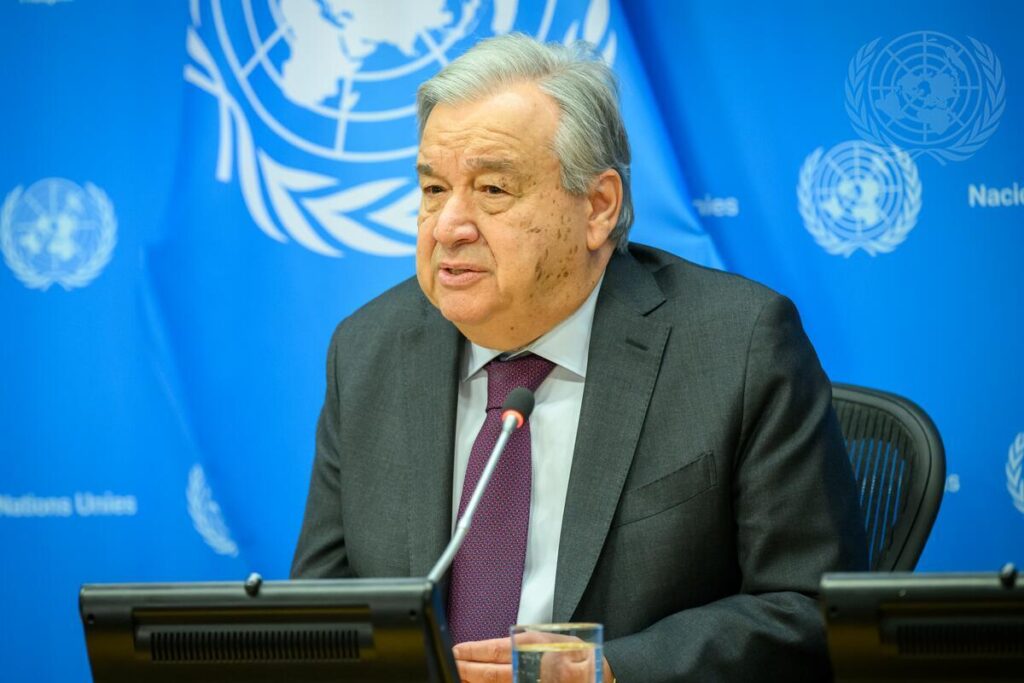
Women’s organisations are anxious that Secretary-General António Guterres will push the controversial proposed merger of the UN Population Fund (UNFPA) and UN Women at the UN General Assembly later this month.
Guterres proposed the merger as part of his UN80 initiative, aimed at streamlining and cutting costs as the global body tries to recover from the United States’ funding withdrawal.
Briefing the UN General Assembly on the merger on Thursday, Guterres said that the proposal had undergone a strategic assessment, and the two bodies’ executive directors had also presented detailed analysis to their respective boards.
“We will carefully consider the next steps, taking into account the results obtained by the boards,” he told the Assembly.
However, the Feminist Cross-Coalition UN80 Working Group, made up of key women’s organisations opposed to the merger, raised the possibility that Guterres may push the merger without considering alternatives as he has already pronounced that it is “the best way”.
They also assert that the merger “lacks the confidence” of the two entities’ boards.
Merger is ‘technically sound’
The UN merger assessment team’s report in April found that the two organisations had distinct and complementary mandates, and there was not that much overlap in their implementation work.
However, the team concluded that “a merger is a technically sound proposal that has the potential to generate a stronger gender equality and SRHR entity at the heart of the UN, but only if undertaken under specific conditions”.
These conditions include preserving the mandates of the two entities, and implementing the merger “with disciplined attention to political, legal, funding and operational safeguards”.
The team suggests that a merger could generate annual savings of approximately $32-38 million “once integration is fully implemented”, and these “would need to be channelled back into a combined entity “.
UN Women’s mandate encompasses the full spectrum of gender equality and the empowerment and rights of women and girls, including “normative support, UN-system coordination and operational activities”.
UNFPA contributes to gender equality through its specific mandate areas, including sexual and reproductive health and rights, population and development, and gender-based violence.
In 2024, UNFPA total expenses were approximately $1.53 billion, compared to $669 million for UN Women.
Alternative report, civil society scepticism
However, a report commissioned by the executive boards of UNFPA and UN Women found that significant savings could be achieved if the two organisations worked together more closely without merging.
The report also warns that the merger will bring transition costs and operational disruption.
Meanwhile, over 1,400 feminist organisations and individuals from over 146 countries sent a letter to Gueterres last month urging him to withdraw the merger proposal.
“Both the merger assessment and civil society’s evidence have reached the same conclusion: the proposed merger poses significant risks, and could deepen the very challenges it is intended to address,” according to the letter.
“These include risks to donor confidence and resource mobilization, operational continuity in humanitarian and development settings, and most importantly, the erosion of hard-won mandates for both agencies.”
The latter adds that no documents in favour of the merger “explain why these challenges are best answered by building one larger, more exposed target rather than protecting two mandates whose distinctiveness has, until now, been treated as a strength”.
It also questions whether there would be significant cost-savings.
“A decision of this magnitude must be grounded in evidence, not assumptions,” the letter argues.
“There has been no serious consideration of alternatives, including a comparison based on clear benchmarks and indicators of the merger proposal against non-structural reforms. Most importantly, no evidence has been presented that demonstrates that a proposed merger would accelerate progress towards gender equality and the realisation of the human rights of women and girls in all their diversity.”
‘Withdraw merger proposal’
The signatories call on Guterres to withdraw the merger proposal and consider “non-structural alternatives to ensure the UN delivers for gender equality and the human rights of women and girls”.
However, Guterres told the briefing on Thursday: “The principle is simple: Where we perform essentially the same function, we should ask whether we truly need separate systems, separate platforms, and separate infrastructure — and we should act accordingly.”
But the feminist coalition is not convinced: “This merger would fold two specialised institutions, with distinct expertise, relationships, and track records, into one smaller, more easily pressured entity — right at the moment when the issues they cover demand more capacity, not less. That’s not a bureaucratic risk. It’s a risk to whether women and girls can actually access the services and protections they depend on.”
Image Credits: UN Photo.
Combat the infodemic in health information and support health policy reporting from the global South. Our growing network of journalists in Africa, Asia, Geneva and New York connect the dots between regional realities and the big global debates, with evidence-based, open access news and analysis. To make a personal or organisational contribution click the donate button below.