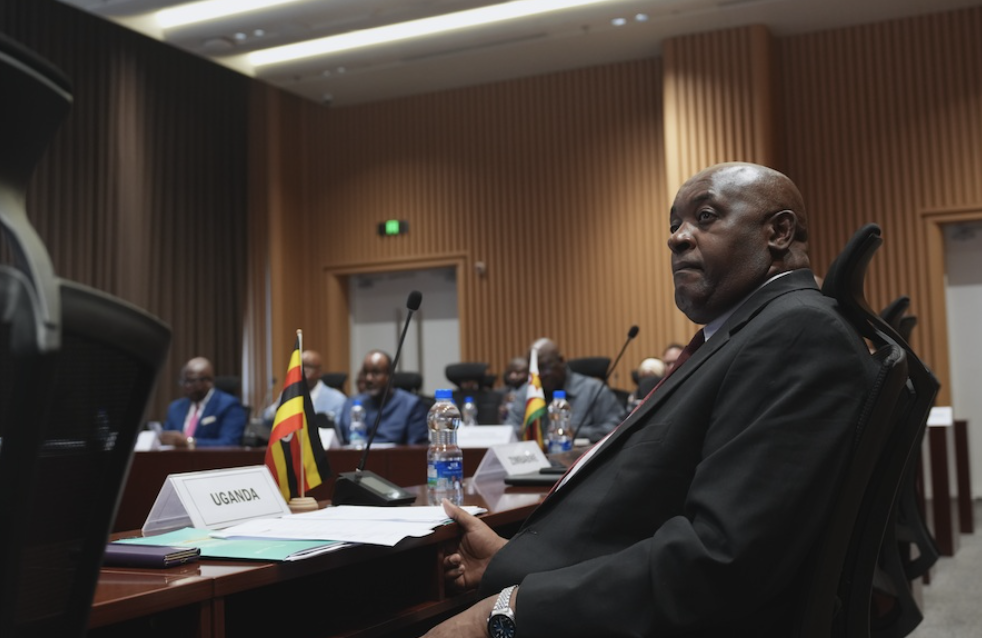
The incoming Governing Board of the Africa Centre for Disease Control and Prevention (CDC) was unable to agree on whether to reappoint the body’s controversial Director-General, Dr Jean Kaseya, on Sunday, according to high-level sources.
The board will resume its discussion on Monday (23 November), sources told Health Policy Watch. Kaseya’s four-year term ends in February.
Aside from reappointment, the board is said to be considering three other options: extending his appointment for six months alongside a professional improvement plan; suspending him and investigating the various allegations; and advertising the position.
The new board held its first formal meeting on Sunday, and Ugandan Health Minister Chris Baryomunsi was elected as its chairperson for the next three years.
Other voting board members comprise the health ministers from Cameroon, Gabon, The Gambia, Kenya, Namibia, Sierra Leone and Zimbabwe. North Africa has not yet nominated its two representatives, which are also entitled to vote.
The remaining nine board members are non-voting, and seven were nominated by African Union Commission (AUC) Chairperson Mahmoud Ali Youssouf to represent various sectors.
Groups appointed this month to serve on the board for two years include the World Bank, Susan Thompson Buffett Foundation, African Development Bank, Green Climate Fund, African Vaccine Manufacturing Initiative, International Livestock Research Institute, and Soins de Santé Primaires en Milieu Rural (SANRU), a Christian NGO based in the Democratic Republic of the Congo (DRC).
Dr Claudes Kamenga, Kaseya’s Chief of Staff, told Health Policy Watch that “the governing board of Africa CDC can do an evaluation of the DG, and, if all agree, they can recommend to the [AU] Committee of Heads of State to reappoint him”.
Health Policy Watch previously reported that serious allegations have been made against Kaseya, including threats to female diplomats, staff intimidation, lavish spending and a shrinking budget.
Health Policy Watch tested the veracity of claims by engaging with 12 sources, primarily Africa CDC staff and former staff, examining several documents, including staff resignation letters, staff emails and presentations, and a letter from the body’s auditors.
Africa CDC responded to Health Policy Watch‘s article with a media statement claiming that the article was written by a “politically motivated Western journalist” backed by unnamed “sponsors”, and rebuffed several claims.
Anonymous staff documents
Three anonymous documents have been circulated within African Union diplomatic circles during the past three weeks claiming to come from staff, who said that they fear reprisals should they reveal their identities.
Health Policy Watch verified some claims in the “policy brief” circulated almost a month ago. Ten days ago, Health Policy Watch also received a petition from “senior staff” urging the governing board and the AU Permanent Representatives Committee (PRC) not to reappoint Kaseya. Several credible sources vouched for its authenticity.
The petition claims that a performance appraisal of Kaseya completed in April has legal and procedural problems and should not be used as the basis for his reappointment. The appraisal, signed by AUC Chairperson Youssouf, covers Kaseya’s entire period of office (2023-2026), although Youssouf only took office in March 2025.
A third document, entitled “Denunciation of Scandal and Abuses in Recruitment”, was sent to the AUC Chairperson and member states last Friday. It makes various new claims, including that staff salaries are often paid late.
Health Policy Watch has asked Africa CDC for comment on whether the governing board delayed its decision on Monday and is to reconvene on Monday, and will update this article should we receive a response.
Image Credits: Africa CDC.
Combat the infodemic in health information and support health policy reporting from the global South. Our growing network of journalists in Africa, Asia, Geneva and New York connect the dots between regional realities and the big global debates, with evidence-based, open access news and analysis. To make a personal or organisational contribution click the donate button below.