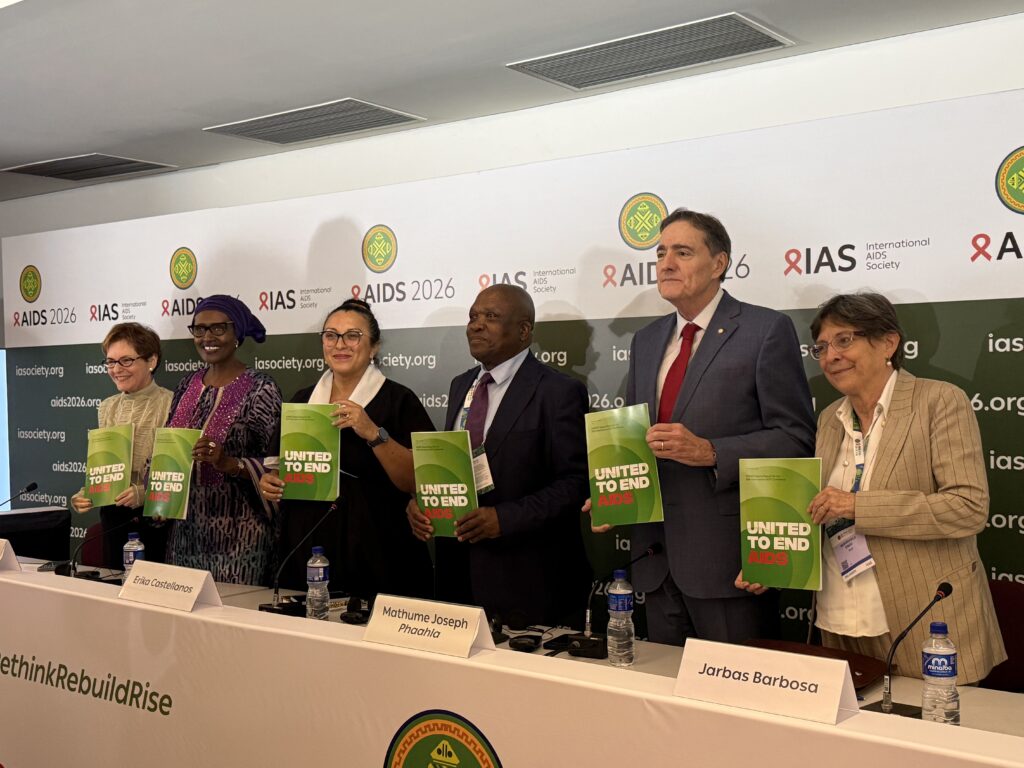
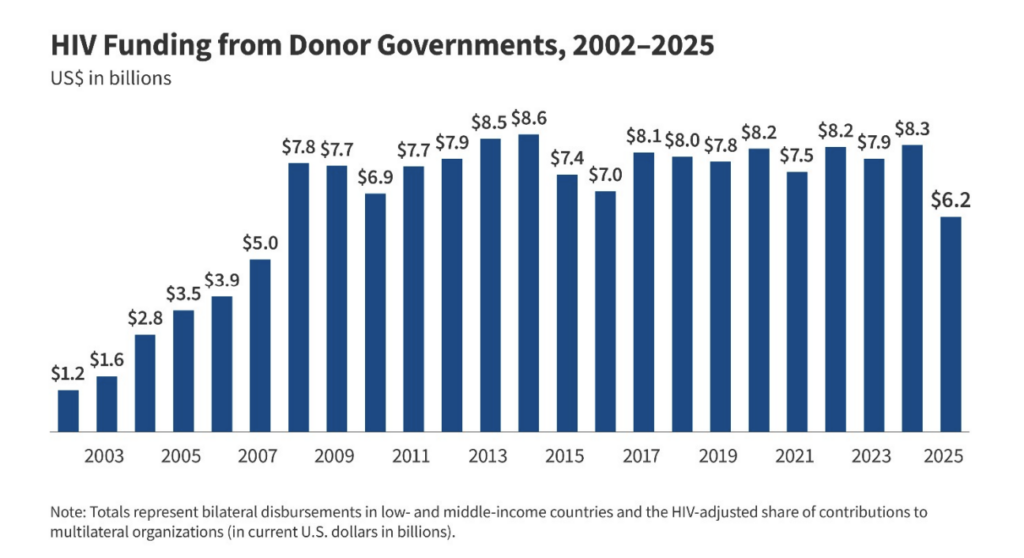
RIO DE JANEIRO – Donor funding for HIV dropped by 25% in 2025 – a staggering drop of $2.1 billion – driven by the United States slashing its funding, according to analyses by KFF and the Joint UN Programme on HIV/AIDS (UNAIDS).
This is the largest single-year drop ever, reducing funds to 2007 levels, according to the reports released shortly before the opening of the International AIDS Conference on Monday.
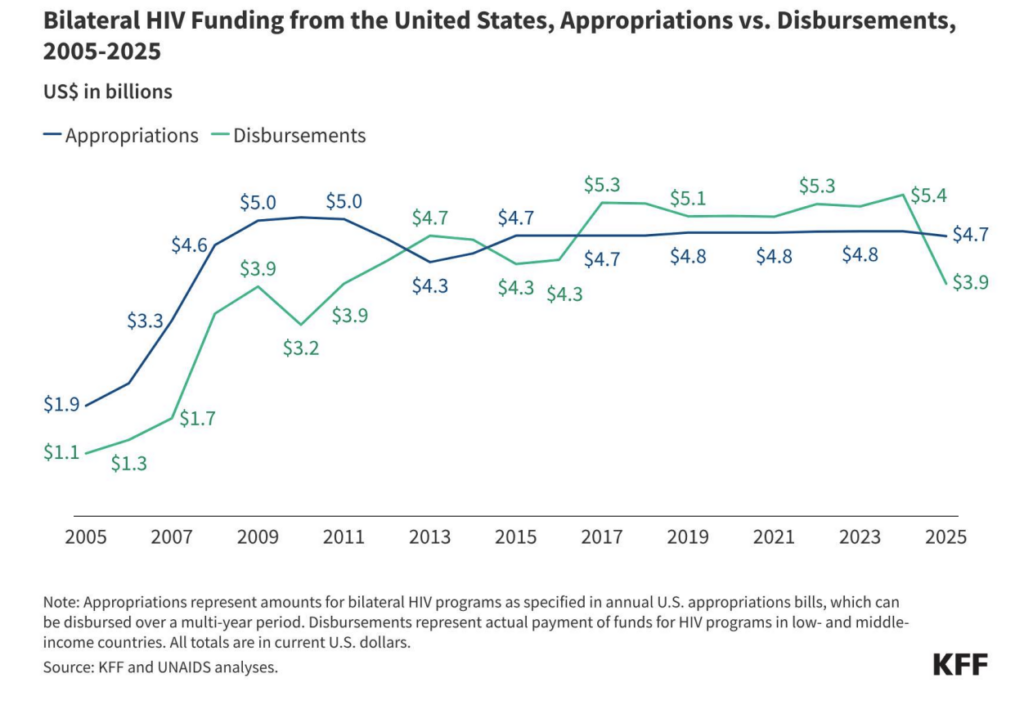
In 2025, US disbursements for HIV totalled $4.6 billion, down from $6.7 billion in 2024.
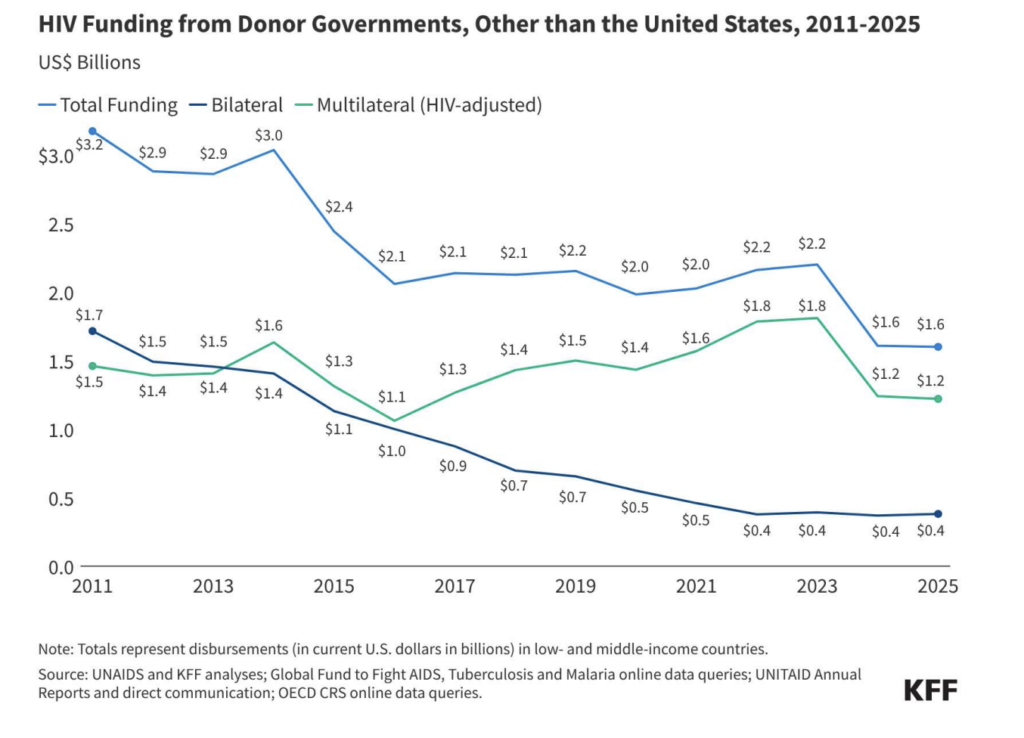
Although spending from HIV’s other key donors remained steady in 2025 (at $1.6 billion), they had already halved their aid since 2011 ($3.2 billion).
The US remains the largest HIV donor to HIV in the world, and its total donor government funding for HIV has risen from 59% in 2011 to 74% in 2025 in the face of other donors’ retreating commitments.
France, the UK, Japan, and Germany are the other major HIV donors. However, when ranked by their contributions in relation to GDP, the Netherlands ranks first, followed by the US, Denmark, Norway, and France.
Impact on prevention
Forty-one million people were living with HIV in 2025, 1.2 million of whom were infected that year.
“Every day, around 3,400 people acquire HIV around the world. Every day, around 1,600 people die from AIDS-related illnesses. The HIV pandemic is not over. Without urgent action, it could resurge,” Byanyima warned.
The funding cuts also threaten global 2030 targets – particularly to reduce HIV infections by 90% in comparison to 2010 levels.
The impact has been felt across all programmes, but prevention services have been particularly badly affected.
Pre-exposure prophylaxis (PrEP) programmes, antiretroviral medicine taken to prevent HIV transmission, and condom purchases “declined drastically and suddenly between 2024 and 2025 in some countries”, according to UNAIDS.
“In countries with a high level of HIV, funding for condom programming declined by 93%, and funding for programmes that ensure people can reach prevention services (eg supportive laws, regulations and policy environments) reduced by 80%,” said UNAIDS.
In Cameroon, Nigeria and Zambia, the number of people receiving PrEP declined by more than 50%.
Meanwhile, a poster presented at the AIDS2026 conference estimates that over 75,000 people will become infected with HIV within a year as a consequence of full withdrawal of the US President’s Emergency Plan to Fund AIDS Relief (PEPFAR) and no additional government or international support. Zimbabwe has been unable to reach agreement with the US on new HIV funding.
“Efforts to reach the 2030 targets are threatened by converging crises, including declines in external financing, high debt burden in the countries most affected by HIV, a growing number of humanitarian crises and displacements globally, emerging epidemics such as Ebola, and a backsliding on human rights and gender equality, which all impact HIV services,” according to UNAIDS.
Domestic funding is not enough
UNAIDS indicates that around 60% of the HIV response is now funded by domestic resources.
Dr Joe Phaahla, South Africa’s Deputy Minister of Health, said that African countries were continuing to strengthen domestic investment.
However, Phaahla warned that the 25% cut in a single year had forced African governments “to make very difficult prioritisation decisions at a very high speed”.
The cuts have affected “the availability of medicines, commodities, pre-exposure prophylaxis and treatment commodities, and community health workers, surveillance and data systems”, he added.
“No country can replace the scale of international partnership that has driven the global HIV response for decades,” warned Phaahla. “Ending the HIV pandemic will require stronger domestic financing, sustained international support and shared responsibility.”
Decades of progress in jeopardy
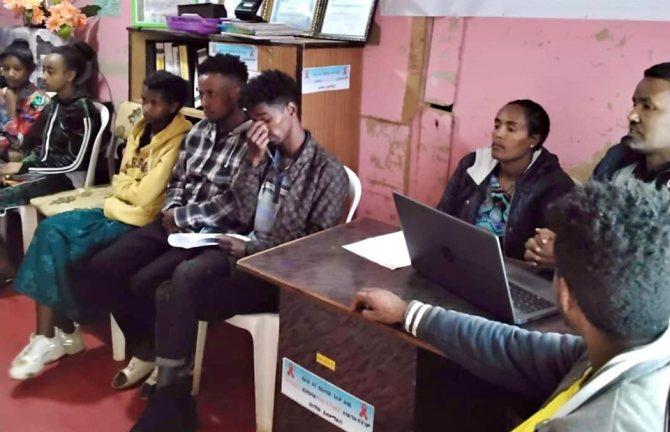
The funding cuts threaten decades of progress, Byanyima warned.
“Since the peak of HIV, new infections have fallen by 65% and AIDS-related deaths have fallen by 73%. More than 28.5 million lives have been saved through antiretroviral treatment. Today, 32.1 million people are receiving life-saving treatment, the highest number in history,” said Byanyima. “This is one of the greatest public health achievements of our lifetime. But let’s be clear: progress is not the same as victory.
“Last year, 1.2 million people acquired HIV, 570,000 people died from AIDS-related illnesses, and 8.9 million people with HIV are without life-saving treatment, and nearly 45% of children living with HIV are still not on treatment.”
Dr Tedros Adhanom Ghebreyesus, Director-General of the World Health Organization (WHO), described progress against HIV as “fragile”.
“We have the tools, the knowledge and the evidence to save lives and prevent new acquisitions. The challenge now is to sustain the commitment, investment and solidarity needed to reach every person who needs prevention, testing, treatment and care, and to finish the job,” said Tedros, who also called for “key populations” most at risk of HIV to be decriminalised.
Swing to the right
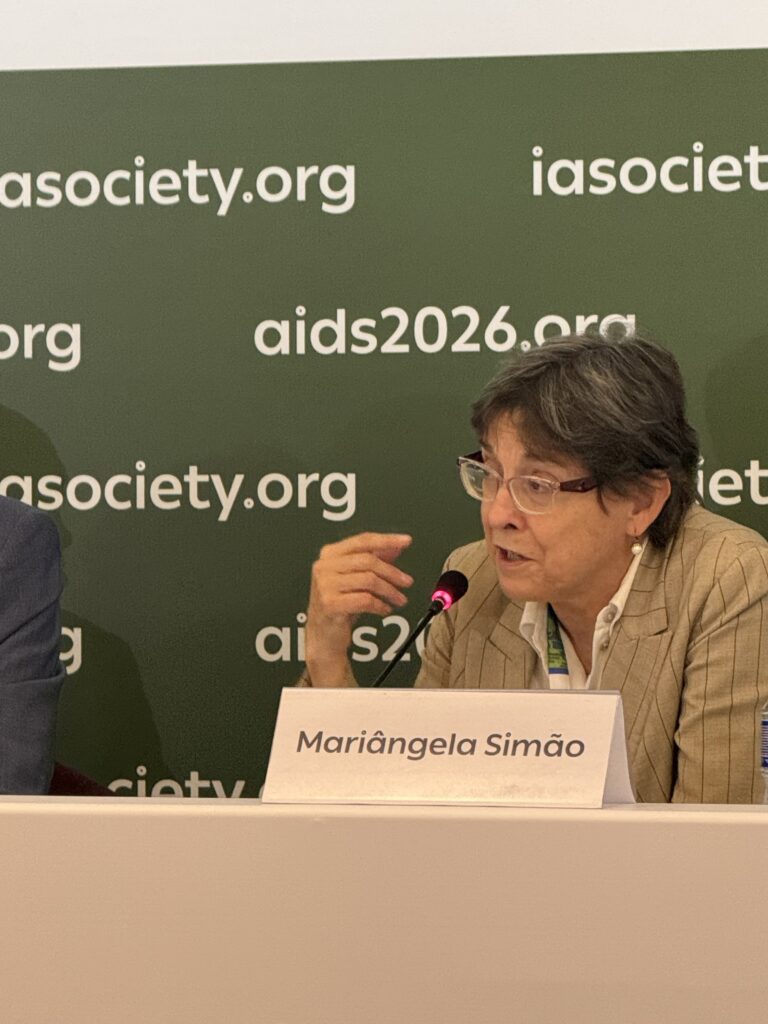
Dr Mariângela Simao, Brazil’s Secretary of Health and Environmental Surveillance, said the funding crisis was partly due to the “increasingly conservative world”.
“We are seeing that conservative ways tend to criminalise or punish people that are different, [and] create problems for access to the treatment people deserve. The human health to right the right to health is a human right,” she added.
Erika Castellanos, executive director of the Global Action for Trans Equality (GATE), who has been living with HIV since 1995, supported Simao.
“I have watched medicines transform HIV from a death sentence into a manageable health condition, but I have also watched people die while those medicines existed,” said Castellanos.
“I have watched many of my friends die while those medicines existed. Science did not fail my friends. Science did not fail those people. Politics did. Survival is determined by a healthcare system recognising our humanity, a government considering our lives worth protecting, and a world that is willing to pay the cost of keeping us alive.”
End of UNAIDS?
UNAIDS itself faces an uncertain future amid a United Nations-wide funding crisis. As part of his UN80 reform plan, the UN Secretary-General has proposed “sunsetting” the programme by the end of this year and “mainstreaming capacity and expertise into relevant entities of the United Nations development system in 2027”.
However, International AIDS Society (IAS) president Dr Beatriz Grinsztejn said that losing UNAIDS would be a “big mess”, particularly for tracking data on HIV.
Grinsztejn acknowledged that UNAIDS would likely need to scale back further, but “we do need UNAIDS to stay in place, and we hope that this can be the final decision”.
“We already have a big issue that most of the systems are not in place anymore for us to understand the numbers: the number of infections, the number of deaths, the number of people on treatment and on prevention.”
UNAIDS has already slashed staff by around 55%, and its Geneva head office has been massively reduced.
The UNAIDS Programme Coordinating Board (PCB) has set up a working group to develop “a plan on the further transition and integration of UNAIDS into the UN system and beyond, in coherence with the UN80 Initiative and based on a realistic financial scenario” by October.
The working group is mandated to identify “functions and units to be transferred, transformed, downsized, merged, decentralised, and/or absorbed by the UN system and other stakeholders”.
How to preserve UNAIDS functions
However, the PCB has stressed that UNAIDS core functions “must be preserved and safeguarded either together in a single unit or with individual UN entities”. It also directs the working group to ensure the “preservation of the role of communities and civil society”, a hallmark of UNAIDS operations.
The PCB has also tasked UNAIDS executive director Winnie Byanyima with preparing a 2027 workplan and budget “aligned with the ongoing downsizing and informed by the plan of the working group”.
Addressing the PCB earlier this month, Byanyima said: “Even in a complex global political context, UNAIDS still has that unique power to unite the world behind a shared vision to end AIDS as a public health threat by 2030.
“We will not deliver on that promise through institutions alone. We will deliver it through people, through the communities who refuse to be invisible, through the staff who carry this mission every day, through leaders in governments and partner organisations acting with courage in the face of uncertainty.”
While the international AIDS conference has scaled back significantly in recent years, the Rio conference has still managed to attract 7,000 delegates, under the theme“rethink, rebuild, rise”,
Image Credits: UNAIDS.
Combat the infodemic in health information and support health policy reporting from the global South. Our growing network of journalists in Africa, Asia, Geneva and New York connect the dots between regional realities and the big global debates, with evidence-based, open access news and analysis. To make a personal or organisational contribution click the donate button below.