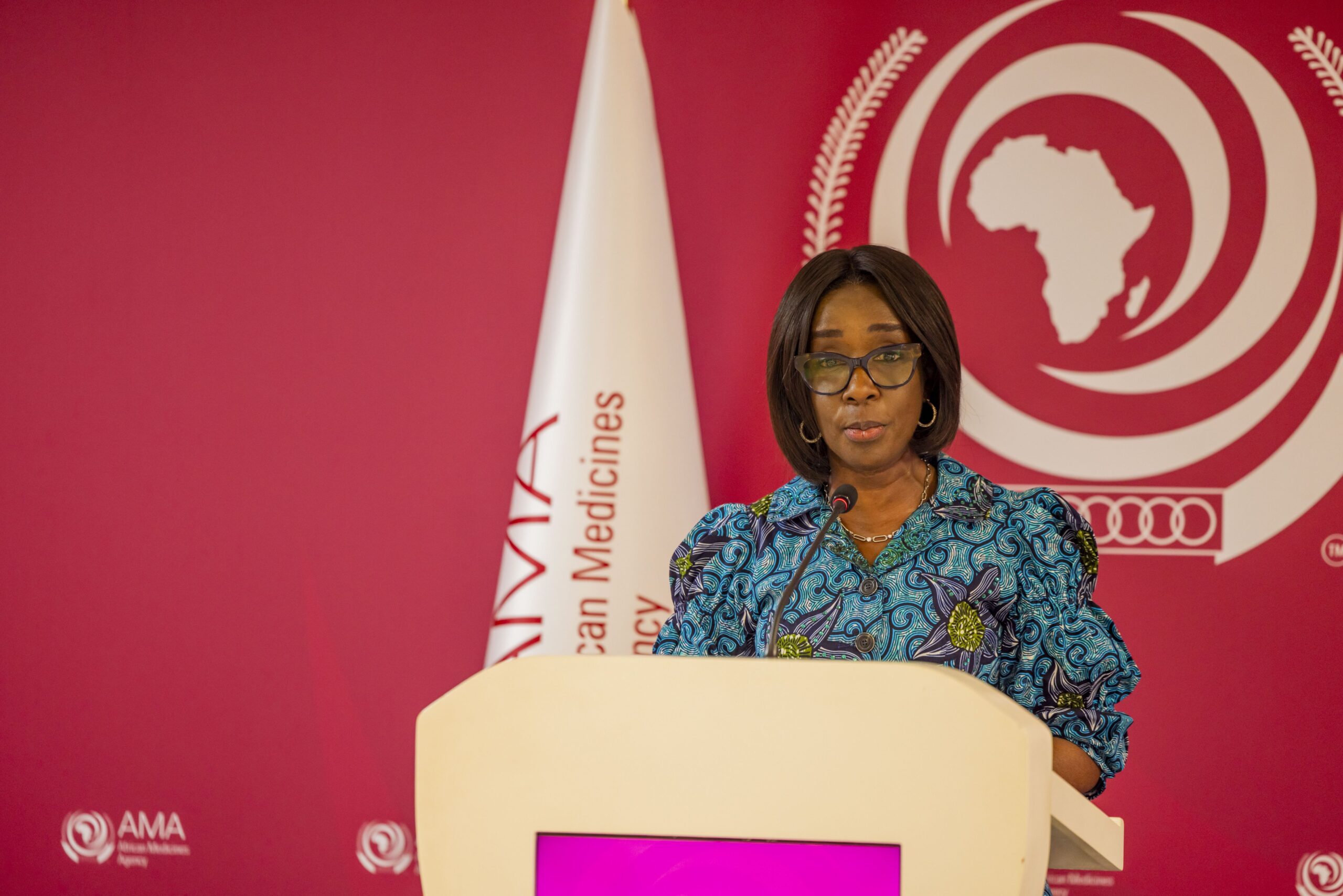
When the African Medicines Agency became operational in Kigali in October 2025, it inherited one of the continent’s most difficult health-policy problems: how to make medicines regulation faster, more trusted and less fragmented across 55 African Union member states.
For years, African countries have relied on a patchwork of national regulators, regional harmonisation initiatives, WHO prequalification, collaborative registration procedures and external pathways such as Swissmedic’s Marketing Authorisation for Global Health Products. Those systems have helped accelerate access to some products, but they have not removed the deeper problem of fragmentation.
For Dr Delese Mimi Darko, the inaugural Director General of the African Medicines Agency (AMA), the issue is not that Africa lacks regulatory expertise. It is that the expertise is unevenly distributed and poorly coordinated.
“AMA is not there to replace any national agency,” Darko explains. “It is there to coordinate them to ensure that their impact or their strengths are magnified as a body.”
In an interview with Health Policy Watch in London on the sidelines of the Global Vaccine Manufacturing Summit, Darko discussed whether the agency is already operating, what it can offer beyond existing reliance pathways, how it is being built institutionally, whether it can function as a single continental regulatory channel, why ratification still matters, and how it is being drawn into the response to the Bundibugyo Ebola outbreak.
This interview has been edited for length and clarity.

Health Policy Watch: Is AMA actually operating yet?
Darko: Yes. AMA was operationalised in October 2025, when I assumed office in Kigali. We now have 33 member states that have ratified the treaty out of 55.
Treaty ratification is one of the main things we must ensure happens if we want the impact of having a continental agency to be felt. All 55 have to ratify. We have a ratification envoy who will be going around to encourage ratification.
Part of what AMA is doing is that there is going to be continental approval of certain products. AMA does not do everything. AMA focuses on complex products, vaccines and products of public health importance.
If AMA is able to do a centralised approval of a new vaccine, for countries to benefit from it in the general pathway, they would have to be state parties. That means they should have signed and ratified the treaty.
The second major priority is capacity strengthening of national regulatory authorities, because at the end of the day, the product is not going to end up only in Kigali. It is going to end up in Nigeria, South Africa or wherever it is used.
Local national regulatory authorities are the ones who must ensure that the product is of the right quality, that what was approved is what actually enters the country, and that quality, safety and supply chains are monitored.
Health Policy Watch: WHO already has collaborative registration procedures, and Swissmedic has its MAGHP process. What can AMA offer beyond those pathways?
Darko: Those pathways are important, but AMA is trying to do something different.
WHO’s collaborative registration procedure and Swissmedic’s MAGHP process are reliance and collaboration mechanisms. They allow national regulators to draw on assessments or participate in reviews involving other trusted authorities.
AMA is meant to be different because it is a treaty-based African institution built around African regulators themselves. It is not just an external pathway through which countries rely on a decision taken elsewhere.
We are building a system where African regulators are part of the process, where their expertise is used, and where the outcome strengthens the continent’s regulatory capacity.
Africa does not lack expertise. A high proportion of people who do prequalification for WHO are from the African continent. The problem is not expertise. The problem is coordination of that expertise and ensuring it is used properly.
AMA has set up a Regulatory Innovation and Market Readiness Office, where sponsors and innovators can come for early scientific advice. The idea is to bring regulators into the process earlier, before a product has reached the end of development and before regulatory questions become delays.
The aim is not to duplicate existing mechanisms, but to bring African regulators into the process earlier and more systematically.
Health Policy Watch: How is AMA set up institutionally?
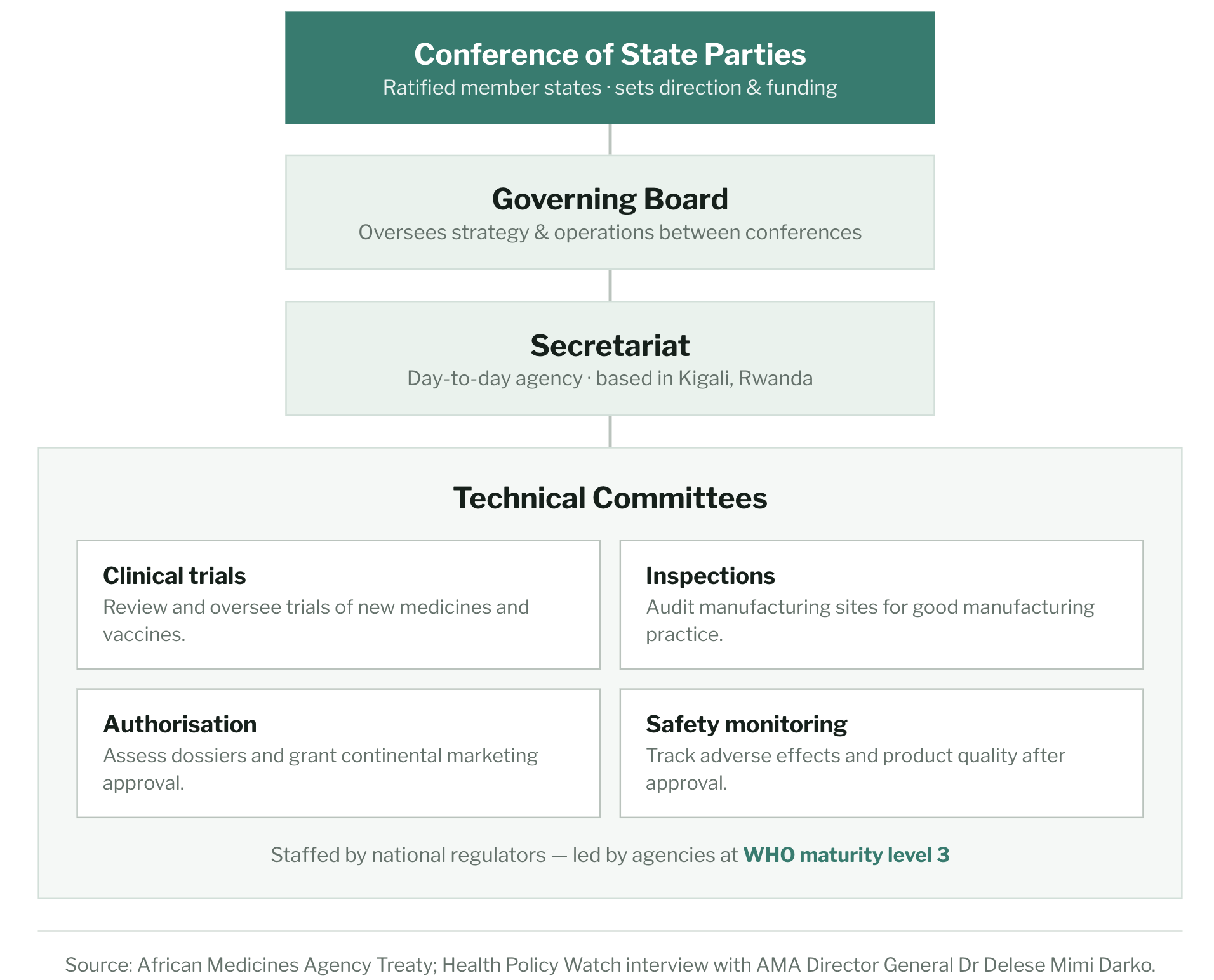
Darko: AMA has the organs set out in its treaty: the Conference of State Parties, the Governing Board, the Secretariat and Technical Committees. The Secretariat is based in Kigali. Operationally, however, our work is built around coordination with national regulatory authorities.
We have a network of the current [countries on the continent with] WHO maturity level three agencies (the second highest level in terms of regulatory agency capacity), and they are going to be the initial backbone of the work AMA does. When AMA gives a scientific opinion or a recommendation for a product to be put on the market, we will start with those agencies.
But even apart from them, there are agencies that may not have been fully assessed by WHO but have expertise in areas such as good manufacturing practice, inspections or clinical trials. We will use those as well.
AMA will also work through technical committees. These include committees for clinical trials, inspections, authorisation and safety. Those committees are made up of national regulatory authorities and focal persons from those agencies.
AMA is a coordinating body, ensuring that regulators can come together and maximise their impact.
Health Policy Watch: How is AMA being financed sustainably?
Editor’s note: A detailed public breakdown of AMA’s current budget, staffing and long-term revenue mix has not yet been published. The AMA Treaty gives the Conference of State Parties responsibility for setting annual and special contributions from state parties to the agency’s budget. Public reporting has also referred to seed contributions from state parties and partner support for AMA’s operationalisation.
That leaves two related questions: how AMA sustains its own headquarters, secretariat, technical committees, digital systems and scientific review functions; and how the national regulatory authorities that AMA depends on are strengthened, because the continental agency cannot function well if national agencies remain under-resourced.
Darko: AMA is only as strong as its agencies. The stronger we make them, the better it is for us, and the more value we add.
Can AMA act like a single regulatory review channel, similar to the European Medicines Agency (EMA)?
Darko: That is the ambition, but AMA is not simply copying the EMA model. Africa has 55 member states with very different legal systems, regulatory capacity and treaty status. Some countries have ratified the AMA Treaty, some have signed but not ratified, and others have not signed.
So AMA cannot yet function as a full single channel for every country in the way some people may imagine.
The goal is that manufacturers and developers should not have to duplicate 55 separate mechanisms or go to 55 countries for approval. We are building a network so that one application can serve the continent, while still strengthening national regulators. See related content here:
AMA adds the most value for products where expertise is unevenly distributed across countries. If a company is making antibiotics or paracetamol, AMA does not necessarily need to get involved because there may be no added value.
But if a company is working on vaccines, complex products, or products of public health importance such as malaria or tuberculosis tools, that is where a centralised approach can help products go quicker and reach everyone who needs them.
The central point is that AMA works with national regulators; it does not replace them. Every piece of work we do links back to the national regulatory agencies. They give us focal persons. They do the work with us. AMA’s role is to coordinate, support and strengthen.
Health Policy Watch: Some of Africa’s largest countries have been slow to sign or ratify. Why does treaty status matter?
Darko: When Covid struck, when Ebola struck, DRC was not a ratified country. The benefits of AMA are to add value to every country, so if the countries are not there, you will not feel the full impact of what AMA does. When the disease is going into a country, it doesn’t care whether it’s a ratified country or not.
If AMA wants to build capacity on the continent, AMA, by legislation, can really only work with ratified countries. So if I am building capacity and you are a country that has not ratified, you have a problem.
If you take South Africa that has not ratified, it’s a big country, it has capacity. But if South Africa manufactures a product that’s going to be available in all the countries, if you are not a ratified member, the benefits go both ways, for the country and for AMA.
It matters to us. We want to stand united as one continent.
Health Policy Watch: Some national regulators have worried that AMA might take over their authority. How are you addressing that?
Darko: Sometimes there is a fundamental thought that if AMA is there, then national agencies will no longer exist.
We have tried to create awareness by working directly with the heads of agencies. We brought them together and developed our five-year strategy with them. Our IT strategy was also developed with them.
We are not working without the agencies. That has given many of them confidence that they are part of AMA.
AMA is there to add value. We continually speak with the heads of national regulatory agencies and ask where they need impact and where AMA can add value. Many countries have not ratified not because they do not want to join, but because the process is long. It goes through parliament, legislative structures and attorneys general.
The way we convince them is by showing that AMA is built with the agencies, not above them.

Health Policy Watch: What is AMA’s current top priority?
Darko: The current top priority is to support capacity building for regulators on the continent.
AMA is only as strong as its agencies. The stronger we make them, the better it is for us, and the more value we add.
And it is the only way Africa can advance any strategy, whether it is health security, clinical trials or access to medical products.
If you have strong regulators, products move more quickly. Safety is monitored properly. Quality is monitored properly. The patient receives the right medication.
The most important thing for us now is getting national regulators together and ensuring there is more equitable capacity strengthening across the continent.
Once we do that, everything else follows.
Health Policy Watch: Has AMA been involved in the current Bundibugyo Ebola outbreak – noting the plans for the clinical trials of two antivirals, and most recently, trials of a vaccine candidate?
Darko: Yes. AMA has been involved in regulatory discussions around the outbreak, including work with the European Medicines Agency and African national regulatory authorities on clinical trial designs and medical countermeasures.
For an outbreak like Bundibugyo Ebola, where there are no authorised vaccines or treatments for that specific virus species, the regulatory pathway has to be prepared early. Regulators need to know which products are in the pipeline, what data may be needed, which clinical endpoints are appropriate, and how to balance speed with scientific rigour.
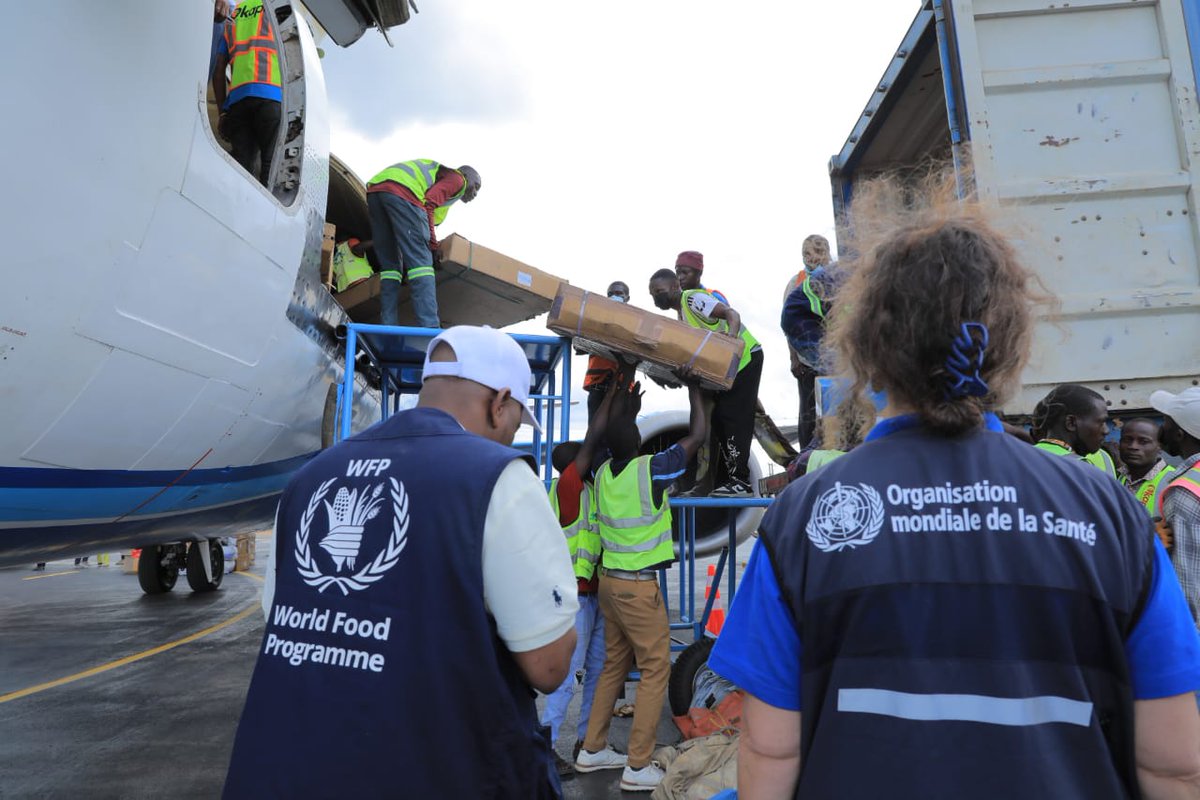
That is exactly the kind of situation where AMA can add value: bringing regulators together early so that developers and researchers are not waiting until the end of the process to find out what evidence is required.
EMA’s Emergency Task Force is working with the AMA, African national regulatory authorities and WHO AFRO’s African Vaccines Regulatory Forum on discussions covering candidate vaccines, treatments and post-exposure prophylaxis for Bundibugyo virus disease.
For AMA, the Ebola response is an early test of whether it can coordinate African regulatory input during a fast-moving public health emergency, rather than leaving each national regulator to work separately.
Health Policy Watch: What would success look like for AMA over the next few years?
Darko: The current top priority is to support capacity building for regulators on the continent. That is the only way AMA will be strong, and it is the only way Africa can advance any strategy, whether it is health security, manufacturing, clinical trials or access to medical products.
If you have strong regulators, products move more quickly. Manufacturing is done according to the right quality. Safety is monitored correctly. Quality is monitored correctly, and the patient receives the right medication.
The most important thing for us now is getting our national regulators together and ensuring that there is more equitable capacity strengthening on the continent. Once we do that, everything else follows.
At the end of the day, everything we are doing is about the patient. We also need to ensure that all 55 member states have signed and ratified the treaty.
“If you have a strong regulator, your products go quickly,” Darko said. “Your safety is monitored correctly. Your quality is monitored correctly. The patient receives the right medication.”
Image Credits: Rwanda MoH, Rwanda Ministry of Health, African Medicines Agency , @WHO African Region.
Combat the infodemic in health information and support health policy reporting from the global South. Our growing network of journalists in Africa, Asia, Geneva and New York connect the dots between regional realities and the big global debates, with evidence-based, open access news and analysis. To make a personal or organisational contribution click the donate button below.