Dr Jean Kaseya is campaigning to be reappointed as Director-General of the Africa Centres for Disease Control and Prevention (CDC) – amid serious allegations of threats to diplomats, staff intimidation, lavish spending and a shrinking budget.
Eight highly placed sources, mostly CDC staff or former staff, told Health Policy Watch that Kaseya has threatened two very high-profile AU female diplomats; removed and reassigned staff who question his decisions; and appointed staff without following proper procedures.
Four other staff or former staff spoke through intermediaries or shared written documentation. All spoke on condition of anonymity for fear of reprisals.
In addition, the financial management letter for 2025, issued by the African Union’s Board of External Auditors and seen by Health Policy Watch, flags 49 flaws in the year’s financial management processes.
The letter does not give the overall budget for the year 2025 but cites a cash balance of just $52.9 million at the end of 2025, while Africa CDC’s Annual Report for 2025 said it was managing a “grant portfolio” of $463 million.
Automatic re-appointment?
Kaseya’s term ends in February, and he could be reappointed for another four years if the Africa CDC governing board recommends this to African Union (AU) Heads of State, and the AU Assembly accepts this.
However, a brand-new group of eight AU member states, represented by their health ministers, has just joined the CDC governing board as part of the periodic shuffle of membership.
The new members, who attended an orientation meeting on 10 November, are from Cameroon, Gabon, Gambia, Kenya, Namibia, Sierra Leone, Uganda and Zimbabwe. (North Africa has not yet nominated its two representatives.)
The governing board is due to discuss Kaseya’s reappointment at its first official meeting on 22 November – apparently based on an April assessment conducted by the AU Commission Chairperson. Outside observers expect the process to be a virtual rubber-stamp.
“The governing board of Africa CDC can do an evaluation of the DG. And, if all agree, they can recommend to the [AU] Committee of Heads of State to reappoint him,” Dr Claudes Kamenga, Kaseya’s Chief of Staff, told Health Policy Watch.
Staff petition against reappointment

A petition from “concerned senior staff” circulated last week urges the governing board and the AU Permanent Representatives Committee (PRC) not to reappoint Kaseya. Health Policy Watch received the petition from several credible sources who vouch for its authenticity.
The petition claims that a performance appraisal of Kaseya completed in April has legal and procedural problems, and should not be the basis for his reappointment.
The appraisal, signed by AU Commission (AUC) Chairperson Mahmoud Ali Youssouf, covers Kaseya’s entire period of office (2023-2026), although Youssouf only took office in March 2025. It was also completed before the current Ebola outbreak, one of the biggest challenges of Kaseya’s term so far.
The petition-writers say that they have “direct knowledge of Africa CDC’s operations, management and regulatory framework”. They defended their anonymity, citing fears of “retaliation and victimisation”, noting that their action is within the parameters of AU whistleblower regulations.
Lingering questions remain about Kaseya’s initial appointment almost four years ago. He was not the highest-ranked candidate – former Guinea-Bissau Health Minister Dr Magda Robalo was, and she questioned why she was overlooked.
At the time, Rwandan President Paul Kagame wrote that “no debate was allowed” on Kaseya’s appointment and that it was the only agenda item on which discussion was “forbidden”, according to a letter he sent to the AU Commission Chairperson in March 2023.
In its written response to Health Policy Watch, Africa CDC referred to sections of the Africa CDC Statute which set out that the DG undergoes a “selection and appointment process”, not election.
Alleged threats to female diplomats
Three highly placed sources told Health Policy Watch that Kaseya threatened two very senior female AU Commission diplomats in front of several witnesses. Security personnel intervened in at least one of these incidents, the sources said.
Health Policy Watch knows the identities of both diplomats and reached out to them for comment but did not get a response at the time of publication.
The sources also said Kaseya was told to take leave after the second incident. However, the staff petition claims he was suspended for 10 days after “inappropriate conduct” towards an “AUC official”, and asks why this was not noted in his appraisal.
While Africa CDC did not respond to Health Policy Watch questions about whether Kaseya has threatened any female AU diplomats, it stressed that he “has never been suspended, sanctioned or placed on administrative leave since taking office in April 2023”.
“The Director General, as an elected official, cannot be suspended or asked to take leave (by whom?) without a proper procedure that is written, with accusations formally formulated and known to the AU policy organs,” noted Africa CDC in a written response to questions.
“It is not credible that the supervising authority and the [AU] Assembly would publicly commend an official whom they had, in the same period, suspended or sent on leave for misconduct,” added Africa CDC.
‘Toxic work environment’
Ten current and former staff told Health Policy Watch that the work environment at Africa CDC is “toxic”, fuelled by fears that Kaseya and his inner circle will remove or reassign anyone seen to question his actions or obstruct his ambitions.
They claim there is high staff turnover and that staff are often reassigned. For example, there have been five Chiefs of Staff in less than four years. In 2024, 14 staff resigned, including the Deputy Director General and five directors. Several said poor working conditions drove them away.
One staff member said almost all staff are on annual contracts with renewals requiring the Director-General’s approval.
In August, the Nigerian-based organisation African Health Initiative Advocacy (AHIA), wrote to the AU Permanent Representatives Committee (PRC) in August asking for an independent review of “recent appointments, recruitment practices, organisational changes and staff management” at Africa CDC.
There is a “growing sense among staff that they are not adequately protected when raising legitimate concerns about institutional practices,” according to the letter, obtained by Health Policy Watch.
It claimed that staff members are “being intimidated or placed under significant pressure, with some employees reportedly reaching the point of resigning because of the working environment and the pressure they experience”.
The organisation also flagged an increase in appointments of limited duration (ALD), made “without transparent competitive recruitment”, to fill positions of staff who did not have their contracts renewed despite performing well. It also claims that advisors have been appointed and assigned functions that are usually performed by directors and heads of departments.
Expanding not contracting
Africa CDC disputes that there has been a high turnover of senior staff, claiming that only two directors have left while seven have been recruited since Kaseya took over as DG in 2023.
“On the contrary, the institution is retaining its people and growing. It has expanded substantially over the past three years,” the body said, reporting that the staff complement has expanded from 262 staff in 2023 to 620 in 2026.
“This reflects its enlarged mandate, new functions and recruitment across the continent”, it told Health Policy Watch.
In response to criticism of arbitrary staff reassignments, Africa CDC notes: “[In] any institution that grows this fast, some colleagues change roles, some complete fixed-term contracts and some move on to other opportunities. This is normal career movement; it is not high turnover and it is not a sign of instability.”
Only 37 staff “hold posts approved and paid for by member states”, according to CDC. The remainder of staff are funded by major donor projects, and when those end, then so do the assignments.
For instance, a $1.1 billion five-year MasterCard Foundation grant for the “Saving Lives and Livelihoods (SLL) initiative ended in June, resulting in significant job losses.
At the same time, the Ebola outbreak has required the deployment of new field personnel – and is likely a major factor in the creation of new positions in 2026. Africa CDC alludes to this, telling Health Policy Watch: “In an active outbreak, speed is decisive, and the ALD [appointments of limited duration] modality allows qualified personnel to be deployed quickly”.
While several critics complained that Kaseya is appointing staff outside the agreed organogram, Africa CDC contends that “positions outside the approved structure are not irregular positions: they are a category that the rules expressly provide for, tied to partner funding”.
In response to Health Policy Watch queries about Kaseya not allowing discussion about his decisions, Africa CDC responded that “decision-making at Africa CDC is structured, collective and documented, and decisions are discussed at every level”, citing weekly, monthly, quarterly and annual staff meetings.
Standoff with African Union Tribunal
For several months, there has also been a formal standoff between the Africa CDC and the African Union Administrative Tribunal after Kaseya reassigned three regional directors (RDs) to the organisation’s headquarters in February.
The RDs contested their removal, lodging a complaint with the Tribunal, which is an independent judicial body that settles disputes between the AU and its staff members. The Tribunal issued an order on 12 May suspending the directors’ reassignment and directing the “respondent “ (technically, the AU Chairperson) to keep them in their positions.
However, by then Kaseya had replaced the three regional directors with people he later designated as “Special Regional Representatives of the Director-General”. They had effectively taken over the functions of the RDs in West, Central and East Africa. These posts were never advertised.
On 20 July, AUC Chairperson Youssouf directed the three RDs to accept redeployment to the Africa CDC headquarters. Then on 26 October, the Tribunal also suspended that decision.
The Tribunal has yet to rule on two contempt filings brought by the directors against the AU Chairperson, and by extension Africa CDC, for failing to implement the Tribunal’s 12 May order.
Meanwhile, the three RDs are apparently working at home, and sources told Health Policy Watch that they have faced threats and intense pressure to withdraw their cases.
Africa CDC reiterated that the AUC Chairperson, who “exercises administrative and financial oversight of Africa CDC” in terms of the Africa CDC Statute, is responsible for handling the issue.
‘Extravagant expenditure’, financial weaknesses
In late October, before the circulation of the petition, an anonymous “policy brief” was sent to AU member states and Africa CDC donors.
The ‘’brief’’ is similar to a 2023 document that also made serious allegations against Kaseya’s leadership style. Claims made in the October brief include: “intimidation” of staff, the “diversion of emergency funds towards ostentatious spending, lavish travel and favours granted to close associates”.
Six current and past staff who spoke with Health Policy Watch echoed reports of excessive travel spending, saying that Kaseya “does not spare any expense” on international trips, including stays in suites typically reserved for heads of state.
The external auditors’ letter flagged weak control of travel spending across Africa CDC, although it does not single out Kaseya directly. For example, of the $8.8 million spent on air tickets in 2025, $1.78 million (1,608 tickets) were booked late, while 298 tickets were “irregularly” requested after the date of departure, the auditor’s letter states.
Balances in Africa CDC’s books for airline travel also did not match the airlines’ own records; the difference for Ethiopian Airlines alone was $1.56 million
In September 2025, Devex reported that an advisor’s internal email had flagged “immense amounts of funds for travel and meetings” as part of the World Bank’s five-year, $100 million grant to Africa CDC. This travel was later deemed justified by the body’s auditor.
A separate Devex report said the World Bank had raised concerns that the spending could be seen as “extravagant” and make Africa CDC look like a “travel agency”.
Campaigning conference?

The CDC governing board meeting on 22 November falls on the eve of the International Conference on Public Health in Africa (CPHIA), Africa CDC’s flagship event. Insiders see the conference as a showcase event for Kaseya’s reappointment campaign.
Some 30,000 delegates are expected, according to Kaseya’s on X on 2 November, despite the fact that Addis Ababa, the host city, only has around 25,000 hospitality beds.
The projected budget for the conference is said to run to several million dollars, but it is unclear who is funding it.
“For CPHIA 2026, [host country] Ethiopia is making a major contribution, including in-kind support, and these are not ours to quantify or to disclose,” Africa CDC told Health Policy Watch, when asked about the conference’s financial backers.
It added that fees from exhibitions, side events and registration were helping to cover costs, and it did not have “a CPHIA budget, as such”.
However, Africa CDC’s Quarter 3 Review Meeting Report, presented to staff on 15 October and shared with Health Policy Watch, reports that “$36.5 million in funding requests was pending” for CPHIA, while around $400,000 in cash and $75,000 in kind had been secured.
Several iNGOs also were approached to help sponsor people to attend the conference, and each was asked to contribute over a million dollars each, according to a source.
Meanwhile, young people who were awarded fellowships have complained that some had their fellowships revoked. However, Africa CDC said 12,000 young people applied, and it could only accommodate 4,000.
Following the CPHIA conference in Zambia in 2023, a special audit found that a Zambian company that won the bid to organise the conference for $618,638 was ultimately paid nearly $2.4 million, and that the invitation to bid had gone to only four companies, according to Devex.
Listing the financial flaws
The organisation’s 2025 annual report notes that “the grant portfolio directly managed by Africa CDC grew from $52m in 2022 to $463m in 2025, with portfolio diversification over 66 active grants”.
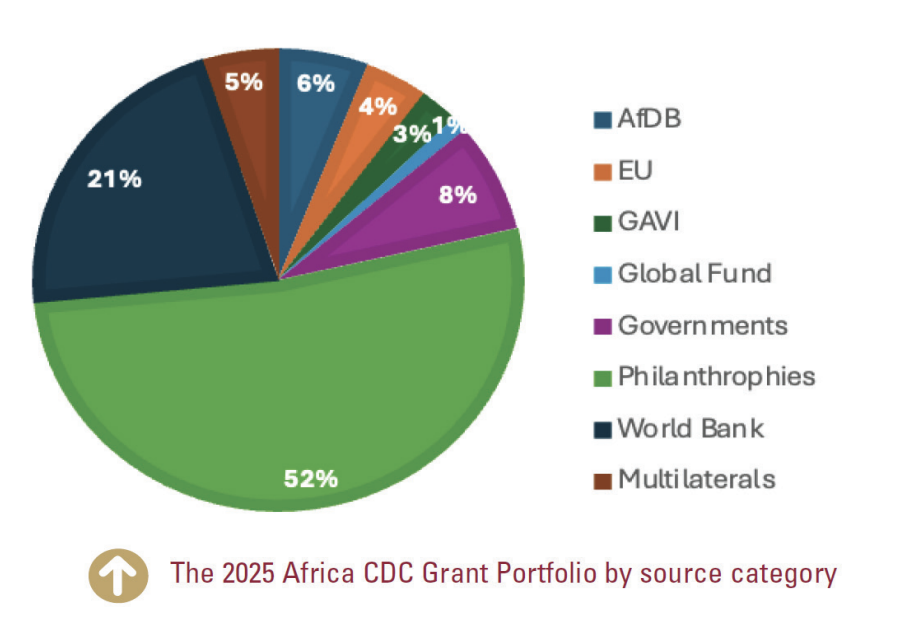
Philanthropies contribute the bulk of Africa CDC’s revenue (52%), with the remainder being made up by the World Bank (21%), African Development Bank (6%), governments (8%), Gavi the Vaccine Alliance (3%), The Global Fund to Fight AIDS, Tuberculosis and Malaria (1%), European Union (4%), and other partners (5%).
Health Policy Watch asked Africa CDC for a copy of its latest audited financial statements, but Kamenga said the organisation had no single audit for its entire budget, but rather had “seven audits this year alone”.
The external auditors’ financial management letter, dated 27 May 2026 and covering the year to 31 December 2025, gives no overall budget figure either, but reports a cash balance of $52.9 million at the end of 2025.
The World Bank’s $100 million over five years is the largest. Three years into the grant, Africa CDC had received $44.2 million and spent $39.8 million.
Twelve of the 49 flaws listed by the auditors are rated Grade 1, the most serious. These include $23.5 million in 2,013 bank reconciliation items that have not been cleared; spending against activities with no budget; no internal audit in 2025; and about $2.3 million of African Development Bank (AfDB) funded spending not recorded in Africa CDC’s accounts because the bank paid suppliers directly.
The auditors also flagged slow spending of World Bank and Gavi grants, and $5.3 million in a World Bank COVID-19 account that had been inactive since September 2025, with no decision on whether to use, reprogramme or return it.
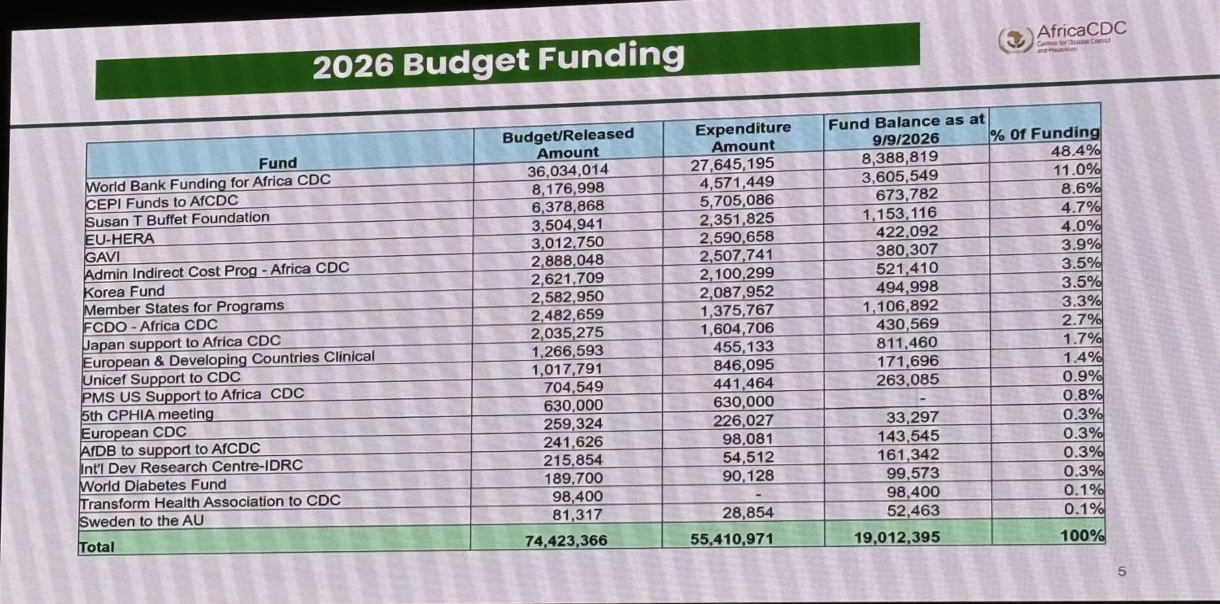
Meanwhile, internal reports of spending for 2026 reveal different budget chronologies for this year. In one recent presentation to staff, seen by Health Policy Watch, the 2026 budget was $74.4 million, and $55.4 million had been spent by 9 September.
Another internal finance document, also seen by Health Policy Watch, put the body’s total revenue for this year, including grants, Ebola funding and the Africa Epidemics Fund, at $147.7 million.
There is no published budget, and the 2025 annual report refers only to the “portfolio’ of $463 million, likely multi-year grant commitments.
History of accusations
Shortly after Kaseya’s appointment to lead Africa CDC in February 2023, the Presidency of the Democratic Republic of Congo (DRC) hailed it as a “great diplomatic victory and recognition of Congolese competence on a global scale”, adding that the appointment was “the epilogue of a long, secret diplomatic battle waged for six months by President Félix Tshisekedi”.
But a few months after Kaseya’s term started in 2023, a group calling itself the African Union Leadership Focus Group levelled similar claims against Kaseya as those made in the recent “policy brief”, including the “abuse and threatening of staff” and a “clear lack of leadership”, according to Devex. Africa CDC described the allegations as “unverified and baseless” at the time.
Previously, Devex reported on clashes between Kaseya and his former employer, the Clinton Health Access Initiative (CHAI), which decided not to renew his contract after two years as its country director in the DRC.
Additional reporting by K. Rifat Hossain.
Image Credits: DRC Presidency, Africa CDC, African Union, African Union, Africa CDC.
Combat the infodemic in health information and support health policy reporting from the global South. Our growing network of journalists in Africa, Asia, Geneva and New York connect the dots between regional realities and the big global debates, with evidence-based, open access news and analysis. To make a personal or organisational contribution click the donate button below.