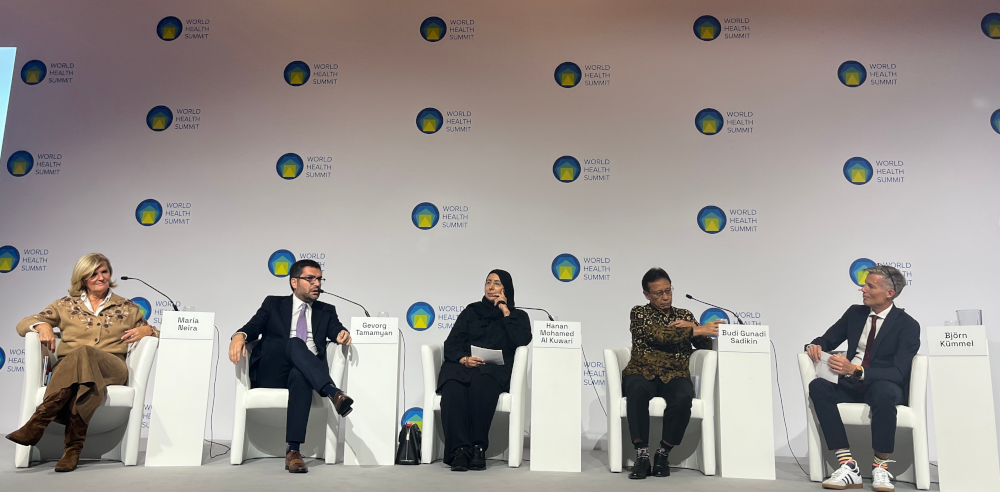
Children with cancer in wealthy countries have survival rates of around 85 percent, while in parts of Africa, survival can fall to 20 percent or 30 percent, and sometimes even lower. For Dr. Gevorg Tamamyan, an Armenian paediatric oncologist seeking to become the next director-general of the World Health Organization (WHO), the disparity illustrates one of the biggest failures of global health.
“People are dying not because of the lack of knowledge or science, but because of lack of equity, lack of access,” Tamamyan said.
Speaking on the Inside Geneva podcast, produced in partnership with the Geneva Graduate Institute’s Global Health Centre and SWI swissinfo, Tamamyan outlined his ambition to reform WHO, arguing that the organisation must become more responsive to the needs of countries and communities.
Unlike many candidates, Tamamyan comes from outside WHO and was nominated by Botswana rather than his native Armenia.
His experience treating children with cancer has shaped his approach to global health. He pointed to Armenia, where paediatric cancer survival has risen from approximately 0 percent to 5 percent in the 1990s to more than 75 percent, as evidence that improving access and strengthening local capacity can transform outcomes.
Tamamyan also questioned the pace of international health decision-making, arguing that countries cannot afford to wait years for meetings, recommendations and implementation.
“How long it takes to get these meetings? How long it takes to get these recommendations? How long it takes to implement all this? It’s years. And it’s horrible,” he said.
He called for WHO to shift its focus toward stronger country-level operations rather than concentrating authority in Geneva.
“The strongest foundation of WHO should be in the countries,” Tamamyan said.
Despite the organization’s shortcomings, he defended its importance at a time of declining international funding and growing challenges to global health cooperation.
“I’m convinced that the world is much better with World Health Organization than without it,” he said.
Listen to the full podcast:
The interview series with WHO DG candidates is being co-produced by the SwissInfo media platform with the Geneva Graduate Institute’s Global Health Centre, as part of a media collaboration on the upcoming WHO election also supported by Health Policy Watch.
See more about the candidates on Health Policy Watch’s special WHO election website.
Image Credits: Elaine Ruth Fletcher/HPW.
Combat the infodemic in health information and support health policy reporting from the global South. Our growing network of journalists in Africa, Asia, Geneva and New York connect the dots between regional realities and the big global debates, with evidence-based, open access news and analysis. To make a personal or organisational contribution click the donate button below.