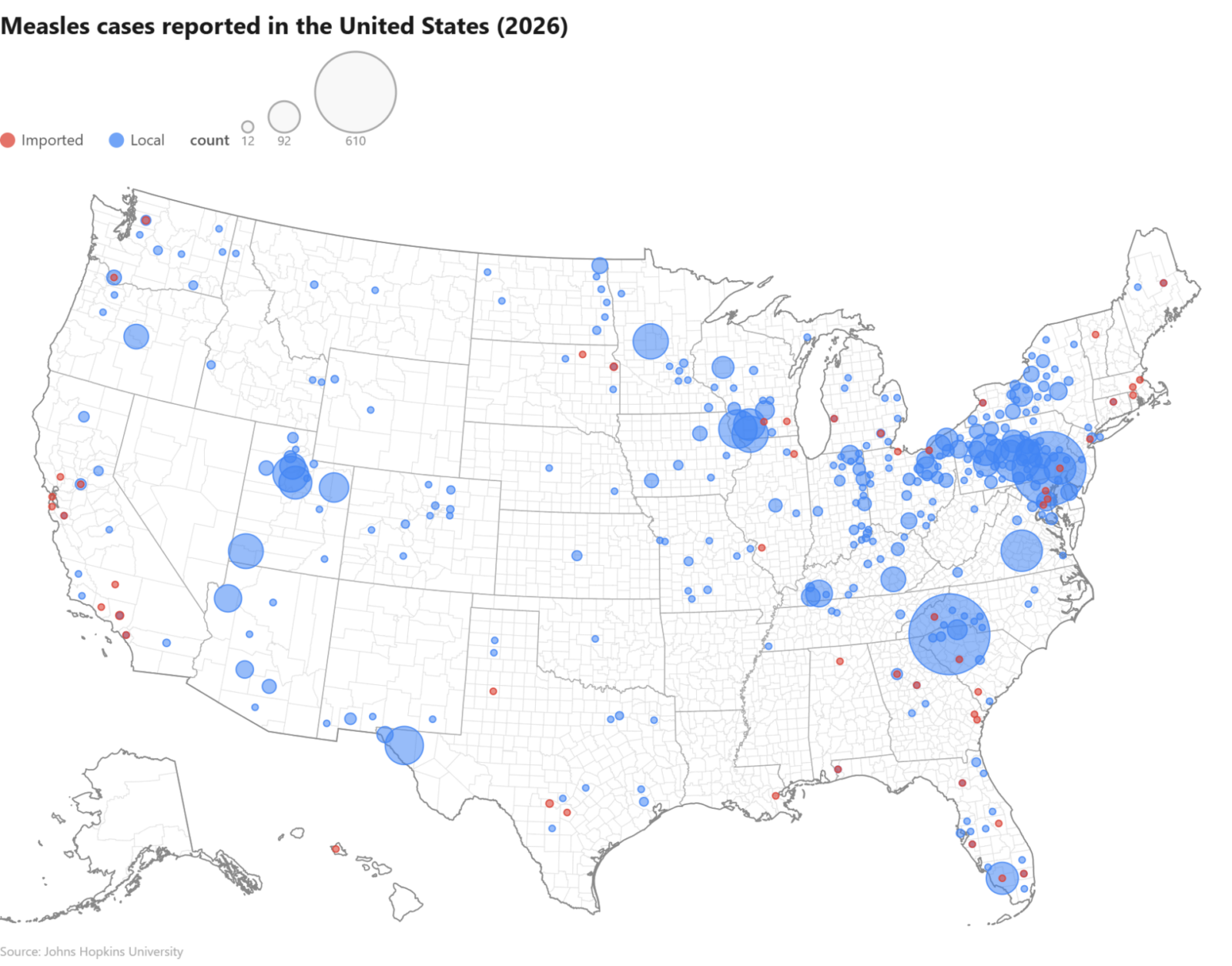
Plummeting vaccination rates have fueled a historic and prolonged wave of measles in the US – with the Pan American Health Organization expected to revoke the country’s elimination status it enjoyed since 2000. Experts told Health Policy Watch that the shifting vaccination landscape and persistent cases globally have fueled the worst outbreak since 1991.
WASHINGTON – The Pan American Health Organization (PAHO) is expected to revoke the US’s measles elimination status this week, ending a 26-year streak of little-to-no local transmission in a country that once declared victory over measles.
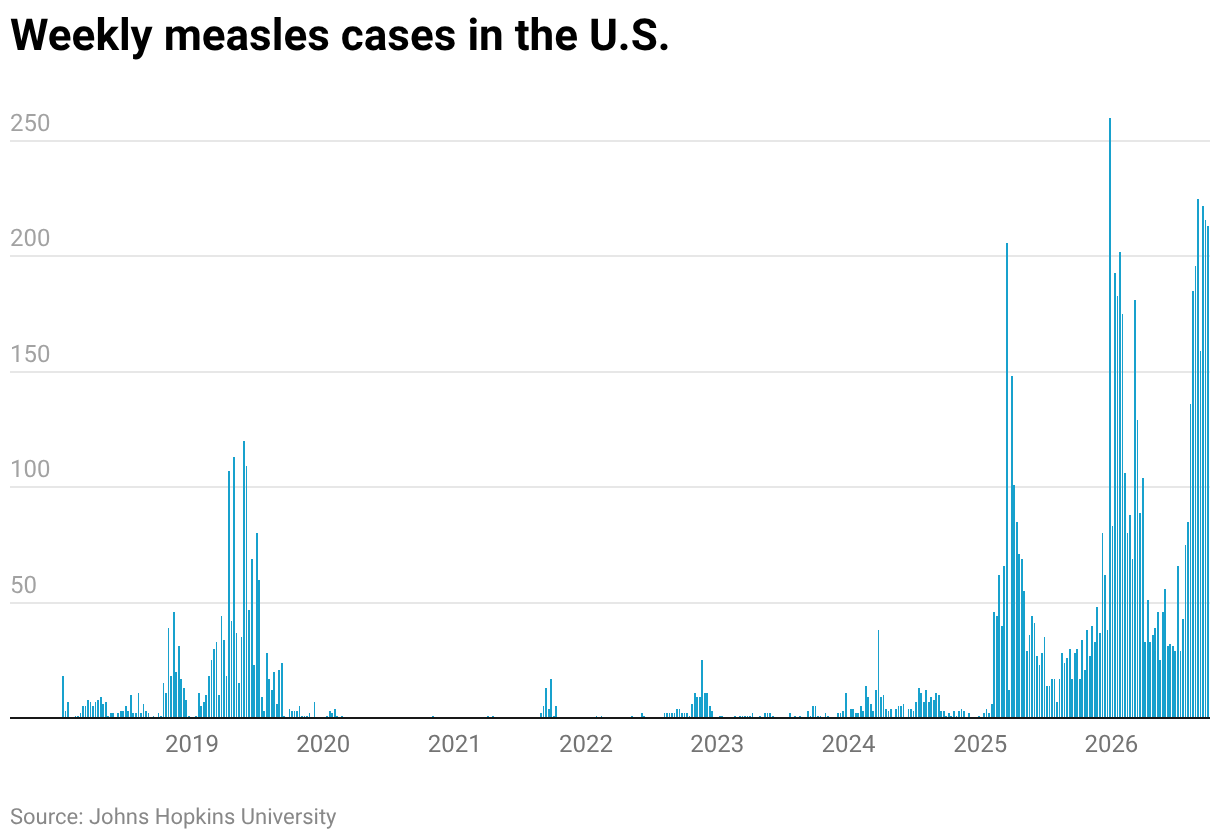
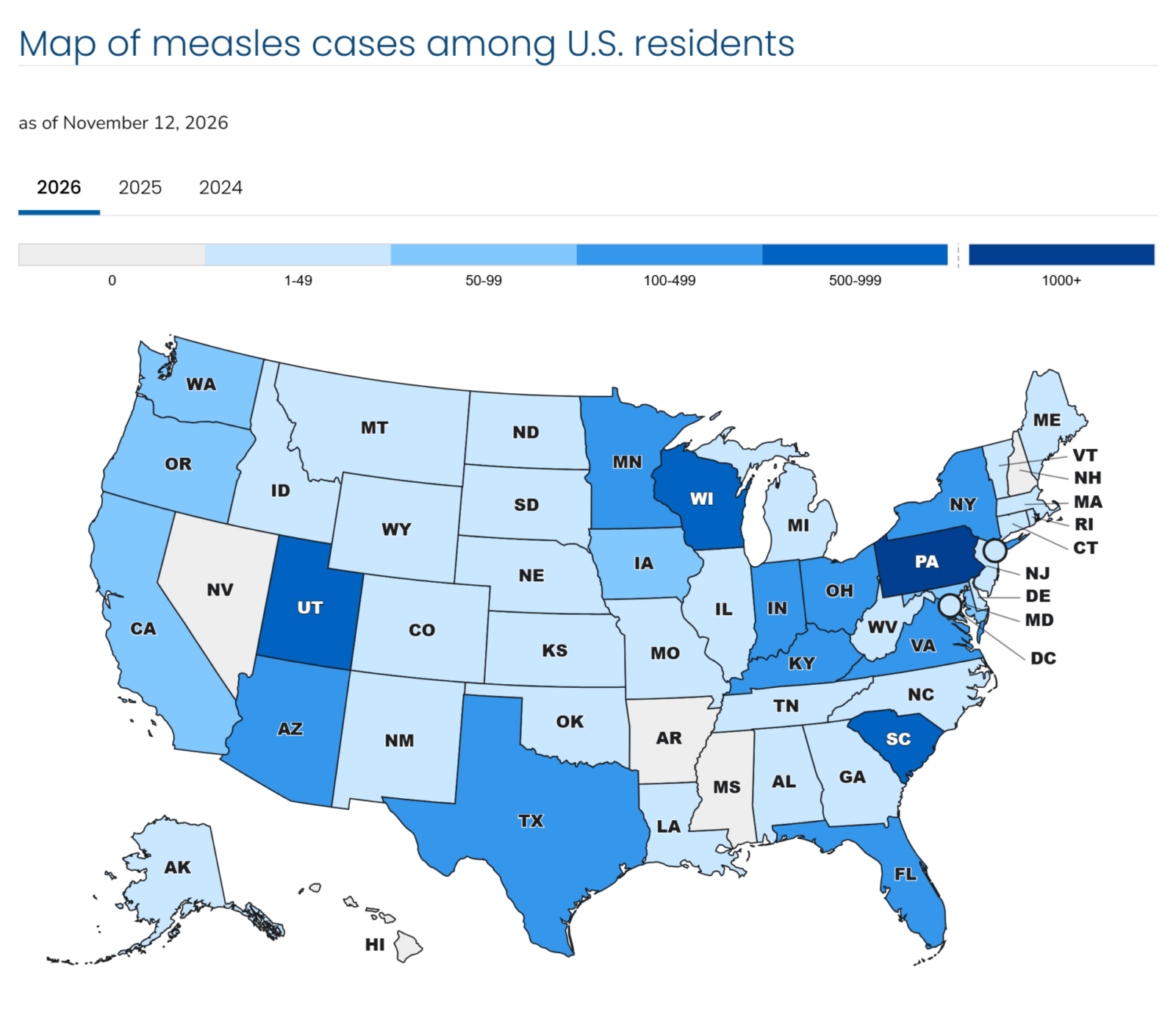
More than 5,200 cases of measles have been reported across the country by the Centers for Disease Control and Prevention (CDC) this year. Cases are likely to continue climbing. In contrast, in 2000, the year the measles was declared eliminated in the US, the CDC reported 85 cases.
Outbreaks in Pennsylvania, South Carolina, Texas, Utah, among other states have fueled governors to declare states of emergency and plead residents to vaccinate their children.
The CDC has reported six deaths from measles this year, though state and local officials in New York and Wisconsin have reported two additional deaths, bringing the total to eight deaths from the vaccine-prevantable yet highly contagious virus.
“It is unthinkable that people in the United States should be dying from measles in 2026,” said Dr Wendy S Armstrong, president of the Infectious Disease Society of America, in a statement 12 November. “For nearly 30 years, the measles virus posed little threat in the United States because of strong public health leadership and trust in science.”
At this pace, there is little question the US will lose its measles elimination status, infectious disease and public health experts told Health Policy Watch. “The only reason that the US could retain its status is through raw political pressure on PAHO,” said Dr Lawrence Gostin, distinguished university professor in global health law at Georgetown University.
PAHO experts met on the issue last week and the agency, the regional affiliate of the World Health Organization in the Americas, will announce its final decision on Tuesday.
Continuous measles outbreaks in several states
Measles elimination occurs when there is more than a year without any endemic (locally transmitted) cases of measles. It is lost when an outbreak is sustained for more than a year.
The US outbreaks, which began in early 2025 have hit states across the country, racing unabated in unvaccinated communities. Notably, this year marks the first time in several decades that the cases are primarily locally-transmitted. Prior to 2025, measles outbreaks typically began with imported cases from Americans traveling abroad, explained virologist Dr Angela Rasmussen and pediatrician Dr Anita K Patel in a newsletter.
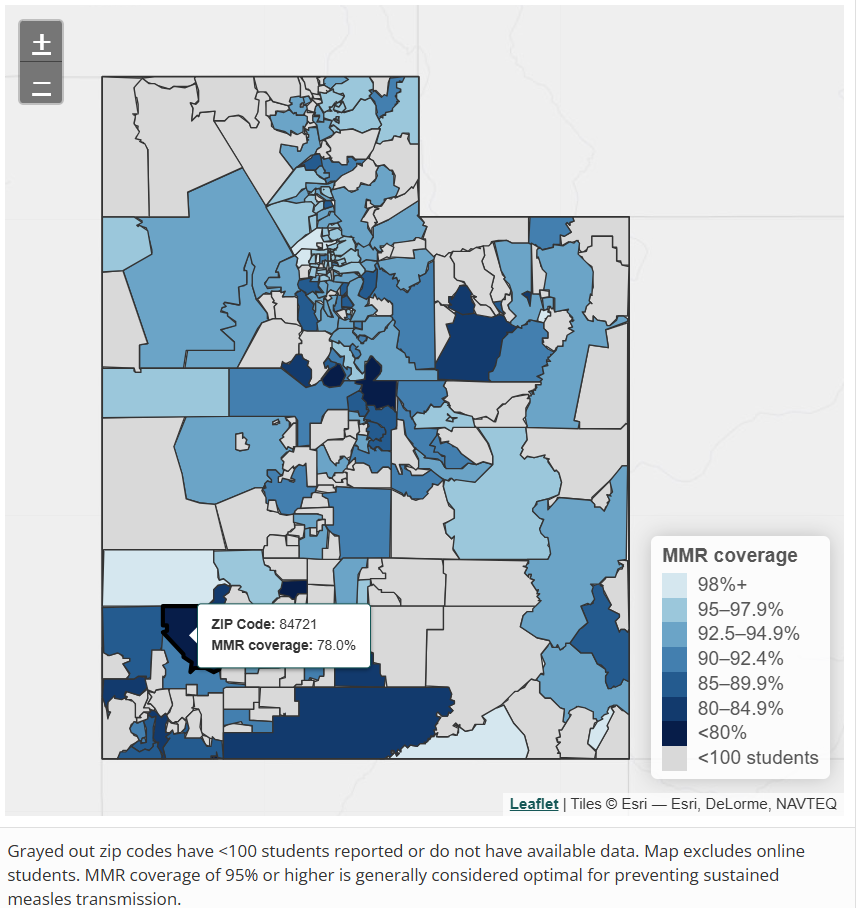
“There were usually anywhere between 50-100 imported cases per year, with very little onward transmission,” they said. Now, though, the outbreak in Utah has been continuously spreading for more than a year- “the US will lose elimination status on the basis of that outbreak alone.”
Local transmission is also a key consideration for the PAHO independent technical body of infectious disease experts evaluating the US elimination status. The experts look at genetic sequencing data to determine whether an outbreak is driven by the same viral genotype, and whether that viral “family” caused disease across multiple communities, as compared to infections emerging from imported cases.
International body to deliberate elimination status after postponement

The PAHO expert session, held 10-13 November, was postponed from April. The Organization pushed back against accusations that postponing the elimination review to a date after the US midterm elections was due to political pressure. The panel reviews all countries in the region of the Americas. Mexico, for instance, also has faced severe measles outbreaks this year and may well lose its elimination status as well, experts said.
While the loss of the US’s measles elimination status has no legal or practical consequences, “[i]t does send an urgent warning that measles transmission is unchecked and that our vaccination system has broken down,” said Gostin in a statement to Health Policy Watch. Gostin, an expert in global health law and founding chair of Georgetown’s Global Health Law center, noted that the loss of status is a blow to the US’s “political and moral authority” in a time when its global health leadership is in flux.
“Countries around the world are already deeply skeptical of the political will to prevent transmission of childhood diseases,” Gostin said. Bangladesh, Indonesia, Guatemala, India, Yemen, Pakistan,and Angola accounted for the majority of the global disease burden in 2025. Cases spread internationally through unvaccinated travelers.
‘Entirely preventable’
The US achieved elimination status over 25 years ago, marking a victory over a disease that once infected nearly every child and claimed 500 deaths per year before widespread vaccination.
The outbreak that began in January 2025 “has not stopped,” said Rasmussen and Patel. “It has turned into a series of never-ending outbreaks flaring up nationwide.”
The pair write that “unequivocally” the outbreaks could have been prevented. “This is a national crisis and the worst part about it is that it was completely preventable.” They and others advocate that bumping the US’s vaccination rates is the solution to the number of cases not seen since 1991.
Slipping vaccination coverage in the US has left “pockets of vulnerability,” said Dr Michael Osterholm, an epidemiologist and director of the Center for Infectious Disease Research and Policy (CIDRAP). In the US, 96% of all infections occurred in unvaccinated individuals.
The combined measles, mumps, and rubella vaccine (MMR) is 97% effective after two doses. Children 12-15 months receive a first dose, followed by a second dose when 2-4 years of age.
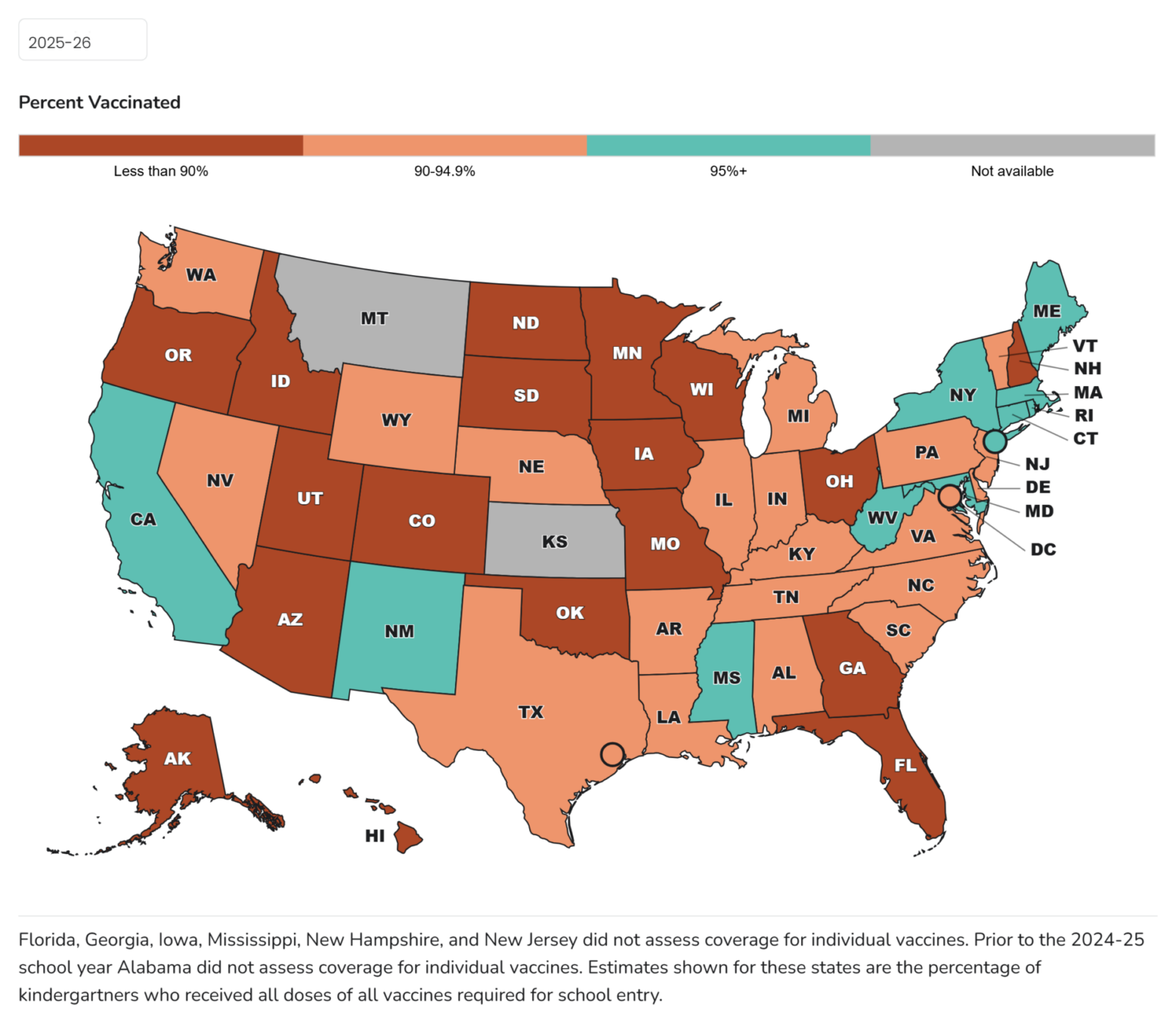
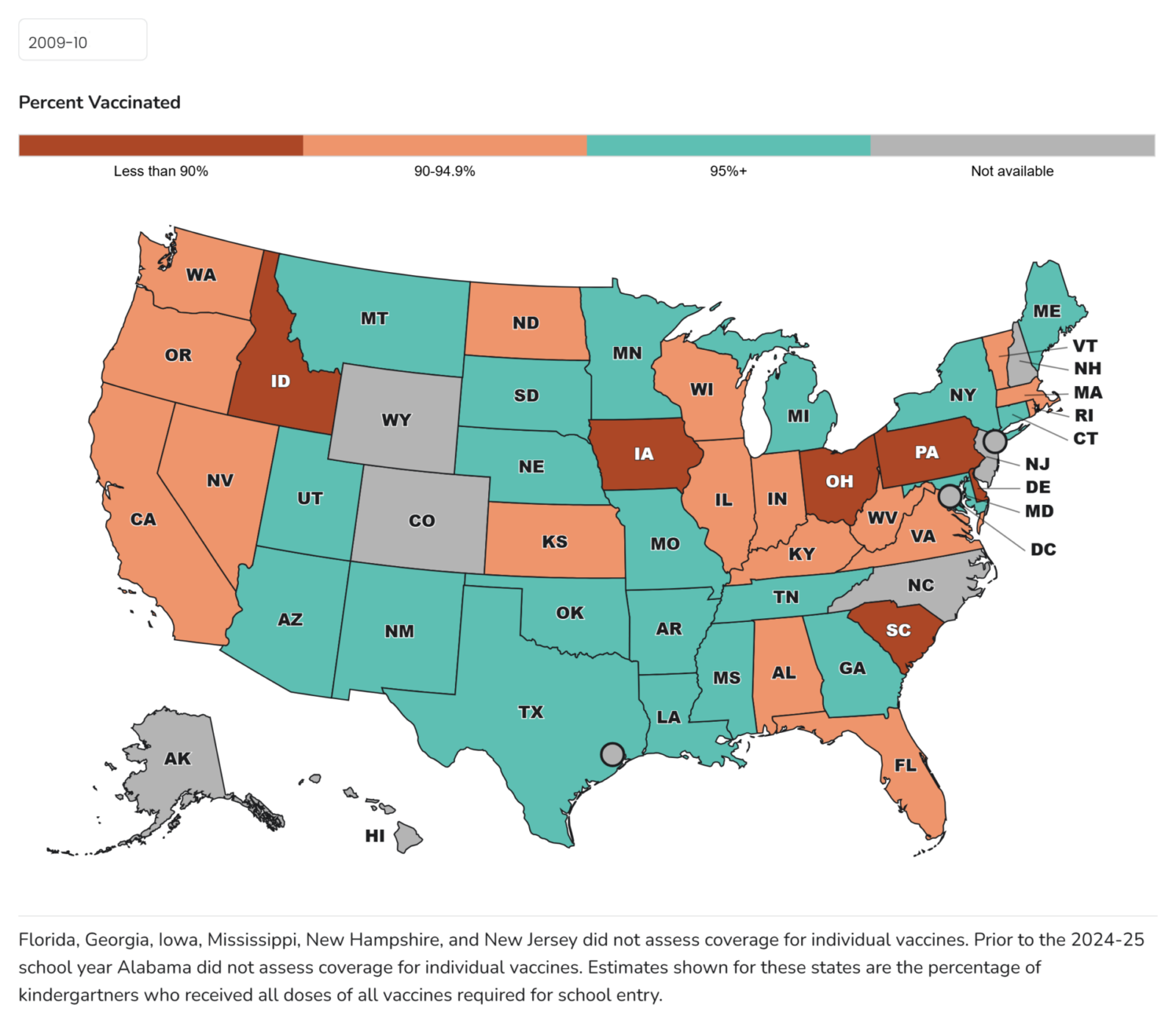
In the 2025-26 school year, 18 US states had vaccination rates below 90%. In 2010, only six states fell below 90%, according to CDC data.
And when using the WHO’s threshold for herd immunity – 95% – only 10 states currently meet that criteria.
Successful vaccination campaigns in upper income countries, followed by a drop in vaccinations have left these countries especially vulnerable to measles outbreaks. In some communities, an entire generation of young adults have no protection – either from infection or vaccination.
“Those are pockets of vulnerability where all it takes is one case to get introduced, and it’s like a spark in a forest fire, it takes off quickly and dangerously,” said Osterholm.
Worries over congenital measles
“The expected loss of America’s status as having eradicated measles will be a tragedy because it reflects the preventable loss of human lives,” said Armstrong of the IDSA. “Perhaps most heartbreaking is the potential long-term toll on infants infected this year, some of whom may develop fatal neurologic disease years after the initial infection.”
Infants under one year of age are largely ineligible for the vaccine, making them particularly vulnerable.
Armstrong also alluded to the fact that for the first time in decades, congenital measles, which is passed from an infected pregnant woman to her newborn, now poses a serious public health threat.
This is because as people who were never vaccinated, or even exposed to measles as children, have children themselves, they risk passing the disease to the most vulnerable.
Now, there is a growing number of pregnant women who were infected with measles, said Osterholm. Again, that is due to the lack of protection among adults for the first time. In prior generations, nearly all adults were either infected or vaccinated as children.
This poses a challenge to healthcare providers, who may have never treated measles in pregnancy.
The Pennsylavian Department of Health, which is coordinating the response to the largest current outbreak in the US, said “[b]ecause measles was declared eliminated in the United States decades ago, modern data related to measles during pregnancy and the related risks is limited,” The DOH also said despite the limitations, “clinical studies and systematic reviews provide clear statistical evidence of the dangers associated with contracting measles while pregnant.”
Experts point to US political leadership as casting vaccine doubts
When asked how the US ended up with such a large number of cases, some experts argued that inconsistent messaging has led to confusion and unvaccinated communities.
“Mis- and disinformation about measles vaccines continues to haunt us,” Osterholm told Health Policy Watch. He argued that the inconsistent messaging from the federal government sets the US apart; other nations with similar high burdens have deployed concerted vaccination efforts.
Others went further: “The failure rests directly with our political leadership in health,” argued Gostin. “The Secretary of HHS has actively fueled conspiracy theories such as the link between MMR vaccines and autism. He has also cast doubt on vaccine safety. This failure is a direct consequence of an administration that lacks fidelity to science and public health.”
Gostin said that “[t]he end of measles elimination in the US has been under Secretary Kennedy’s watch, and he should be held politically accountable by the President and Congress,” echoing calls from some on the political left for the removal of US health officials from office.
Other countries battle measles
In January, the UK, Spain, Armenia, Azerbaijan, and Uzbekistan lost their measles elimination status after the Europe and Central Asia regional committee met to review the status.
PAHO, or the WHO Region of the Americas, on the other hand, has historically been the WHO Region that is home to the most countries to reach elimination status.
Beyond the US, other oubreaks in Canada, and Mexico futher threaten that status.
Mexico has recorded over 50 measles-related deaths this past year. And globally, 95,000 measles deaths occur each year, mostly among unvaccinated or under-vaccinated children under the age of five.
Cases and deaths are mostly concentrated in low- and middle-income countries and in low-resource or conflict settings.
The disease is one of the most contagious viruses that can lead to severe complications and death, according to the WHO. Vaccination, though, averted nearly 59 million deaths in the past quarter-century.
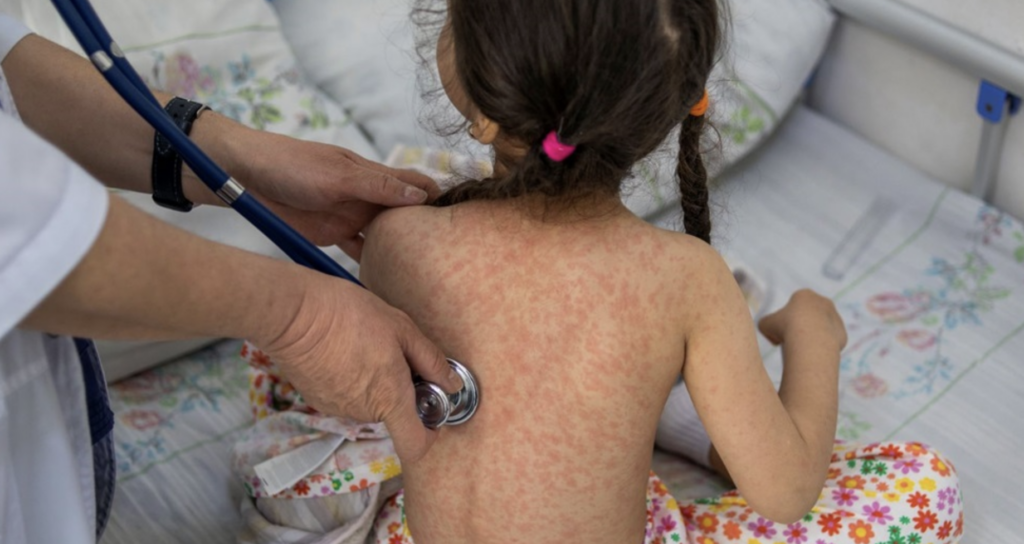
The measles virus infects the respiratory tract and then spreads throughout the body. Symptoms include a high fever, cough, runny nose and a rash all over the body, per the WHO.
See related story:
US Measles Elimination Status Review Postponed for ‘Technical Reasons’, Says WHO
Image Credits: Johns Hopkins, Johns Hopkins University, Utah Health and Human Services, CDC, S. Samantaroy, WHO.
Combat the infodemic in health information and support health policy reporting from the global South. Our growing network of journalists in Africa, Asia, Geneva and New York connect the dots between regional realities and the big global debates, with evidence-based, open access news and analysis. To make a personal or organisational contribution click the donate button below.