
HARIPUR, Pakistan – Unregulated industrial pollution and lead exposure are poisoning a generation, with four in 10 children in high-risk cities carrying unsafe blood-lead levels, exacerbated by toxic smog and weak enforcement, according to a UNICEF study.
Few months ago, Malik Ayaz Ahmed, 22, took a job at a lead-processing factory in Hattar, an industrial belt outside Haripur in Khyber Pakhtunkhwa, in the northwest of Pakistan.
He started work barely a month after a national study revealed that children living near his hometown’s factories had among the highest blood-lead levels ever recorded in Pakistan.
Weeks later, Ahmed fell seriously ill and was admitted to the district headquarters hospital. A clinical test seen by Health Policy Watch put his lead level above 103 micrograms per decilitre — nearly 30 times the safe threshold reference of 3.5 µg/dl.
“It was the test case that showed whether industry had followed any safety protocols to control lead exposure. It had not,” said Tariq Mehmood, executive director of the Human Unity Movement in Haripur, who has spent years documenting the toll of the Hattar industrial zone.
In Pakistan, lead battery manufacturing units and paint factories are major sources of lead exposure, while informal recycling of lead batteries is the main lead poisoning route.
The lead batteries market volume was estimated to be worth $1.65 billion in 2026, while in the paint industry 40% of solvent-based paint samples exceeded Pakistan’s legal lead limit of 100 ppm, with a maximum of 97,000 ppm.
Alarming pattern
Ahmed’s case is an adult echo of a much larger and alarming pattern disclosed by Pakistan’s government and UNICEF earlier this year. Four in 10 children aged 12–36 months in high-risk areas of seven cities carry lead in their blood at levels that the World Health Organization (WHO) considers unsafe.
In Hattar itself, 88% of children tested had elevated blood-lead levels, compared with just 1% in nearby Islamabad, the federal capital of the country. Researchers describe this gap as one of the starkest environmental health disparities documented anywhere in South Asia.
The study, “Ending Childhood Lead Poisoning: Evidence for Policy Action,” shared exclusively with Health Policy Watch, tested 2,175 children across 21 sites in Pakistan’s major industrial cities, including Karachi, Lahore, Peshawar, Rawalpindi, Islamabad, Quetta and Haripur.
It found a national mean blood-lead level of 3.12 µg/dl, with one child registering 107.63 µg/dl, among the highest values ever reported in the medical literature.
UNICEF estimates that 47 million Pakistani children have blood-lead levels above the WHO threshold, and warns that global modelling suggests the true toll could be far worse, with up to eight in 10 Pakistani children potentially affected. This is among the highest rates in the world. The organisation puts the economic cost of the resulting lost cognitive potential at 6–8% t of GDP, or roughly $25–35 billion a year.
“Protecting children from lead exposure is a national public health priority,” said Muhammad Aslam Ghauri, former federal secretary of the Ministry of National Health Services, Regulations and Coordination, calling for stronger surveillance and enforcement.
UNICEF Representative in Pakistan Pernille Ironside was blunt about the stakes: “There is no safe level of exposure to lead for children whose harmful effects are irreversible.”
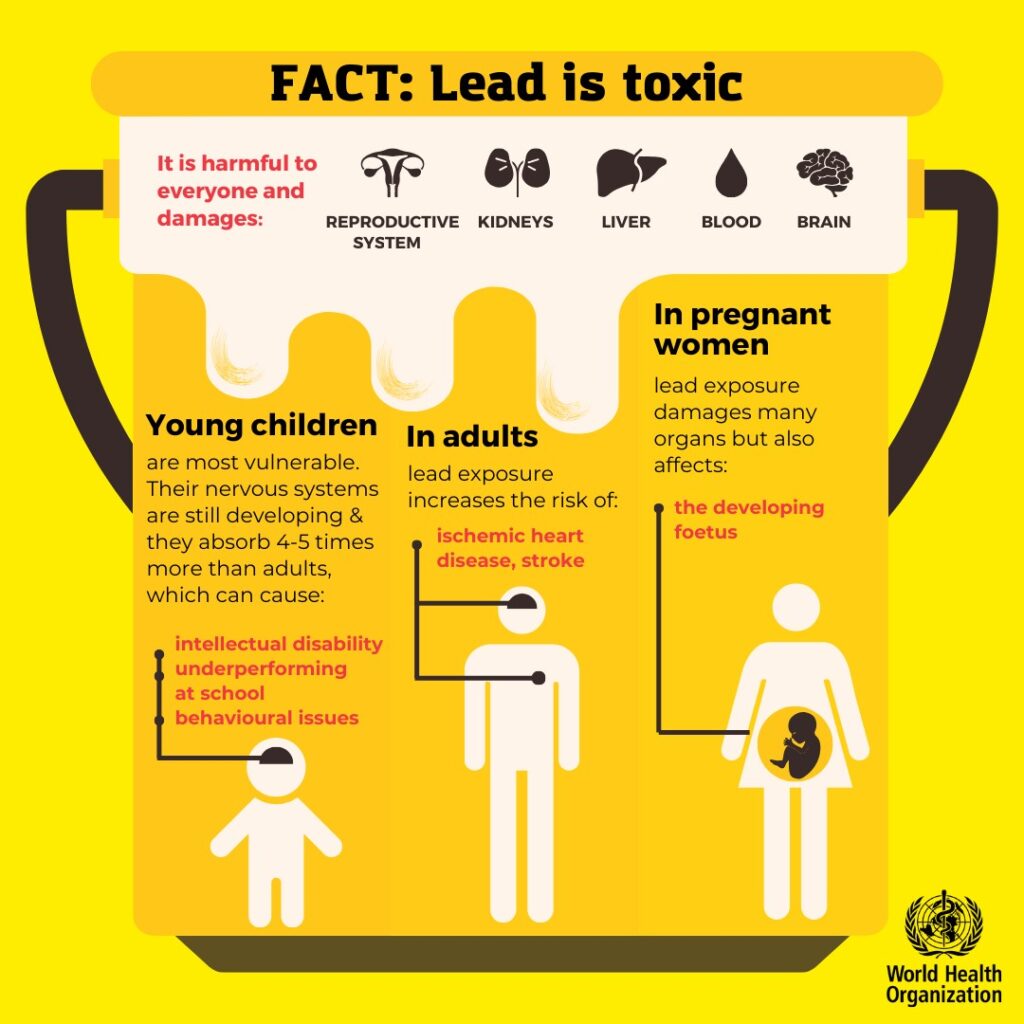
Where lead meets smog
Public health experts and environmental researchers insist that Pakistan’s lead emergency is unfolding inside one of the world’s most polluted airsheds, and the two toxins appear to interact.
“Co-exposure to air pollutants like particulate matter can significantly affect lead absorption, bioavailability and overall metabolism,” said Dr Ammara Naeem, a consultant paediatrician at Sulaiman Al Habib Hospital in Saudi Arabia.
Fine particulate matter can chemically alter how lead behaves in the body, trigger inflammation, and act as a carrier that deepens exposure, meaning a child breathing Pakistan’s smog is likely absorbing more lead, not less, than the same child in cleaner air, explained Naeem.
Islamabad-based climate policy advocate Dr Zainab Naeem of the Sustainable Development Policy Institute points to shared sources: old paint and mining residue in Khyber Pakhtunkhwa, informal battery-recycling smoke, e-waste burning, and the open incineration of industrial waste.
“There are no safety protocols for battery recycling; this informal smoke damages [health], and there is a problem of child labour in the industry, especially in the big cities,” she said, adding that weak coordination between federal and provincial environmental agencies has let both crises fester in parallel.
The numbers bear this out. Pakistan ranked as the world’s most polluted country in IQAir’s 2025 World Air Quality Report, with an average PM2.5 concentration of 67.3 µg/m³ – 13.5 times the WHO annual guideline of 5 µg/m³.
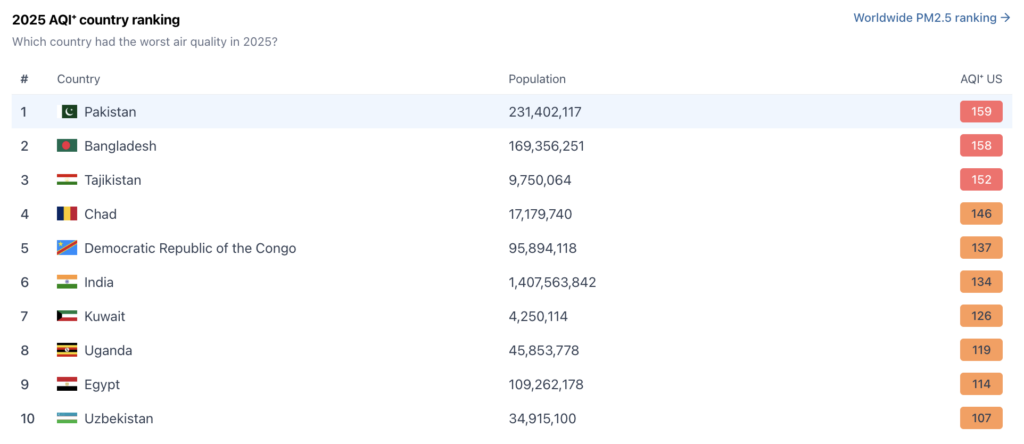
As of mid-February 2026, IQAir’s real-time index placed Lahore as the third most polluted major city on Earth and Karachi eighth, with AQI readings above 200 recorded across the country’s urban centres.
Pakistan’s own National Environmental Quality Standards permit ambient air lead levels of up to 1.0 µg/m³ annually, but researchers and lawyers alike say enforcement of that ceiling is negligible outside a handful of monitored zones.
The World Bank has repeatedly quantified the economic toll of dirty air. Its Pakistan Country Climate and Development Report estimates air pollution imposes economic losses equivalent to roughly 6.5% of GDP annually, and health costs equivalent to roughly 9% of GDP in 2019.
The Federal Minister for Climate Change, Dr Musadik Malik, framed the two crises as inseparable: “Air pollution is a major challenge to human health,” he said, calling for reforms across industry, transport and energy, tighter monitoring and enforcement, and wider adoption of electric vehicles.
In a statement he said clean air is a basic right of every citizen, describing joint national efforts on the environment as unavoidable — language that mirrors, almost verbatim, the coordinated-action rhetoric now attached to the lead response.
A patchwork of poorly enforced laws
Pakistan is not without a legal architecture. The Pakistan Environmental Protection Act, 1997, together with the National Environmental Quality Standards, hazardous-substance rules and provincial environmental laws, gives regulators broad powers to monitor pollution, investigate violators and issue Environmental Protection Orders.
“The more significant weakness is implementation and enforcement rather than the complete absence of law,” said Advocate Bina Faraz, an environmental lawyer.
Faraz argues there is a strong case for regulating air pollution and toxic-metal contamination jointly, as industrial emissions routinely poison air, soil and water through the same smokestacks.
“Treating air pollution and toxic-metal exposure as entirely separate regulatory silos can leave gaps in accountability,” she said, calling for independent monitoring of emissions and blood-lead levels alike, and a legally binding action plan with enforceable timelines, mandatory reporting and defined penalties, rather than the largely aspirational plans Pakistan has produced to date.
Industry, for its part, does not fully dispute the picture. Malik Ashiq Awan, chair of an industries association covering the Hattar zone’s roughly 418 factories, acknowledged there are “health issues because of industry,” including from lead-battery units, alongside ongoing air pollution and water contamination.
He said filtration systems needed to curb emissions are prohibitively expensive to install and operate, but added: “I support it should be checked.”
Haripur’s District Health Officer, Dr Mohsin Turabi, confirmed that his department took part in the sampling, and that affected workers and children were treated if lead was detected – a response he called a step toward a broader government policy to curb exposure, although he acknowledged children were harmed in the first place because safety protocols were never implemented.
Children pay the most
The health data from the UNICEF study reads as a cascade of compounding harms. Nearly 40% of the children tested were stunted, over a third underweight, and 55.7% were anaemic. These figures rise to 63–66% in Karachi and Lahore.
Children with detectable blood-lead levels had significantly higher rates of stunting, being underweight, and anaemia than those without. Behaviourally, 74% of exposed children showed hyperactivity, 71% frequent mood swings, and 68% regular tantrums. These patterns are consistent with the neurodevelopmental damage lead is known to cause.
But blood-lead testing itself remains a bottleneck.
“Most primary, secondary and even tertiary care public-sector hospitals don’t have the facility for lead testing in their laboratory,” Dr Ammara Naeem said, warning that real surveillance would require major investment in lab equipment, trained phlebotomists and electronic reporting – infrastructure Pakistan largely lacks outside a single accredited national facility.
A plan, if it is enforced
Pakistan’s first Multi-Sectoral National Action Plan on Childhood Lead Poisoning has been developed as a result of the study. It is endorsed by federal and provincial stakeholders and built around a national steering committee, harmonised standards for paint, food and cosmetics, formal oversight of informal battery recycling, and integration of lead screening into routine child-health programmes.
“Lead poisoning is one of the most preventable threats to child health and development,” said Abdullah Fadil, director of the Partnership for a Lead-Free Future, whose mission to Pakistan coincided with the study’s launch, with a stated goal of eliminating childhood lead poisoning by 2040.
Whether that target is credible will depend on the same institutional weaknesses that have long stalled clean-air enforcement in Pakistan — chronic under-resourcing, poor federal-provincial coordination, and industries able to absorb fines more easily than they can afford filtration.
For now, in Hattar, Tariq Mehmood says villagers are still filing complaints with the Environmental Protection Agency office that rarely seals a factory, breathing air that a UN agency has linked directly to the lead now circulating in their children’s blood.
Image Credits: Luis Arias/ Unsplash, WHO, IQ Air.
Combat the infodemic in health information and support health policy reporting from the global South. Our growing network of journalists in Africa, Asia, Geneva and New York connect the dots between regional realities and the big global debates, with evidence-based, open access news and analysis. To make a personal or organisational contribution click the donate button below.