A painkiller designed by artificial intelligence that beat morphine in animal tests; a “biological age” score on a government app. Smart-ring makers fighting each other in court while signing deals with the same health department. At its Future Health Summit, Abu Dhabi showed how hard it is to bet on the business of ageing, and its own longevity doctor was the first to admit that the evidence has not caught up.
ABU DHABI, United Arab Emirates – The doctor at the heart of Abu Dhabi’s longevity ambitions did something rare in his line of work. When asked whether the medicine he practises can actually make people live longer, he said that no one can yet show that it does.
“I’m being honest with you. I would say to you there’s no evidence,” Dr Rory Melville, medical director of the Institute for Healthier Living Abu Dhabi (IHLAD), told Health Policy Watch on the sidelines of the Abu Dhabi Future Health Summit.

“For me to work out whether there’s evidence, I’m going to have to wait for that person to get to the end of their life, which could be, you know, 20, 30, 50, 70 years.”
The admission came from inside the very institution that Abu Dhabi presents as the flagship of a new branch of medicine. In November 2024, the emirate’s Department of Health (DoH) licensed IHLAD as “the world’s first specialised Healthy Longevity Medicine Centre”.
On the summit’s exhibition floor, a longevity stand carried its promise in large letters: “Longevity for all”.
Between that slogan and that admission lies one of the boldest bets in health today. Over three days in October, the emirate courted wearable makers, AI drug developers and longevity clinicians, all chasing the same prize: to measure how fast our bodies are ageing, and to sell ways of slowing it down.
Rulebook for the ‘wild, wild West’
Longevity medicine has a reputation problem. Private clinics sell blood panels, infusions and “biological age” tests to people who are already well, often for thousands of dollars a year.
“It’s a wild, wild West at the moment,” Prof Andrea Maier of the National University of Singapore, a founder of the Healthy Longevity Medicine Society, told MIT Technology Review in 2024.
Eric Verdin, head of the Buck Institute for Research on Aging, was harsher: “It’s medicine for the rich, by the rich, which is something I deplore.”
Abu Dhabi’s answer is regulation. Its Healthy Longevity Medicine Clinic Standard, in force since April 2025, is more cautious than much of the industry’s advertising. Epigenetic and protein-based “clocks” that claim to measure biological age are listed as “Optional AND needs further validation”. Drugs repurposed for longevity should have “randomized controlled trial (RCT) data in humans with positive results”.
But the rules were written by a small circle. Melville said IHLAD helped DoH write them, “with the expert help from the Healthy Longevity Medicine Society”, on whose council IHLAD’s chief executive, Dr Nicole Sirotin, sits.
In effect, the regulator, the clinic and the society wrote the rulebook together. Asked who had reviewed it independently, Melville said there were no global standards yet. “I would say they’re probably as independent as you’re going to get in this field, given that they’re so young.”
He was just as blunt about his own trade. “There are a lot of people out there who are selling longevity,” he said. “I cannot say something to you if it’s not been proven fact.”
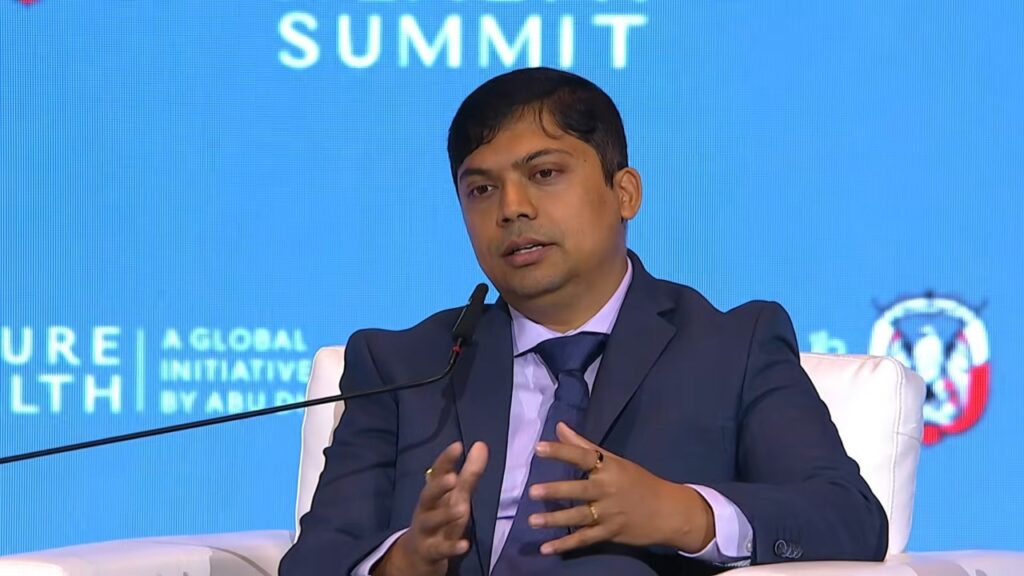
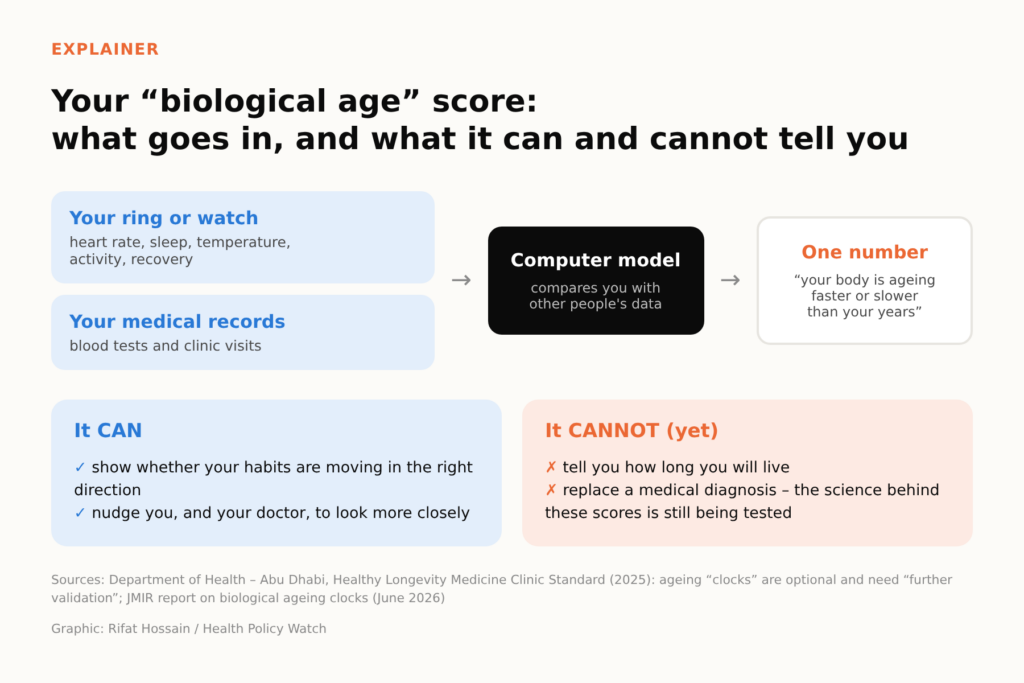
The boldest experiment is not in a clinic but on residents’ phones. On 13 October, a week before the summit, the Abu Dhabi Public Health Centre signed a two-year agreement with Indian smart-ring maker, Ultrahuman, to build a “biological health age” model from medical test results and wearable data.
The DoH already runs its own “health age” score in Sahatna, an app also offered inside the government services platform TAMM, which joins wearable readings to patients’ records in the Malaffi health information exchange, according to a white paper on wearables released at the summit.
“The score is visible on the government app, and it is available for anyone who is a resident here,” Mohit Kumar, Ultrahuman’s founder and chief executive, told Health Policy Watch.
Kumar was candid that the number won’t reveal anything a doctor could not. “Doctors can say and tell anything that the model could tell because it’s the same human body and biological information,” he said. “The only difference is that we could tell this continuously.”
The aim, he said, is to take a “burden” off doctors that they cannot carry at scale. He argued that Abu Dhabi’s model is more open than rivals “doing their own calculations in a closed window kind of a setup and you don’t know whether what’s going into it, what’s not going into it.”
Migrant workers, who make up most of the UAE’s population, would also have access to the app, he said. The catch is the cost of the device. Kumar priced his ring at $350, though he said Ultrahuman is exploring with governments a device for 10 million people at $50-$100.
The bigger catch is the science. A wearable ageing clock “doesn’t really measure a true age in a literal sense,” Dr Russell Bowler of the Cleveland Clinic said in June.
In August, a review in JAMA Internal Medicine found that “there is no scientific evidence” that continuous glucose monitors, another product sold by Ultrahuman, improve health or prevent disease in healthy people.
Even the ring’s heart-rhythm alert runs on FibriCheck, whose software, not the ring, holds the US and European medical clearances.
Ring wars
Ultrahuman is not alone. Abu Dhabi is courting the whole wearable industry, rivals included. At the summit, DoH and Finland’s Oura launched Project Cradle, a two-year study at Corniche Hospital and Mediclinic Airport Road testing whether a ring worn through pregnancy can warn doctors of premature labour.
“We know today that we can identify about two weeks before labour what the signs of the onset of labour are,” Oura’s chief executive, Tom Hale, said. “What we want to do is take those signals and see if we can identify them in preterm births.”
The same week, the US company WHOOP deepened its own research deal with DoH. Its founder, Will Ahmed, said Gulf membership had grown more than 85% in a year, after Abu Dhabi’s state investor Mubadala put $75 million into the company in May.
“In the future, we will be able to say you are at risk of a heart attack,” he said, conceding that “the timing of some of that partnership was complicated with the wars in this region”
Behind the handshakes, two of Abu Dhabi’s partners are at war. Oura won a US trade case in 2025 that barred imports of Ultrahuman’s older ring. After US customs cleared a redesigned Ultrahuman ring in March, Oura filed fresh patent claims against Ultrahuman’s new Ring Pro – in the very week of the summit.
Kumar said the ring remains on sale and that his company will answer the claims “through the appropriate legal process”.
For the emirate, the prize is data: millions of hours of heartbeats, sleep and body temperature, joined to clinical records. Its own wearables White Paper concedes that the most basic rule is still missing, posing the question it does not answer: “What consent model should govern wearable data across clinical care, public health, research, and secondary use?”
The painkiller that beat morphine – in animals
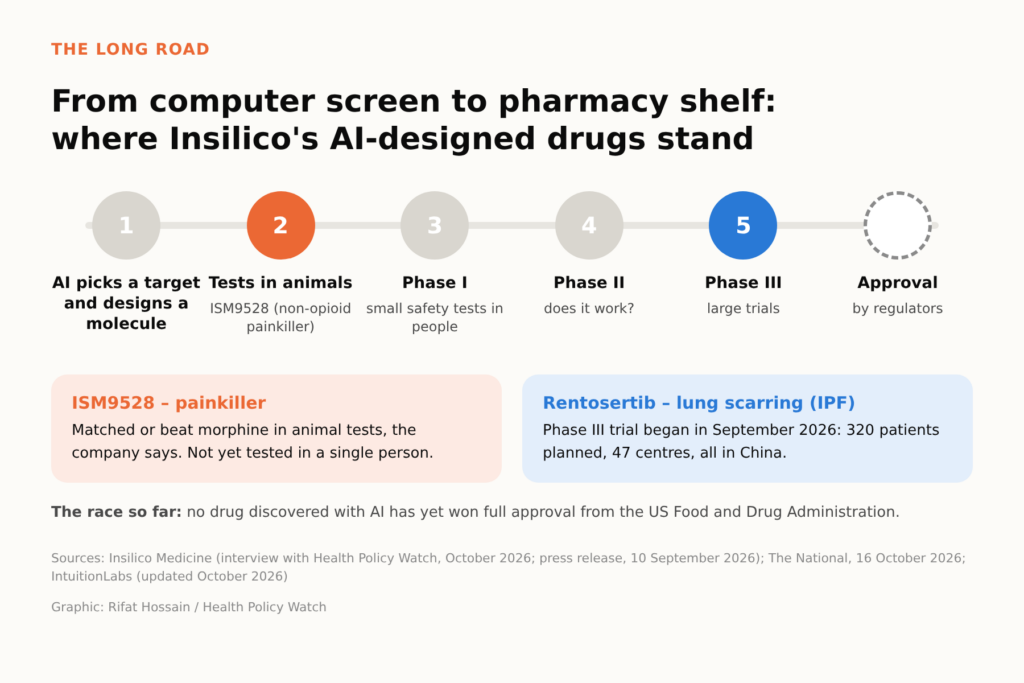
The most startling claim of the week came from Alex Aliper, co-founder and president of Insilico Medicine, which runs an AI drug-discovery centre in Abu Dhabi’s Masdar City. His company’s software designed a new painkiller, ISM9528, which is not an opioid.
“In terms of injectable formulation, we showed that it was on par and even sometimes outperformed morphine in terms of its efficiency of ameliorating and stopping pain,” Aliper told Health Policy Watch. “So it can replace morphine.” Then came the sentence that matters most: “That’s what we saw in animals.”
If that result holds up in people, it would be enormous. Opioids have driven an overdose crisis that has killed hundreds of thousands of people in the United States alone.
“If you have a safe, non-addictive way to treat pain, that’s a game changer,” Aliper told The National days before the summit. But ISM9528 has not yet been given to a single human being, and most medicines that shine in animals fail in people.
What AI has already changed is speed. Reaching a promising drug candidate usually takes about five years, Aliper said. Insilico’s first took 18 months; it now averages about 13 and its fastest took nine. “This year we’re nominating a candidate a month,” he said. “This year we discovered two drugs, two drug candidates out of our Abu Dhabi office.”
“You don’t have to be located in US, China, Europe,” he said. “You can innovate here in Abu Dhabi. If you have the right technology, if you have AI.”
He borrowed Apple’s label, “Designed in California, made in China”, for a company that designs its molecules in the emirate and runs more than 60 contract laboratories around the world from there.
Ageing claims are where caution is needed most. Insilico’s lead drug, rentosertib, treats idiopathic pulmonary fibrosis, a scarring lung disease that, Aliper said, “is heavily involved in aging. It has many hallmarks of aging integrated in there.”
In September, the company’s scientists reported in Nature Biotechnology that 42 patients from an earlier trial of the drug looked biologically “younger” on six protein-based ageing clocks.
These are exactly the kind of clocks that Abu Dhabi’s own standard says need “further validation”, and a small analysis of this kind cannot on its own show whether patients aged more slowly or simply had healthier lungs.
The real test has only begun. In September, Insilico dosed the first patients in a 52-week phase III trial of rentosertib, and plans to enrol 320 people at 47 centres, all in China.
Aliper insisted the rigour must stay. “Clinical trials are there for a good reason. Science has to be rigorous,” he said. As of October, no drug discovered with AI had won full approval from the US Food and Drug Administration.
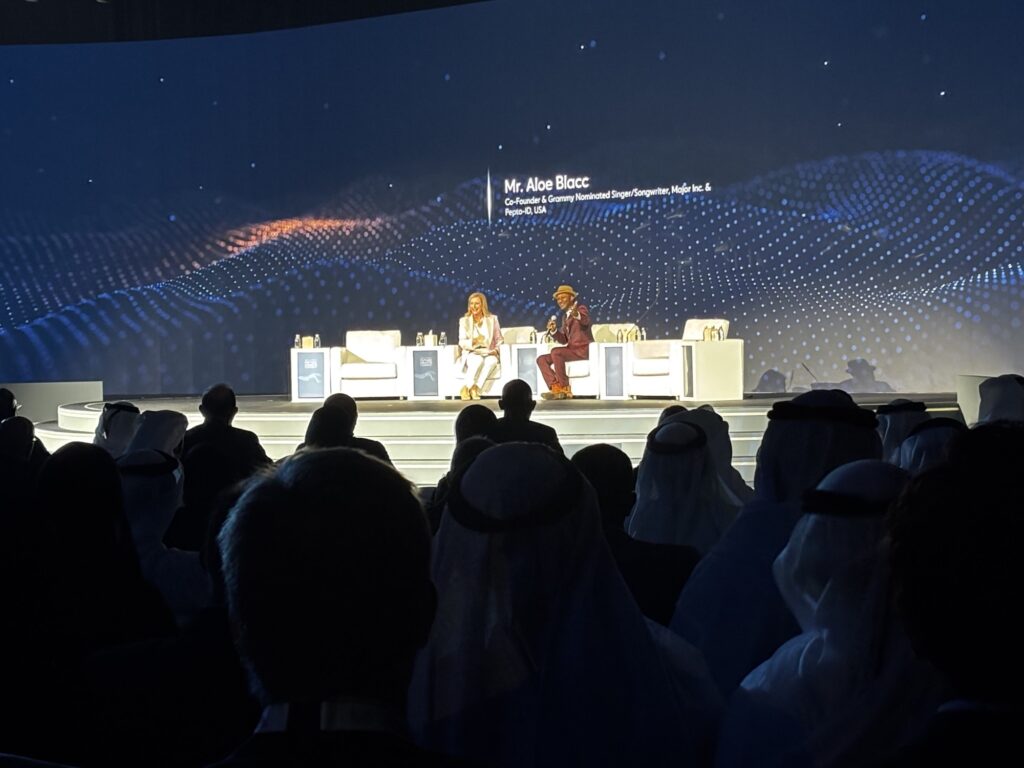
On the summit’s second day, singer Aloe Blacc took the main stage as co-founder of Pepto-ID, a cancer start-up built on “molecular mask” research by Gomika Udugamasooriya of the University of Houston.
“We’re targeting some of the most difficult-to-address cancers, the biggest unmet needs,” he said on stage.
The epidemic behind the glamour
For all the talk of algorithms, the case for longevity medicine in the Gulf rests on an old-fashioned epidemic.
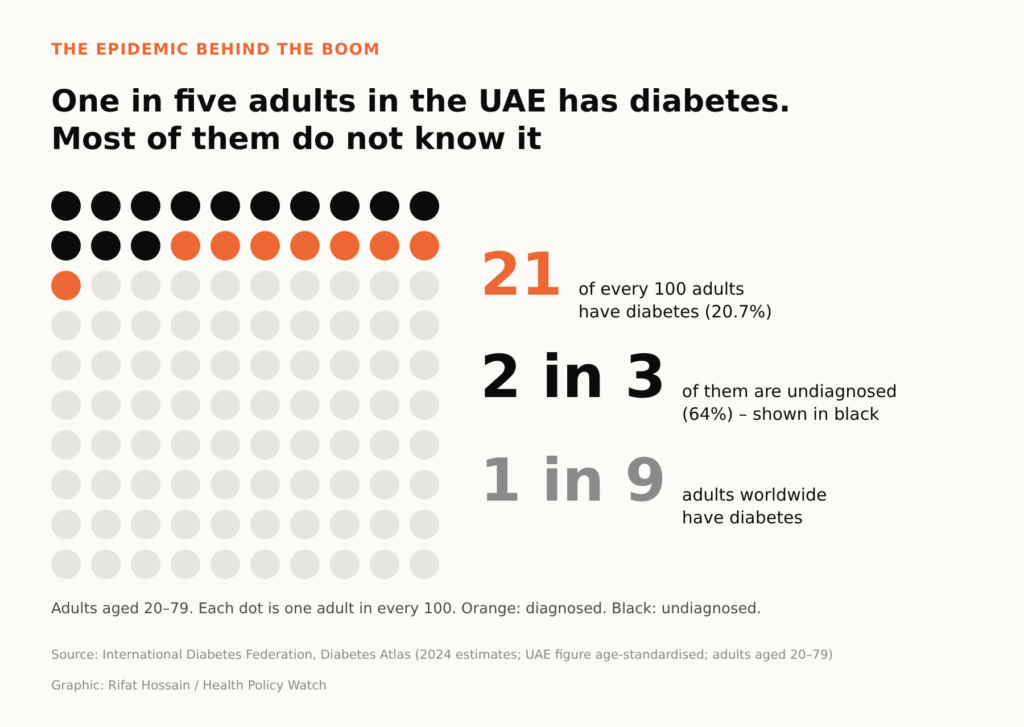
“We have a 21% incidence of diabetes in this country,” Melville said. “The global incidence on average is 11%. So we’re double, we’re double.”
The International Diabetes Federation puts age-standardised diabetes prevalence among UAE adults at 20.7%, and estimates that nearly two in three of them (64%) have never been diagnosed.
“Up until 50 years ago they were living a Bedouin life, so they actually had a much more active life,” Melville said of Emiratis. Then came Western food.
“As soon as we bring Westernized diets into local cultures, their health deteriorates.” Genes play a part too. Emiratis “do genetically seem to have a predisposition to cardiometabolic disease”, he said, and South Asians, a large part of the UAE’s workforce, develop heart and metabolic disease at a much lower body weight than Europeans.
Then came the line that should give every health minister pause. Despite all the screening, “looking at the statistics, the [Abu Dhabi] population [are] not getting any healthier. And there’s something not quite right with the system.”
Better years, not more of them
The wider science counsels humility. Survival to 100 this century “is unlikely to exceed 15% for females and 5% for males,” S. Jay Olshansky and colleagues concluded in Nature Aging in 2024. The realistic prize is fewer years lived in sickness: worldwide, the gap between lifespan and healthy lifespan reached 9.6 years in 2019, according to a study in JAMA Network Open.
Melville would not promise even that: “We can’t prove this either, that it does compress the time that we live in disease or frailty at the last decades of our lives. I can’t even prove that,” he said. “We need to prove that what we’re doing actually does have validity.”
IHLAD says its research arm is trying to answer exactly that, asking, in Melville’s words, “What tests are worthwhile doing and bring value for money?”, and what can be carried from the clinic “into the general populace”.
“Better health decisions need better evidence”: the Institute for Healthier Living Abu Dhabi’s population health research display at the summit. Image: Rifat Hossain/Health Policy Watch
Longevity for whom?
That leaves the question that matters most beyond the Gulf. Nearly 90% of the people living in the UAE are not citizens, and many of them are low-paid workers.
Health Policy Watch could find no published prices for IHLAD’s services. A $350 ring is a smaller barrier than a clinic programme, but a barrier all the same. Kumar sees no ceiling on demand. A person “below poverty line” can “still aspire for an iPhone today because internet is the true leveller,” he said.
Abu Dhabi has the money, the genomes, the connected records and the political will to turn the science of ageing into regulated medicine, something no country has yet done.
If it insists on trial evidence, publishes how its scores are validated and carries what it learns into primary care for the construction worker with undiagnosed diabetes, it could give health systems everywhere a model worth copying. If it does not, it will have built a licensed version of the Wild, Wild West, with a government seal on the door.
Melville, for his part, sounded more like a sceptical family doctor than a salesman. “I think there’s a lot of promise,” he said, “but we just need to wait and see whether that comes to fruition.”
See Health Policy Watch‘s first story on the summit:
Abu Dhabi Wants Health Systems to See Disease Coming. But Who Owns the Data and Who Gets Left Out?
Image Credits: Rifat Hossein, Future Health, Rifat Hossain.
Combat the infodemic in health information and support health policy reporting from the global South. Our growing network of journalists in Africa, Asia, Geneva and New York connect the dots between regional realities and the big global debates, with evidence-based, open access news and analysis. To make a personal or organisational contribution click the donate button below.