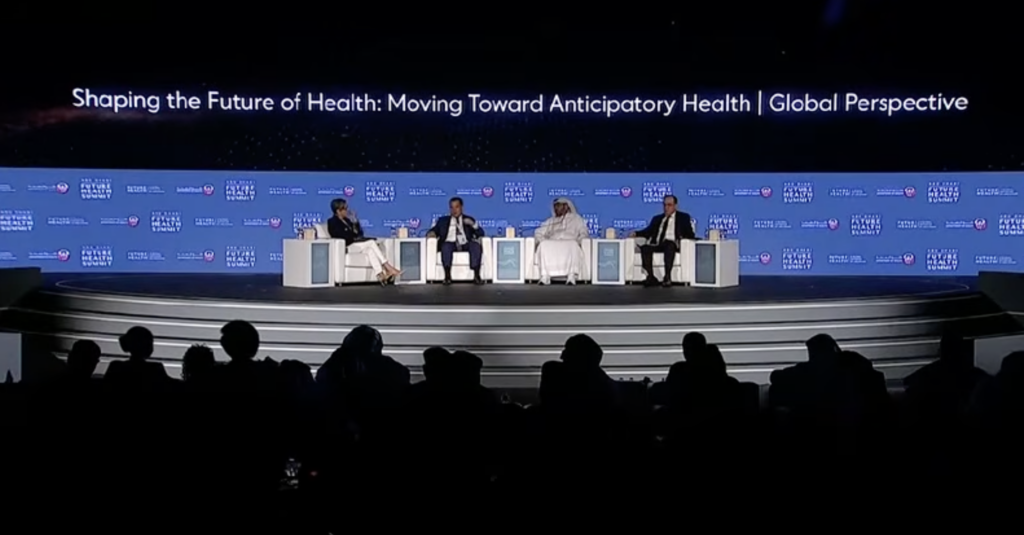
At the Abu Dhabi Future Health Summit, ministers and officials from Greece to Jordan lined up to learn from the emirate’s bet on genomes, wearables and artificial intelligence. Away from the main stage, the clinicians and engineers building these systems were more candid about consent, price and proof.
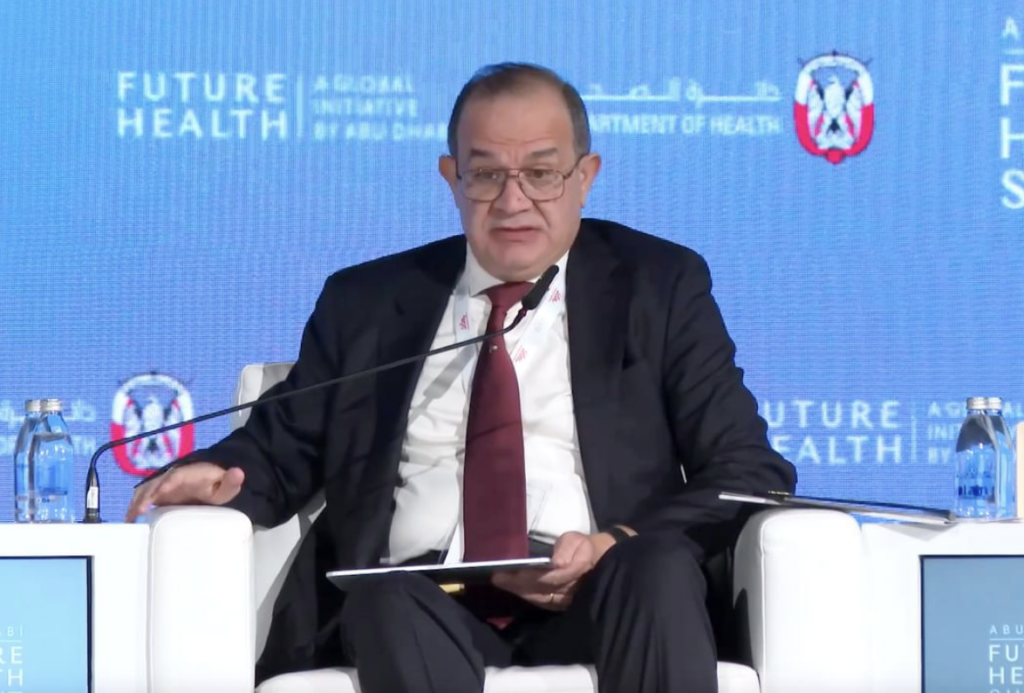
ABU DHABI – Greece’s health minister did not hide his envy. “I always say UAE lives in the 22nd century. We still are in the 21st,” Adonis Georgiadis told the opening session of the Abu Dhabi Future Health Summit on Tuesday (20 October).
On genomics, he was blunter still: “We’re practically zero, to be honest.”
Georgiadis had come, he said, to learn how the Emirates plans to use the genome to know “far faster what is going to happen”. He was not the only visitor shopping for a model. The three-day summit, convened by Abu Dhabi’s Department of Health (DoH) under the theme “To Sense is to Predict”, drew participants from about 100 countries, with health ministers from Armenia, Egypt, Montenegro, Kosovo and Colombia expected to attend.
Health systems everywhere wait for people to fall ill and then try to fix them. Abu Dhabi wants to use genomes, connected health records, wearables and AI to spot risk years earlier and act before disease takes hold.
“The next chapter of health will be defined by our ability to act earlier,” DoH Undersecretary Dr Noura Al Ghaithi said ahead of the summit.
For readers in Lilongwe, Dhaka or La Paz, the more useful questions are about what sits underneath that promise. Who owns the data that makes prediction possible? Who pays for it? Does it reach the foreign residents who make up nearly nine in ten of the UAE’s population? And what, if anything, can a ministry with a fraction of Abu Dhabi’s budget take home?

‘More years in good health’
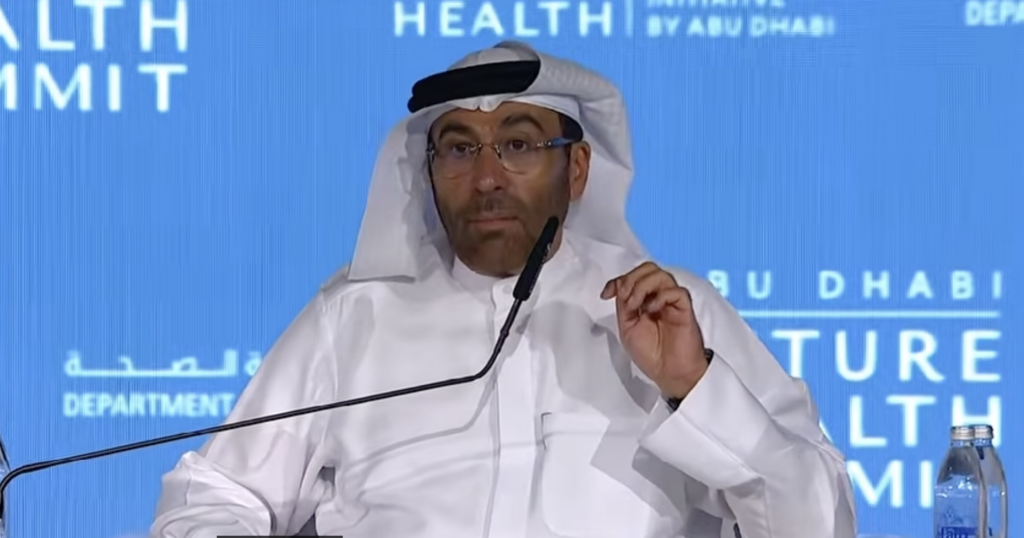
UAE Minister of Health and Prevention Ahmed bin Ali Al Sayegh set out the national version of the plan: “In simple words, the future really means more years in good health,” he told the opening panel.
His country is building what he called “an approach we call Healthy UAE”, rooted in a national public health and wellbeing strategy that would reach “beyond healthcare”.
“This is the first time we really look at public health and well-being across the UAE,” he said, describing it as a response to a presidential call to link all of the country’s medical systems.
The minister also gave a new figure for the Emirati Genome Programme, which he said “has covered almost 920,000 people”. Reports are now being prepared for those who agreed to receive their results.
“Those at risk will receive a personalized action plan, which they can visit their primary family doctor to go through further testing and arrive at a preventative action plan for their disease,” Al Sayegh said.
“It’s heading towards a personalized approach to each one of us. And that’s something that’s doable today if we have the data and if we have the resources.”
Georgiadis, who described medicine since Hippocrates as “dealing the disease as the firefighter dealing the fire”, was frank about the money.
“The resources you have as ministers of health are never enough,” he said. “To find a way to use our resources in a more efficient way is the only way out.”
Greece has moved fast on the digital basics. Georgiadis told the conference that 11 million Greeks now carry their medical records on the MyHealth app and that the national screening drive had examined 6.8 million people.
Changing tyres at full speed
Jordan offered the clearest example of what the Abu Dhabi model looks like when it travels. Jordan’s Minister of Digital Economy and Entrepreneurship, Sami Smeirat. described the work as “basically like changing your tyres while racing your race car. That is how difficult it is.”
“Medicine is governed by protocols, procedures that have matured over years and years and hundreds of years,” said Smeirat. “And coming to them and trying to do changes overnight is not an easy task.”
Jordan’s Digital Health Centre in Salt, funded by the Abu Dhabi Fund for Development and built with M42’s Abu Dhabi Health Data Services and G42’s Presight, now links dialysis and intensive care units in 12 public hospitals and radiology in 19.
By July, it had monitored more than 55,000 dialysis sessions and issued more than 45,000 radiology reports, according to Jordan’s Royal Hashemite Court.
On stage, Smeirat said mortality in the remote ICU had dropped from 14% to around 2–3%, a figure Health Policy Watch could not find in published sources. “This is sensing at its best,” the official said. “When you provide remote sensing, then you drop mortality.”
Who owns a million genomes?
Data is the fuel for all of this, and Abu Dhabi has a great deal of it. Its health information exchange, Malaffi, held 3.5 billion clinical records and 12.7 million patient profiles by August 2025.
A Future Health white paper with EY, released on the eve of the summit, says more than 900,000 genomes had been sequenced by June and that about 660,000 participants’ data sit inside a government-run Trusted Research Environment, where companies and researchers can analyse the data without taking it away.
The rules are tight on paper. Under the DoH policy for that environment, raw genome files are never released and the encryption keys “must be under the exclusive control of DoH”.
UAE federal law bars health data from being stored or transferred outside the country unless the health authorities allow it. On the question of who owns it, DoH’s 2022 draft policy on genomics is unambiguous: “Data ownership belongs to the UAE government.”
However, Dr Angela George, clinical director of genomics at London’s Royal Marsden, which is helping Dubai Health to develop the Hamdan Bin Rashid Cancer Hospital, said that patients should own their data.
“And I think there is a responsibility to use this information appropriately,” George told Health Policy Watch.
Asked about middle-income countries that lack the capacity to regulate private and AI companies moving into health, she did not single out any country, but her worry was plain.
“There has to be some eye to the regulatory oversight, because that’s also how you protect people,” George said. “This should not be something where people are harvesting other people’s genetic data to make money, and I worry about some of what is going on in some other countries. … So I think we have to be really careful about how this is used.” Large population programmes, she added, could have “enormous power” if used appropriately.
Populations missing from the data
George also made the case for why population genome programmes in under-studied regions matter well beyond them. Genomic science has been built overwhelmingly on people of European descent. As of mid-2021, 86.3% of participants in genome-wide association studies were of European ancestry, according to a roadmap published in Nature Medicine.
Arabs, about 5% of the world’s population, account for roughly one in 600 participants in genome-wide studies of common disease.
“It is really important that we actually map the genomes from these other countries as well, because there are differences in diseases, there are differences in how things like cancer behave,” George said. “It is really clear to me as a clinician that my patients from different ethnic backgrounds will develop slightly different side effects … for different drugs.”
Her own work suggests the gap is not only about money. She directed the Royal Marsden’s Mainstreaming Cancer Genetics programme, which moved BRCA testing for women with ovarian cancer out of specialist genetics clinics and into routine cancer care, cutting waiting times for results from 12–15 weeks to about four.
The approach was then tested in Malaysia, a country with very few genetic counsellors. “So actually we know that it does [work], because we ran the same program in Malaysia,” she said. The MaGiC study, of 790 women at 23 sites, found that 80% took up testing when oncologists offered it, against 79% when genetics specialists did.
Price is the other barrier. George said a large DNA panel on a tumour costs “a few hundred pounds” at NHS-approved prices in her lab, and a liquid biopsy closer to £1,500.
Tests from some commercial companies, she said, “can cost upwards of £3,500, £5,000. So I think there is a bit of a wild west sometimes.” Depending on the market, “there aren’t necessarily controls on price”.
‘Pura already knows everything about you’

The same questions follow data into consumer apps. At the PureHealth stand, the state-linked group that owns the SEHA hospital network, a senior AI engineer for its health app, Pura, explained its selling point. “The main differentiator here is that Pura already knows everything about you,” the engineer told Health Policy Watch.
Users who sign in with the national digital identity, UAE Pass, and consent to share their records get “hyper-personalized suggestions” drawn from their hospital files, the engineer said.
Visitors without UAE Pass can answer onboarding questions and upload their own blood tests instead.
The app offers meal plans, exercise plans and answers to health questions, but “strictly within the boundaries of not diagnosing something or not recommending you medication to take”.
Asked how many patient records sit behind those suggestions, the engineer said that was a technical question, adding: “We have a lot of data with us, since we are integrated with all these hospitals, which we use to train our AI.”
Pura’s App Store listing advertises an AI health assistant and “smart insights” drawn from wearables and SEHA medical records. Health Policy Watch could not find a published document setting out whether, and under what consent, patients’ hospital records are used to train the company’s AI models.
Deals, drugs and a shifting map of research money
The summit was also a marketplace. On 21 October, DoH signed an agreement with Isomorphic Labs, the AI drug discovery company that grew out of Google DeepMind, to work inside Abu Dhabi’s secure research environment; a 24-month heart and metabolic health study with the wearables firm WHOOP; and an agreement with Cleveland Clinic Abu Dhabi and AstraZeneca to explore the feasibility of up to 30 clinical trials by 2030, worth an estimated AED 180 million (US$50 million).
Mubadala Bio and Eli Lilly announced they would localise packaging and logistics for Lilly’s GLP-1 medicines in the emirate.
Sanofi signed a memorandum with DoH in June to explore a Vaccine Innovation Centre in Abu Dhabi covering AI-enabled vaccine design, mRNA research and clinical manufacturing.
It follows a 2025 agreement, signed by Baptiste de Clarens, Sanofi’s vaccines head for the Greater Gulf, that, in his words, “allows us to examine how Sanofi’s experience in vaccine development could complement Abu Dhabi’s growing R&D ecosystem”. Both texts still speak of exploring; no budget, site or timeline has been published.
The talks come as traditional funders pull back. In August 2025, the US Department of Health and Human Services cancelled or scaled back 22 mRNA vaccine projects worth nearly US$500 million, and Washington said it would withhold its US$1.58 billion pledge to Gavi.
Stanford’s Prof Jeffrey Glenn, whose ViRx@Stanford programme is building antivirals for the next pandemic on the premise that “even the fastest vaccine takes one year to deploy”, was among the summit’s speakers.
In the TOGETHER trial, a single dose of interferon lambda, a drug that grew out of his lab’s work, cut hospitalisations and long emergency visits among Covid-19 patients by about half.
Can prediction reach the poor?
For lower-income countries, the risk is that prediction becomes another layer of care that only the rich can use.
Dr Jayasree Iyer, chief executive of the Access to Medicine Foundation, came to the summit with two decades of data on how far medicines actually travel.
In the foundation’s last published Index, only 43% of clinical trials by the largest drug companies took place in the 113 low- and middle-income countries it covers, which are home to nearly 80% of the world’s people.
Its March AMR Benchmark found that in 17 sub-Saharan African countries, none of the companies assessed had registered a child-friendly version of any of their antimicrobials. “We can tilt the battle against superbugs in humanity’s favour,” Iyer said then.
Some of the most convincing prediction tools on show were also the cheapest. VectorCam, built at Johns Hopkins and taken to scale by Vector Control Innovations, turns a basic smartphone into a mosquito identifier for village health workers in Uganda, where malaria surveillance has long depended on a handful of entomologists.
“Every district just has one entomologist,” Prof Peter Waiswa of Makerere University said when the scale-up was announced. “The app does it in 20 seconds using computer vision.”
The tool is now being rolled out in 14 districts under Uganda’s malaria programme, just as US funding cuts have ended 80% of USAID awards with malaria activities.
ThinkMD, which won the $200,000 first prize in Future Health’s global innovation challenge earlier this year, gives offline clinical decision support to more than 9,000 frontline workers in 885 facilities.
BlueDot’s Dr Kamran Khan, whose system flagged a cluster of unusual pneumonia cases in Wuhan on 31 December 2019, has long argued that early warning is about speed. “What I learned during SARS is, let’s not get caught flat-footed; let’s anticipate rather than react,” he said in 2020.
The test ahead
A small, wealthy state is trying to rebuild a health system around early warning when the traditional donors of global health are cutting back. If it works, its tools, data rules and failures will shape what other countries copy.
If its benefits stay with a small group of citizens and paying clients, it will become another example of the global health divide it says it wants to close.
Three things will show which way it goes: who controls the genomes, whether patients see what their data earns, and whether the next generation of tools is built for a nurse in Uganda as well as a clinic on Saadiyat Island.
Georgiadis, for one, has set himself a deadline. “And after three years, I’ll be here again to see what we’ve really done with you, with your cooperation,” he told his hosts
Image Credits: Abu Dhabi Ministry of Healthh, Abu Dhabi Ministry of Health.
Combat the infodemic in health information and support health policy reporting from the global South. Our growing network of journalists in Africa, Asia, Geneva and New York connect the dots between regional realities and the big global debates, with evidence-based, open access news and analysis. To make a personal or organisational contribution click the donate button below.