
Four of the 58 health zones in the Democratic Republic of Congo (DRC) affected by the Ebola Bundibugyo outbreak have had no new cases in the past 42 days, while five others have been case-free for at least three weeks.
“The message is that it is definitely possible in that environment to break the transmission,” said Professor Yap Boum, Africa CDC’s head of Emergency Preparedness and Response, at a media briefing on Thursday.
The four zones are Kambala, Goma, Lubunga and Miti-Murhesa. Meanwhile, an additional five DRC zones have recorded no new cases in the past three weeks or more.
Uganda also marked 42 Ebola-free days on Thursday, marking the end of its outbreak.
The 42-day period is twice the 21-day incubation period for Ebola, the established international benchmark for determining that Ebola transmission has ended.
However, on the other end of the spectrum in the DRC, Mongbwalu (also known as Mongulu), Rwampara, and Nizi, all in Ituri province, are reporting the highest Ebola incidence.
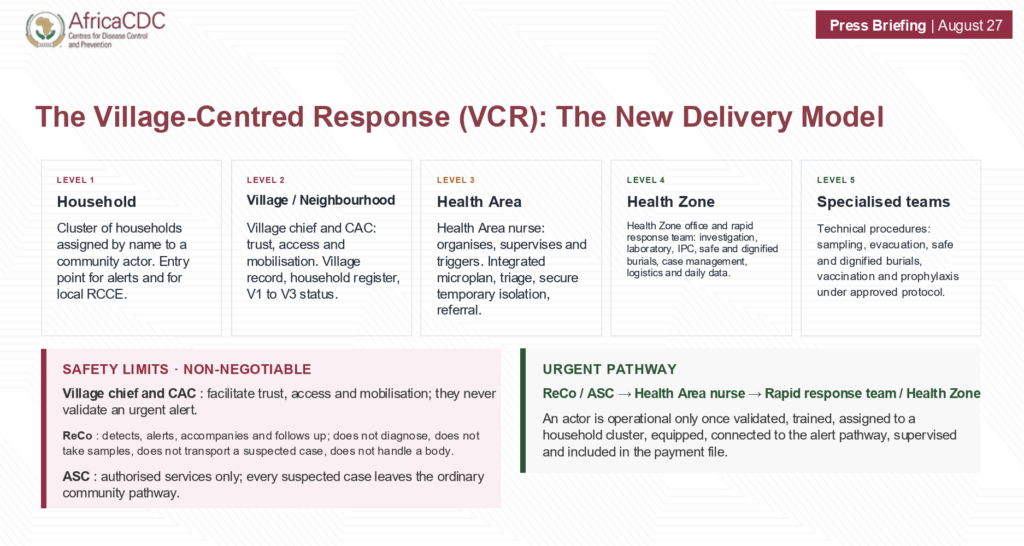
Boum also revealed details of the village-based approach recently adopted by the DRC government and partners. It will be built from clusters of households to villages, health areas, health zones and finally, specialised teams to deal with a range of issues from dignified burials to vaccinations.
This decentralised community approach “will improve the trust, the access, but more critically, the mobilisation”, said Boum.
Essential health services disrupted
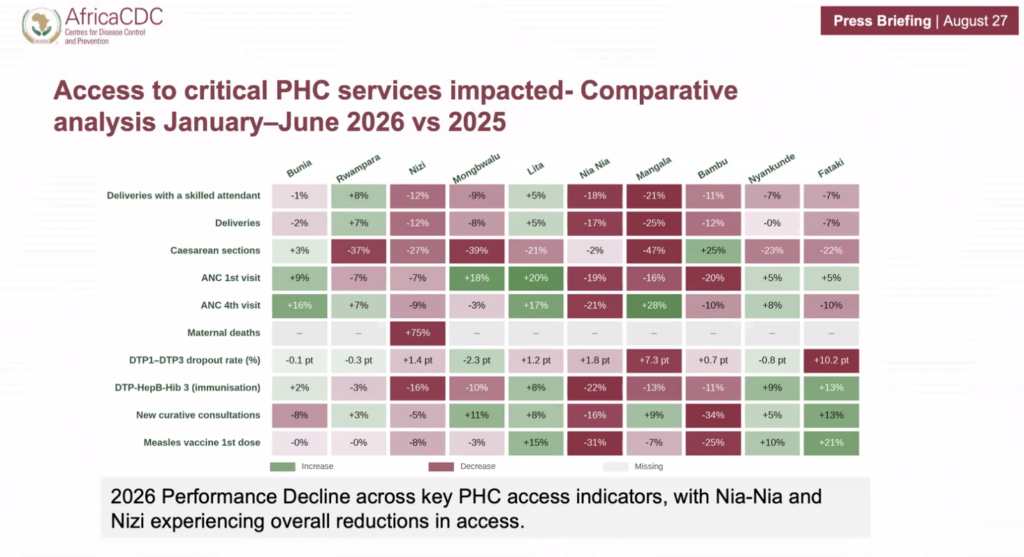
The outbreak has disrupted essential health services, particularly maternal health and immunisation services.
In Mangala health district, births in facilities have fallen by 25%, while in Bambu, antenatal visits have plummeted.
Meanwhile, baby immunisations have dropped in eight health zones, the worst effect has been on measles vaccinations, which plummeted by 31% in Nia Nia and 25% in Bambu.
New consultations have decreased across the affected health zones.
Boum said that there were two main reasons for the drop. First, some health facilities at the epicentre of the outbreak had closed after health workers became infected. Second, some people avoided health facilities with Ebola treatment centres as they feared being infected.
Health worker strikes
Boum said that the ongoing strikes by health workers over non-payment of salaries are being addressed “health zone by health zone”.
A “major challenge” has been to ensure that all the health workers working on the outbreak are registered on the government payroll, as some had been recruited by different partners.
“Implementing that registration and payment has been quite tedious,” said Boum. “But I can confirm that, as we speak now, 2,800 of those health workers have been paid by the government and some by partners.”
Community healthcare workers are to be paid $150 per month, which Boum described as a positive development that will “fast-track the deployment of community healthcare workers within the village-centred approach”.
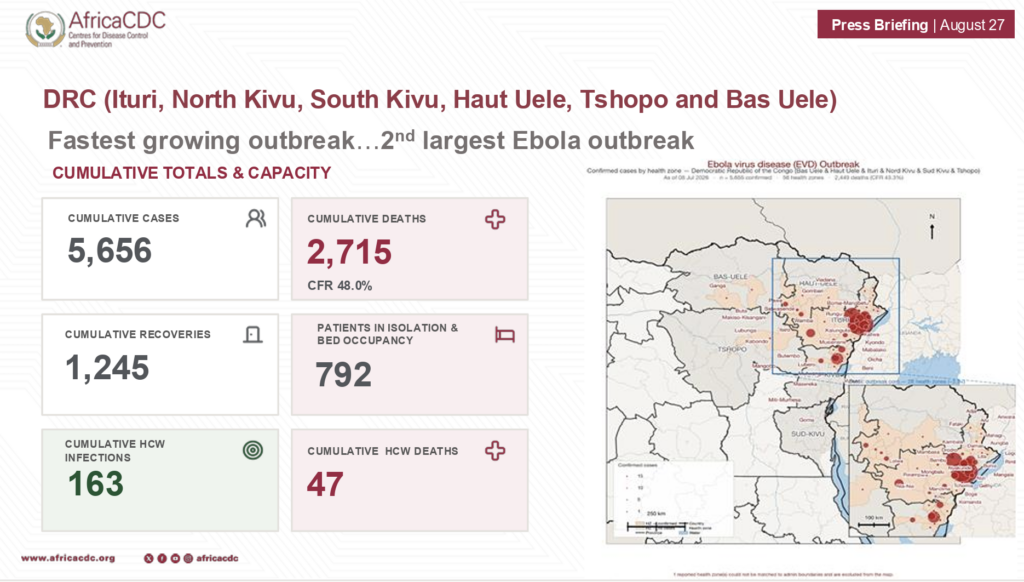
By Thursday, 5,656 cases and 2,715 deaths had been recorded, with 1,245 recoveries. The case fatality rate is 48%.
Combat the infodemic in health information and support health policy reporting from the global South. Our growing network of journalists in Africa, Asia, Geneva and New York connect the dots between regional realities and the big global debates, with evidence-based, open access news and analysis. To make a personal or organisational contribution click the donate button below.