
The levels of major greenhouse gases reached record highs in 2025, locking in more long-term temperature rise for the planet, according to a new bulletin from the World Meteorological Organization (WMO).
Among the greenhouse gases, the levels of carbon dioxide (CO2) and methane (CH4) continue to dominate.
In its latest Greenhouse Gas Bulletin, the WMO reported that the globally averaged surface concentration of CO2 in 2025 was 426.8 parts per million, or 153% of the 1750 pre-industrial baseline.
“Another year, another new record. Greenhouse gases are trapping an unprecedented amount of heat in the atmosphere, providing energy for more extreme weather and associated risks to our economies and societies,” said WMO Deputy Secretary-General Ko Barrett.
“The past 11 years have been the warmest on record, and this trend is set to continue. CO2 has a very long lifetime and so will affect the global climate not just for years but for decades and even centuries.”
Concentrations of nitrous oxide, the third most important long-lived greenhouse gas related to human activities, also rose to a new record.
In the summer of 2025, over 50,000 people died from heat in Europe, the region heating fastest in the world, according to a recent study published in Nature.
Researchers used statistics from 854 European cities from heat waves in June, July and August, and found that 50,391 people died from warmer temperatures, and that “68% of the estimated heat-related deaths in 2025 were attributable to human activity”.
Global leaders are set to meet in Antalya, Türkiye, in November to once again seek to turn climate commitments into concrete actions at the annual UN climate conference COP, now in its 31st year.
CO2 growth rates tripled
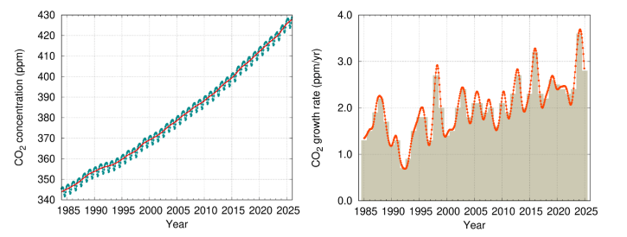
Growth rates of CO2 have tripled since the 1960s, accelerating from an annual average increase of 0.8 ppm per year to 2.4 ppm per year in the decade from 2011 to 2020. From 2024 to 2025, the global average concentration of CO2 rose by 2.8 ppm – above the decadal average but slightly less than the exceptional surge of 2023-2024.
“The more modest growth rate from 2024 to 2025 reflects recovery of the land carbon sinks and reduced fire carbon emissions in 2025 after the strong 2023-2024 El Nino, which reduced the efficiency of the biosphere through more drought, drier vegetation and more wildfires,” said WMO senior scientific officer Oksana Tarasova.
Nearly half of the CO2 released in the atmosphere is absorbed by the water bodies and land sinks like forests and wetlands.
“However, a 2.8 ppm annual increase is still a substantial addition of carbon to the atmosphere from fossil fuel burning. We can expect to see a further increase in concentrations in 2026 because of fossil fuel burning and the development of a powerful El Niño which will impact land carbon sinks as it did in 2023-2024. The risks of reduced CO2 uptake by the ocean are also increasing in our changing climate,” Tarasova said.
Other greenhouse gases are also rising
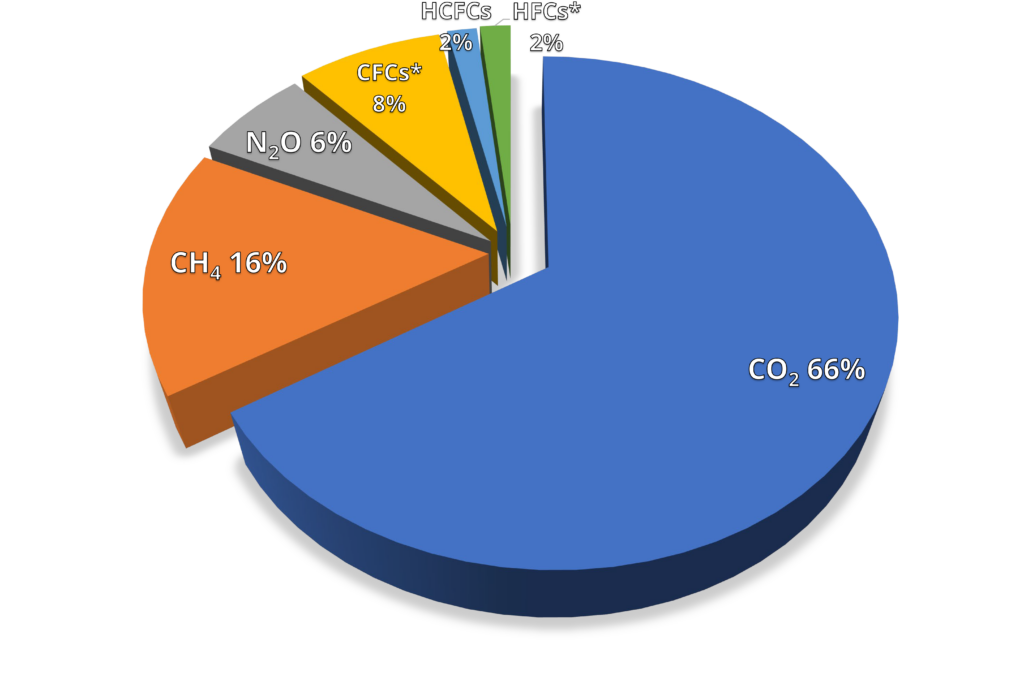
Currently, methane accounts for about 16% of the warming effect on our climate by long-lived greenhouse gases, but it has a much shorter lifetime than CO2.
Around 35% of methane is emitted into the atmosphere by natural sources (for example, wetlands) which are sensitive to climate as well, and about 65% comes from anthropogenic sources such as cattle, rice farming, fossil fuel exploitation, landfills and biomass burning.
Global efforts are on to reduce methane emissions, especially in the agriculture sector.
The bulletin also warns countries to pay careful attention to two potent but less abundant trace gases closely related to electricity production and distribution: molecular hydrogen (H2) and sulphur hexafluoride (SF6).
The increase in SF6 in 2025 was a record high. It has been rising steadily over the past three decades in proportion to increased global electrification, since SF6 is used primarily as a spark suppressant in electricity distribution. It has an atmospheric lifetime of over 1,000 years, and its 100-year global warming potential is approximately 24,300 times that of CO2.
Hydrogen concentration has also increased by 5.3% between 2010 and 2024. Hydrogen is being used as an energy storage medium for hard-to-decarbonize sectors such as steelmaking, shipping, and long-duration energy storage, as well as for renewable sources and as an energy source for transport.
Its leakage into the atmosphere from production facilities, pipelines, storage tanks, and fuel cells poses a growing concern. Hydrogen is not a greenhouse gas, but it influences atmospheric chemistry and so has a strong indirect effect on warming.
Combat the infodemic in health information and support health policy reporting from the global South. Our growing network of journalists in Africa, Asia, Geneva and New York connect the dots between regional realities and the big global debates, with evidence-based, open access news and analysis. To make a personal or organisational contribution click the donate button below.