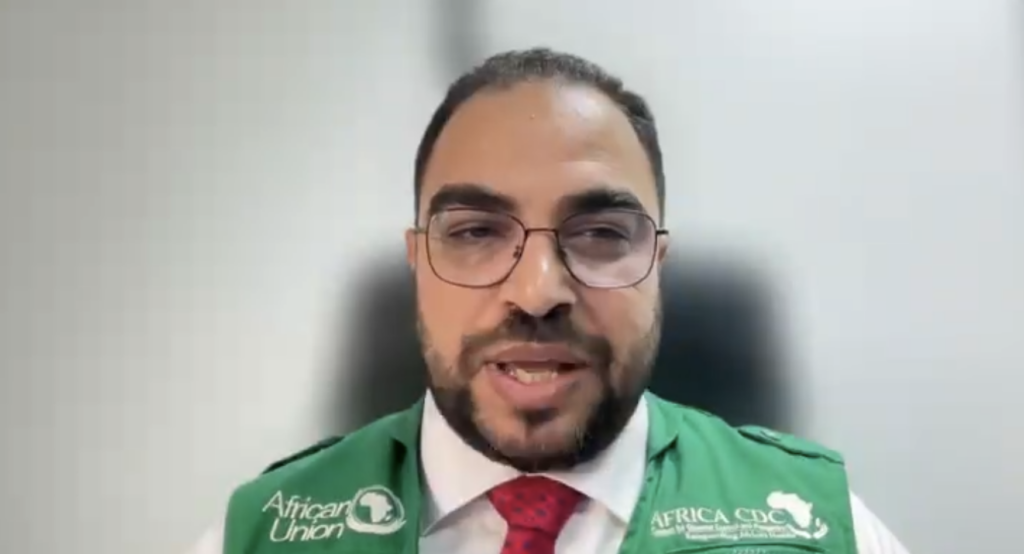
Nigeria’s first Ebola Bundibugyo patient may have crossed paths with Kenya’s recently deceased index patient at Uganda’s Entebbe Airport on 3 October, according to Dr Wessam Mankoula, head of health emergencies at Africa Centre for Disease Control and Prevention (CDC).
Mankoula told a media briefing on Thursday that this was one of the possibilities being considered by health experts who are trying to unravel how the woman in Nigeria became infected.
The Nigerian patient, identified by Mankoula as the Ugandan-born wife of a Swiss diplomat in Nigeria, flew from Uganda to Abuja while the Kenyan man flew to Nairobi’s Jomo Kenyatta International Airport.
“Has there been any touch or contact between the two cases at the airport at the same time?” This is one of the theories that is currently under investigation,” said Mankoula.
“There are a lot of possibilities. A lot of effort is going into the investigation to verify the source of the infection. So let’s avoid anticipating the investigation and try to reach a conclusion at this stage.”
Kenyans in quarantine
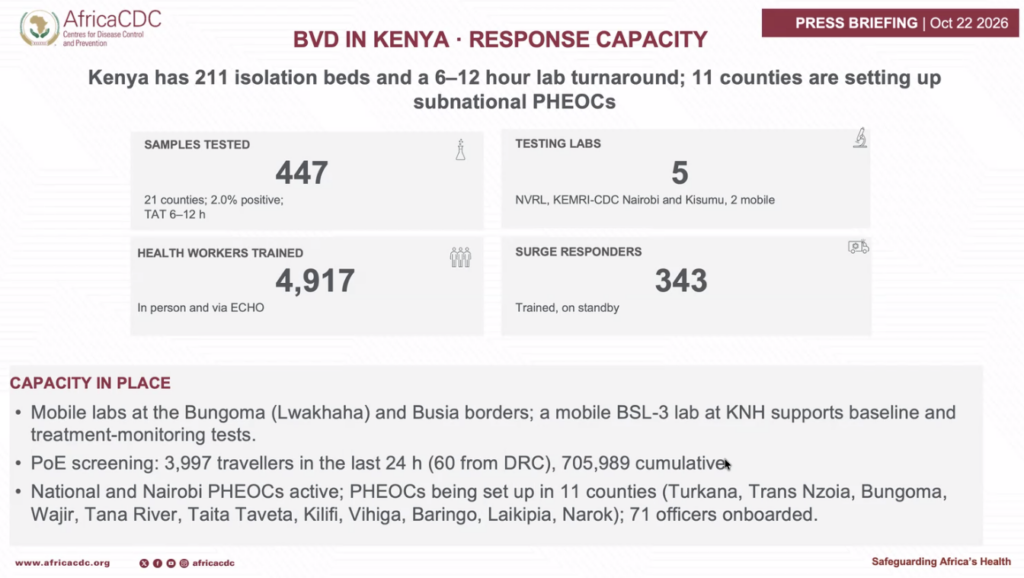
The Kenyan was picked up at the airport by a family member who drove him directly to Nairobi Hospital, where he died of Ebola two days’ later. Eight of his contacts, four health workers and four relatives, have since been infected with Ebola.
Mankoula said all eight patients had been in quarantine and that Kenya had traced all his known contacts. The man had spent several weeks in the Democratic Republic of Congo (DRC), which is currently experiencing the world’s fastest-growing Ebola outbreak ever recorded.
Some 118 of the man’s 135 contacts are in quarantine.
Mystery infection
But the Nigerian patient’s infection is a mystery. She visited Uganda for two weeks from mid-September, but Uganda has been declared Ebola-free since August after it contained an outbreak caused by a case imported from the DRC.
She started feeling sick on 7 October, was admitted to a health facility on 11 October, and her initial diagnosis was malaria, said Mankoula.
On 19 October, in light of her symptoms, the health facility suspected Ebola, and she was tested that day. The test confirmed Ebola, and after a follow-up test was conducted the following day, the outbreak was announced.
Forty-four of her “high risk” contacts are in quarantine in a designated facility.
Illegal crossings
Mankoula told the briefing that the land border between the DRC and Uganda was only open to trucks carrying goods and for humanitarian reasons.
“However, we’re still reporting some illegal crossings between DRC and Uganda, and one of those examples is related to this case in Kenya. He crossed the border from DRC to Uganda, and this was an illegal crossing,” said Mankoula.
He urged countries neighbouring the DRC, particularly in the north where the outbreak is centred, to ensure screening at points of entry and strong surveillance systems to detect cases that may have been asymptomatic during travel.
South Sudan, Central African Republic, Burundi and Rwanda are most at risk.
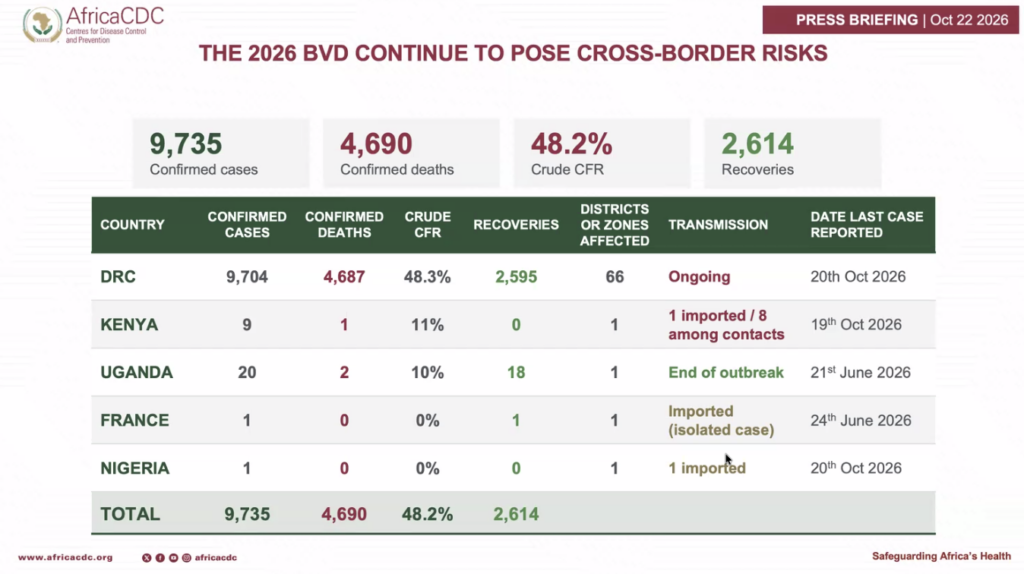
The latest figures from the DRC (20 October) showed 9,704 confirmed cases and 4,687 deaths. Ituri and North Kivu provinces still account for 94% of cases.
Although reported cases had declined slightly since epidemiological week 37, Wessam cautioned that reporting lags, community resistance, security and operational challenges made it too early to call this a sustained decrease.
More than 80% of cases are still coming from outside contact lists, and over half of deaths were occurring in communities.
Combat the infodemic in health information and support health policy reporting from the global South. Our growing network of journalists in Africa, Asia, Geneva and New York connect the dots between regional realities and the big global debates, with evidence-based, open access news and analysis. To make a personal or organisational contribution click the donate button below.