Physicist, Banker, Reformer – And a Balance Sheet Expert for Global Health Crises?
Indonesia’s nomination of its Health Minister, Budi Gunadi Sadikin, for Director-General of the World Health Organization (WHO) introduces an unconventional candidate to the race for the 2027-2032 term. Entering a field alongside medically credentialed contenders, Sadikin stands out as the sole nominee whose career originated outside clinical medicine and epidemiology.
With the publication of his official election platform, “Healthy Long Lives for All”, he has anchored his candidacy in a structured campaign framework encapsulated by his initials: Build, Grow, Scale (BGS). Positioned around economic reform, health sovereignty, institutional efficiency, and the principles of the Accra Reset, his campaign unfolds as the agency is managing severe financial distress and workforce reductions.
Representing the world’s fourth-most populous nation, Sadikin brings a distinct Global South perspective grounded in the frontline health realities of a complex middle-income country. However, his central challenge will be convincing member states that an outsider and financial reformer can safeguard WHO’s scientific integrity and technical authority, while demonstrating that top-down executive drive can build multilateral consensus across a diplomatically fragmented global health landscape.
Strategic vision: economic reform and health sovereignty

Rather than proposing new administrative programmes, Sadikin’s platform grounds global health reform in country-led agency, fiscal realism, and institutional focus. At the first public candidate exchange during the World Health Summit in Berlin, he expanded on his core thesis arguing that WHO must return to its constitutional roots to restore multilateral trust across three core pillars:
- Build strong national health systems: Grounded in domestic reform, he advocates for country-led national health plans. Drawing on his banking background, he targets the communication gap between health and finance ministries, helping health leaders translate technical priorities into credible financial plans that finance ministers, development banks, and donors can fund.
- Grow regional resilience: Rejecting donor-dependent charity in favour of health sovereignty, Sadikin advocates establishing end-to-end vaccine and diagnostic manufacturing capacity across at least 30 to 50 nations in the Global South.
- Scale Global Impact: Drawing on his role as co-chair of the high-level panel on the Accra Reset, Sadikin argues that rather than attempting to fund every health need from its restricted balance sheet, WHO must leverage external capital and align global health entities behind single national health strategies.
Complementing these three pillars is a sharp critique of WHO’s overextended scope. Citing consultations with nearly 100 health ministers worldwide, Sadikin argued in Berlin that WHO currently “does too many things” and must return strictly to its two core constitutional functions: setting evidence-based scientific norms and standards, and exercising its unique convening power. To reduce administrative overhead, he advocates systematically scaling back operational and implementation functions that external partners or country offices can perform more efficiently.
Addressing WHO’s budget constraints and heavy reliance on earmarked voluntary contributions, he frames donor earmarking as a direct symptom of institutional distrust. To restore financial trust and eliminate multi-agency duplication across WHO, Gavi, and the Global Fund, he advocates for costed, one-stop country compacts that streamline global assistance. “As a country … it is ridiculous and becomes more complex when I have to deal with three separate institutions on malaria, each with their own earmarks,” he stressed in an interview with Health Policy Watch.
To measure long-term success, Sadikin set a clear operational benchmark in Berlin: creating a re-unified, trusted WHO where all member states willingly pay their assessed contributions because they proudly recognise the agency’s direct role in enabling their populations to live long, healthy lives.
From corporate banking to pandemic management

His focus on capital mobilisation and fiscal discipline flows directly from Sadikin’s 30-year corporate background prior to public service. A nuclear physicist by training (Institute of Technology Bandung, 1988), he rose through commercial banking to become CEO of PT Bank Mandiri Tbk, managing over $65 billion in assets. Drawing on his background leading major corporate restructurings, Sadikin served as president director of state-owned mining firm Inalum, where he led negotiations and financing for the US$3.85 billion acquisition of a majority stake in PT Freeport Indonesia.
Applying his financial expertise to public health administration, Sadikin points to his track record, leveraging centralised bulk procurement to save $553 million on advanced medical devices and achieving a 32% price reduction across selected essential medicines and consumables.
When COVID-19 struck, Jakarta tapped his corporate logistics background. Appointed health minister in December 2020, he applied supply-chain tactics to direct the rollout of 453 million vaccine doses across 6,000 inhabited islands.
Turning emergency logistics into permanent structural reform, he expanded routine childhood immunisation pipelines with PCV, HPV, and rotavirus vaccines, driving Indonesia’s global rank for zero-dose children down from 3rd to 7th. This shift toward preventive primary care yielded measurable national health outcomes, with Indonesia’s childhood stunting prevalence falling from 24.4% in 2021 to 19.8% in 2024, according to national health data.
Despite pushback over an executive-style overhaul of a health law that centralised medical licensing and specialist oversight directly under ministry control, his domestic record propelled his entry into global health diplomacy. Co-leading the 2022 G20 health track, he spearheaded the creation of the World Bank-hosted Pandemic Fund.
Aside from co-chairing the high-level expert panel on the Accra Reset, Sadikin holds board seats at Gavi and the Stop TB Partnership.
Voting bloc dynamics and geopolitical mediation

To demonstrate multilateral commitment ahead of his campaign, Jakarta backed its candidate with direct capital, scaling up its recorded WHO portal contributions nearly fourfold from $7.67 million in 2024-2025 to $29.39 million for the 2026-2027 cycle. This baseline – which features $13.13 million in flexible thematic funding – was further augmented by President Prabowo Subianto’s pledge of an additional $30 million to the WHO investment round within weeks of Sadikin’s nomination.
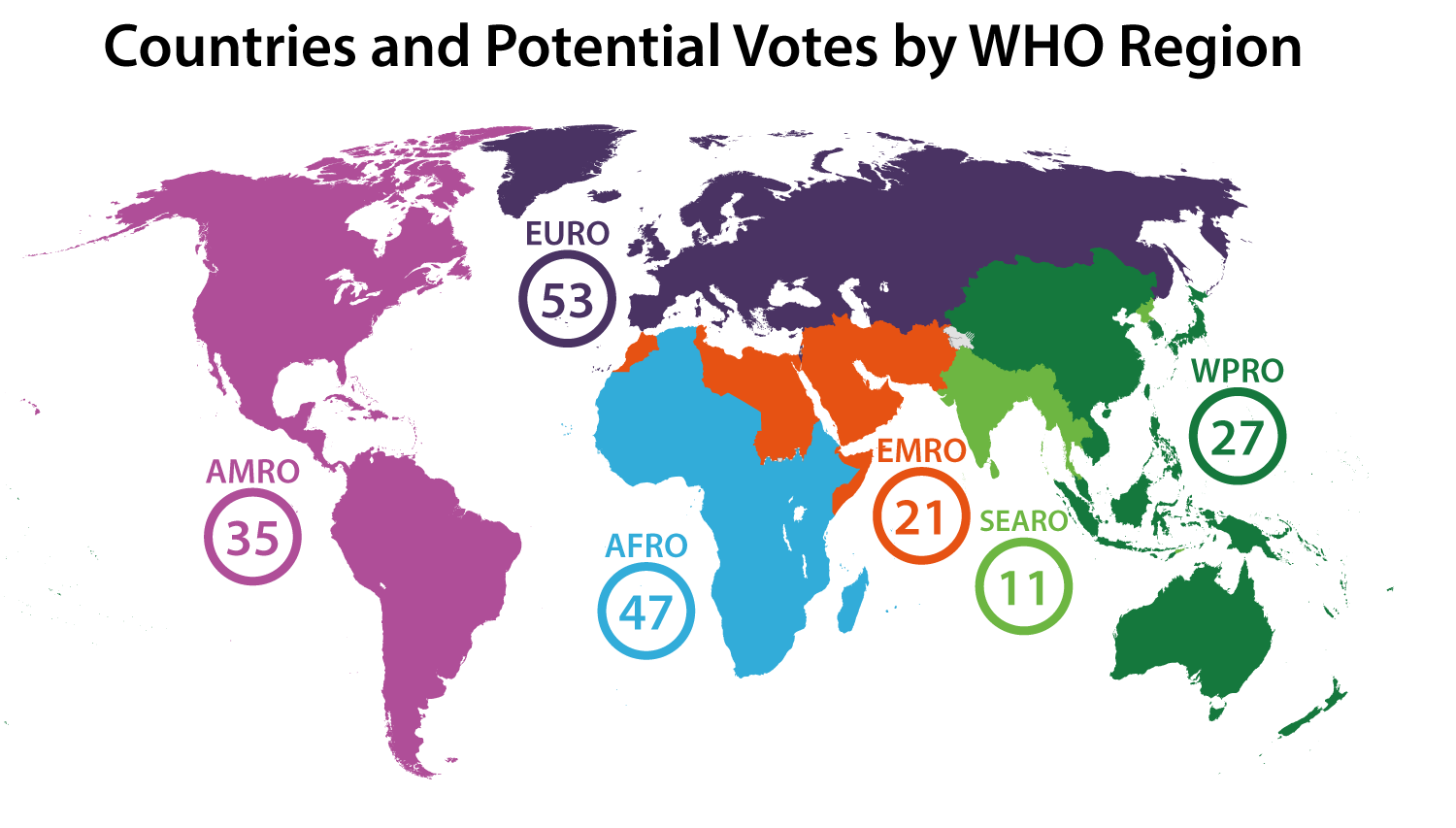
Reinforcing Sadikin’s broader diplomatic strategy, this financial backing leverages Indonesia’s weight as an ASEAN leader, a G20 economy, and a founding Non-Aligned Movement member to build cross-regional consensus. Translating that non-aligned posture into active campaign momentum, Sadikin has logged 16 bilateral meetings with a diverse coalition spanning Brazil, Egypt, France, India, Mexico, the UAE, and the US. He subsequently expanded his Americas outreach at PAHO’s 63rd Directing Council in Washington, D.C., building direct ties with Small Island Developing States.
This non-aligned positioning allows him to bridge diverging Global South priorities with competing global powers like China and the United States.
Addressing US re-engagement in an interview with Health Policy Watch, Sadikin framed global health security as an inescapable, non-political bridge: “It is like a family living in the same house called Planet Earth with eight billion people,” he noted. “Scientifically, it is impossible for the US to insulate itself from pathogens … Stroke, heart attacks, and cancer affect an American, a European, an African, or an Indonesian equally. Health is the ultimate commonality we can use as a key argument to work together.”
Policy frictions, environmental realities, and normative limits

However, on the campaign trail, Sadikin must navigate diplomatic scrutiny over how his home country’s domestic record aligns with WHO’s normative mandates across three key areas. Indonesia’s conservative legal framework, which criminalises extra-marital sex and cohabitation under its revised penal code, restricts abortion access, and does not recognise same-sex unions, creates immediate political friction with liberal member states advocating SRHR protections.
Speaking with Health Policy Watch, Sadikin directly addresses this tension by separating global technical standards from domestic execution. While WHO must operate as an unbiased, science-based normative body, setting standards to prevent maternal mortality, unintended pregnancies, and sexual violence, actual delivery “must remain within the national law and policy of each member state,” he maintains.
Additionally, his recent offhand public remarks – such as describing obesity as “a problem that mainly happens in developed countries” during a Reuters interview – drew criticism for conflicting with WHO’s global non-communicable diseases (NCD) targets and rising obesity rates in middle-income nations. Responding to this scrutiny, Sadikin clarified that national population screening data show undernutrition predominated in primary schools (6-12), while overnutrition officially surpasses undernutrition in high school and upper-middle-income cohorts.
Finally, reflecting a key structural gap in his portfolio, his public record shows a lack of documented climate-health initiatives, dedicated financing instruments, or heat-protection policies. Indonesia’s standing as the world’s largest palm oil producer and a major contributor to plastic waste burning and microplastic pollution presents a complex backdrop for a candidate leading global environmental and planetary health initiatives.
Acknowledging these environmental burdens candidly, Sadikin framed his domestic role pragmatically: “As Health Minister, my job is to fix the downstream side at the end of the tunnel,” noting that curbing air, water, and sanitation risks requires complex inter-ministerial coordination across a vast middle-income nation.
A balance sheet expert for disruptive times?

Navigating domestic normative frictions and his non-clinical background will test his diplomatic agility. While liberal member states are likely to scrutinise Indonesia’s conservative SRHR stance and his portfolio’s climate gaps, many capitals view these issues as secondary to his core assets: proven financial pragmatism, supply-chain execution, and capital mobilisation.
His central hurdle remains translating top-down executive drive into multilateral consensus. Unlike a national health minister exercising directive authority, a WHO Director-General must govern through technical credibility, political neutrality, and soft-power persuasion.
Ultimately, member states must decide whether private-sector financial discipline and balance-sheet restructuring offer the right antidote for an agency in severe fiscal crisis – or whether an outsider can sufficiently safeguard WHO’s normative and scientific authority.
Note: This article incorporates research findings and comparative evaluations from Rifat Hossain.
Image Credits: WHO, Chuanchai Pundej via Canva, Creativa Images via Canva, Naya Nurindra via Canva.