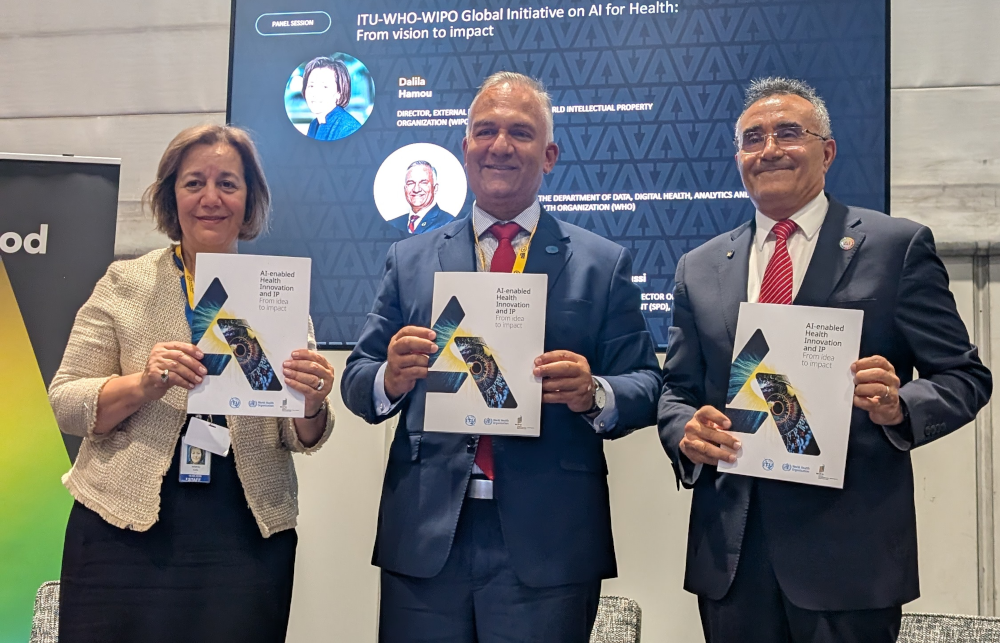
As artificial intelligence drives rapid health innovations, global guardrails, equitable data, and local capacity are needed to ensure equitable progress. To address this, a landmark framework launched by three United Nations agencies lays out a strategic roadmap for innovators. Meanwhile, health leaders emphasise that lower-income regions must become co-creators of future innovations.
New guidelines for the use of artificial intelligence lay out a roadmap for health innovators to navigate complex intellectual property, data governance, and regulatory pathways. The landmark framework, co-authored by experts from the World Health Organization (WHO), the International Telecommunication Union (ITU), and the World Intellectual Property Organization (WIPO), was presented at the “AI for Good” Global Summit in Geneva last week.
“This collaboration between these three organisations brings our expertise together and shows how we can have a collaboration in this very important field,” said Dalila Hamou, director of the external relations division at WIPO, at the Summit.
The joint initiative arrives as technological innovation accelerates, with the number of new generative artificial intelligence patents published over the last two years topping the total from the entire preceding decade. For instance, AI-assisted liquid biopsy tests can now predictively detect multiple cancers at stage one – when survival rates reach up to 92% – long before physical symptoms manifest.
At the same time, critics warn that the rapid deployment of unregulated advanced algorithms increases risks and may end up amplifying existing health disparities and deepening social exclusion.
“The few exceptions when technology actually had an equitable positive impact in society was when equity was included by design,” said Ricardo Baptista Leite, CEO of HealthAI, in an interview with Health Policy Watch during the summit, echoing the need for guardrails.
Embedding equity in the artificial intelligence life cycle
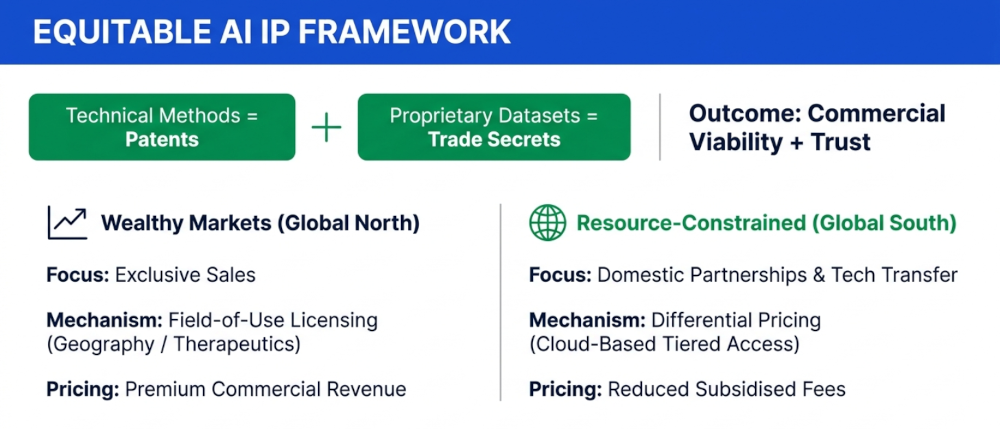
Fundamentally, the joint framework, which is entirely non-biding, recommends a mixed intellectual property system for new AI tools. It guides developers in strategically combining patents for technical methods with trade secrets for proprietary datasets, ensuring commercial viability – while also building trust through careful adherence to quality assurance, safety monitoring and patient privacy.
But to actively embed equity into the innovation life cycle, the joint framework also champions access models such as differential pricing and field-of-use licensing. These mechanisms allow patent holders to serve profitable commercial markets while partnering with domestic manufacturers in the Global South for vital technology transfers.
Specifically, field-of-use licensing allows patent holders to legally differentiate their intellectual property rights by geography or therapeutic application. This means a developer can maintain exclusive, highly profitable sales in the Global North while simultaneously licensing the identical algorithm to a domestic partner in a lower-income region.
Similarly, differential pricing leverages flexible delivery methods, such as cloud-based architectures, to offer tiered access to artificial intelligence services. This mechanism ensures that resource-constrained health systems pay reduced, subsidised fees for vital diagnostic tools, while the same technology generates premium commercial revenue in wealthier markets.
Since the international guidelines lack the binding enforcement mechanisms needed to standardise protections globally, voluntary frameworks must be actively translated into enforceable national regulations, the 2025 HealthAI Global Landscape Report stresses.
Fiscal pressure drives new collaborations
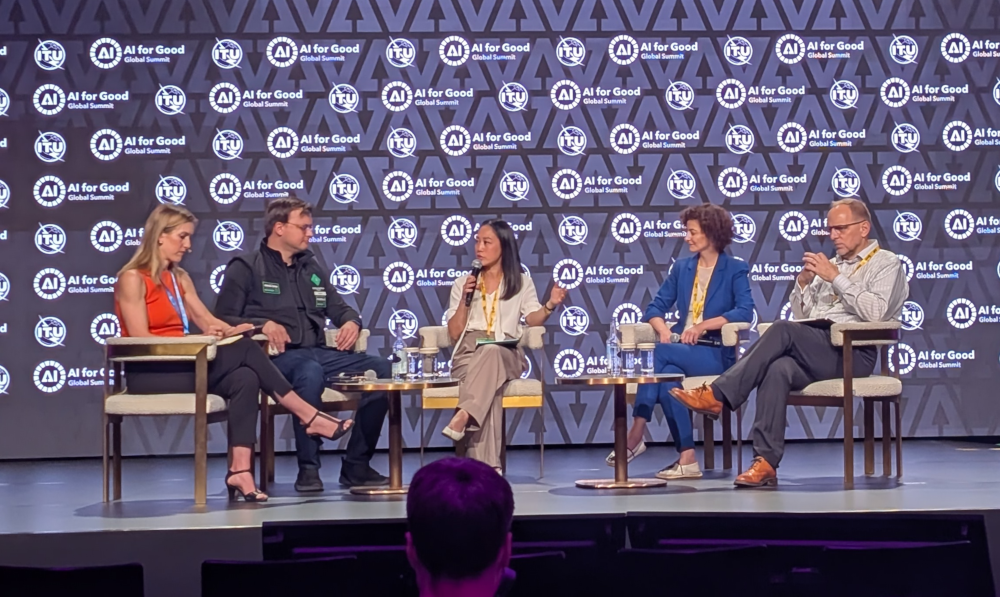
The urgency to implement these global standards is driven by the fast-changing face of the technologies as well as severe economic pressures, which are prompting health systems to leverage largely unregulated artificial intelligence tools for rapid efficiency gains and/or to reach underserved populations.
“We can’t expect every country to suddenly find money in this current fiscal context that they’ve not had for the last 10 years,” said John Fairhurst, head of private sector engagement at the Global Fund to Fight AIDS, Tuberculosis and Malaria, during a panel discussion with Gavi the Vaccine Alliance, and Google.org at last week’s AI for Good summit in Geneva. He noted that AI offers a pathway forward because “what countries are looking for is efficiencies. They’re looking for the ability to drive greater impact from every dollar that they spend.”
One breakthrough innovation highlighted at the summit pairs acoustic analysis with machine learning to detect tuberculosis directly from the sound of a patient’s cough. This tool, currently still in pilot stages, can be scaled up rapidly over basic mobile networks to identify people infected with TB earlier in the infection cycle.
“It’s a disease where we miss something like 3.6 to 4 million people a year, and those people go on to infect more people,” added Fairhurst.
This tool is part of a wider strategic partnership between The Global Fund and Google.org, the corporate social responsibility arm of Google, highlighting the advantages of public-private sector collaborations in a fast-developing AI landscape.
“Rather than focusing on a singular or point-to-point partnership, we try to bring together the cross-functional players [and] the cross-sector players,” said Leslie Yeh, director of scientific progress for Google.org. She explained that by treating health challenges as interconnected systems, partners can share learnings “so that we can get towards this accelerated outcome together and […] not leave anyone behind.”
Empowering local health capacity
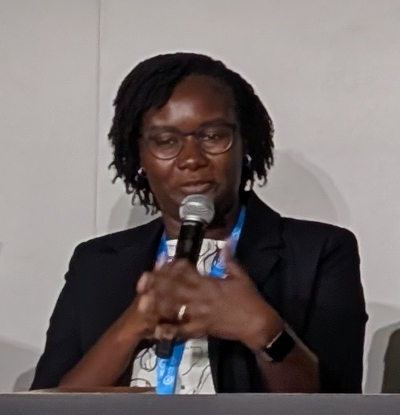
To effectively serve resource-limited settings and build local health capacities, developers must also design digital health tools capable of working entirely offline or with limited power and internet data access.
“If you think about low or limited settings that we come from, then you have to ensure that you have models that can work, for example, offline or with devices that are limited,” emphasised Joyce Nabende, head of the artificial intelligence lab at Makerere University in Uganda.
Innovators are currently working to make new technologies accessible by deploying AI diagnostic tools directly onto portable phones and other devices. For example, healthcare providers in parts of rural Africa can use offline, AI-assisted ultrasound tools to triage pregnancy risks, so that only the most at-risk cases travel to distant specialist centres.
Beyond hardware adaptations, international tech researchers and leaders like Nabende stress that true empowerment requires cultivating technological expertise directly where the medical challenges occur. This strategic shift involves transferring more advanced digital capabilities into the Global South.
Bridging the data equity divide
Another problem involves deploying algorithms in low- and middle-income countries without representative foundational data, which currently risks perpetuating systemic health disparities. Hidden biases within imported models can trigger inappropriate clinical triaging and inadvertently cause severe patient harm.
“When we import models, they’re often trained on usually high-income countries, populations that don’t represent the target populations where these tools are meant to be deployed,” said Alain Labrique, director of data, digital health, analytics and AI at the WHO, during a panel discussion.
Approximately 90% of global genomic data currently belongs to people of European descent, dangerously skewing the efficacy of predictive tools for diverse global populations, warned Alireza Haghighi, director of the Harvard International Center for Genetic Disease, during the summit.
Consequently, governments in the Global South demand an active role as co-creators of medical AI technologies that have to undergo rigorous local validation before clinical deployment.
“Africa must not be only a market for digital health solutions,” said Habiba Mizouni, representing the Tunisian Ministry of Health, during a keynote speech at the summit. She asserted that the continent must become a producer of ethical and context-specific health AI, not merely a consumer of imported digital solutions.
To actively support this transition, the newly launched guidelines champion access models that enable the adaptation of algorithms to local disease patterns and require developers to share performance data across diverse populations to ensure algorithmic non-discrimination.
Addressing regulatory fragmentation
A major issue hindering these equitable advances is regulatory fragmentation, which prevents emerging developers from safely scaling their life-saving tools.
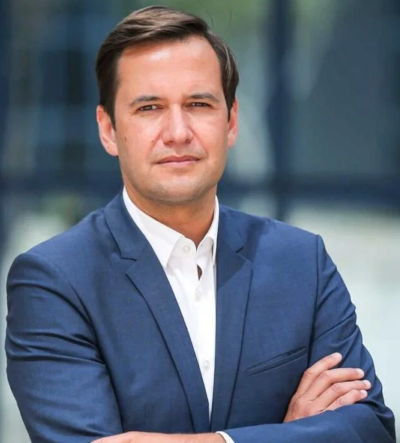
“Small and medium enterprises don’t stand a chance if they have to deal with different regulatory environments in every country they go to,” said HealthAI’s Leite. The Geneva-based global non-profit agency supports governments in building regulatory ecosystems to responsibly assess and scale these AI technologies.
To construct this infrastructure, the agency is building a Global Regulatory Network (GRN) that recently expanded to include Zambia, the Philippines, and Brazil. While artificial intelligence powerhouses like the United States and China remain outside formal GRN membership, they actively engage through broader communities of practice to prevent geopolitical fracturing, Leite explained.
To align internationally fragmented systems, the network is currently developing a global early warning system for post-market monitoring of new digital tools and devices. This shared platform will allow international regulators to instantly detect and communicate adverse algorithmic events, ensuring patient safety while building long-term societal trust in adaptive technologies, echoing the goals of the joint UN guidelines.
Build trust to keep innovation at pace

As long as the regulatory landscape remains fragmented, both developers and patients are ultimately penalised by delayed access to life-saving medical diagnostics, the UN agencies state. The new framework directly addresses this systemic friction by proposing common intellectual property strategies and technical standards.
“Standards create trust. Without standards, innovation remains isolated. With standards, innovation becomes scalable and sustainable,” concluded Tunisian representative Mizouni.
Ultimately, the enthusiasm that greeted the new WHO, ITU, and WIPO joint report signals a readiness to govern digital health. If international guardrails support collaborative momentum and trust, the current wave of technological innovation could successfully reduce global health inequities and scale the life-saving tuberculosis and cancer breakthroughs presented in Geneva.
However, to translate these frameworks into reality, international regulators and national governments must accelerate to match the rapid pace of the technology itself. Building this regulatory legitimacy is the only way to ensure patient safety and global adoption because, as HealthAI CEO Leite emphasised, “Innovation will move at the speed of trust”.
Echoing HealthAI’s collaborative mission, Dr Hans Henri Kluge, WHO Regional Director for Europe, reinforced this urgency during a global conference in Lisbon starting on Wednesday where the WHO brought 37 countries together to establish AI governance.
Urging leaders to regulate artificial intelligence in health “before the gaps become irreversible”, Kluge stressed: “The future of AI in health won’t be decided by algorithms. It will be decided by the frameworks we build now, the partnerships we forge, and the political will we bring to making sure this technology serves everyone – not just the countries and communities wealthy enough to shape it on their own terms”.
See related story:
Image Credits: Tara Winstead via Pexels, Felix Sassmannshausen/HPW, Google DeepMind via Pexels, HealthAI .
Combat the infodemic in health information and support health policy reporting from the global South. Our growing network of journalists in Africa, Asia, Geneva and New York connect the dots between regional realities and the big global debates, with evidence-based, open access news and analysis. To make a personal or organisational contribution click the donate button below.