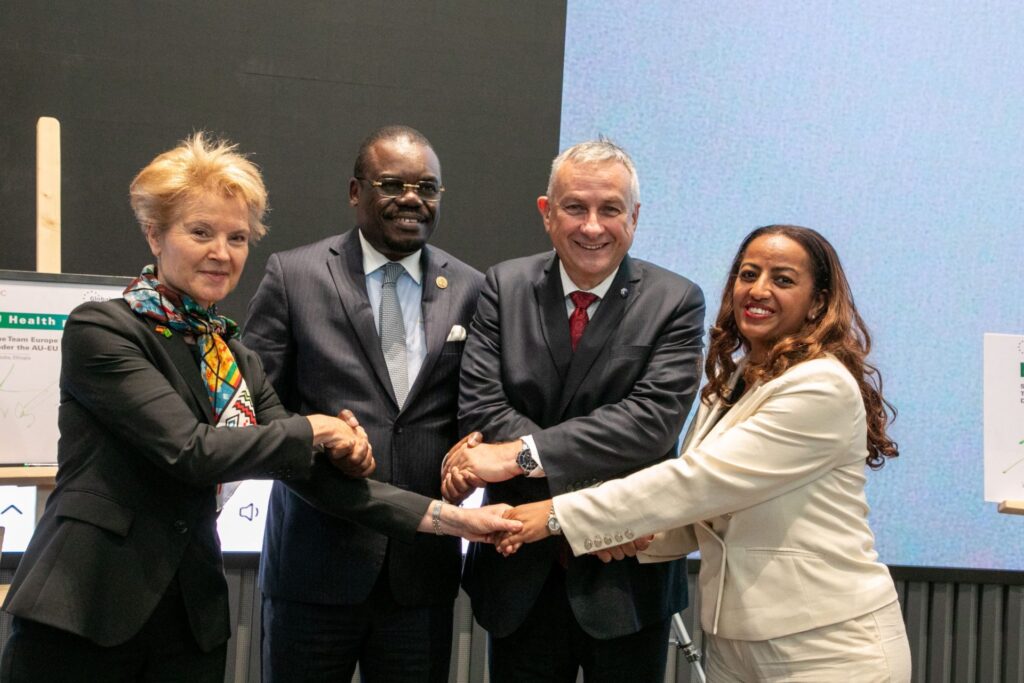
The African Union and the European Commission have concluded three agreements worth €100 million aimed at strengthening Africa’s health systems.
The first initiative supports the national public health institutes of 10 African countries to enhance disease surveillance, early warning systems, emergency response, research and laboratory services.
The second, announced at the One Health Summit in Leon earlier this month, involves addressing antimicrobial resistance (AMR) and developing a workforce trained in a ‘One Health’ approach to detect and prevent health threats in animals, humans and the environment.
The third involves expanding digital health solutions for pandemic preparedness and stronger primary healthcare systems in six African countries.
The initiatives were officially launched at the African Union headquarters on Tuesday by Jozef Síkela, European Commissioner for International Partnerships, and Dr Jean Kaseya, Director General of Africa Centres for Disease Control and Prevention, which is the operational partner for the initiatives.
“Health remains at the top of the EU’s political agenda, including in the shifting geopolitical landscape. While the others are stepping away, we are stepping up,” Sikela told the launch.
“Recent history showed us that a health crisis in one region can turn very quickly into a global emergency, an economic crisis and a security threat. Investing in global health is a strategic investment, not a gesture.”
Kaseya said that the support will assist the continent to achieve its Health Security and Sovereignty Agenda, “strengthening its capacity to build resilient health systems, improve preparedness, and reduce dependency by producing, financing and managing more of its own health priorities.”
Sikela told the launch that the EU and AU are also working on a global health resilience initiative, with the aim of launching it in May.
“This will be a powerful tool, bringing together research with medical technology and innovation programmes, knowledge transfer and systematic cooperation with regulatory agencies, health systems and highly skilled workforces,” he said.
“The aim is to equip and empower health systems worldwide so that they are in a better position to prevent and respond to future crises,” he concluded, adding that this includes European investment in the local manufacturing of vaccines and medicines “to avoid health dependency.”
Welcoming the initiatives, Ethiopian Health Minister Dr Mekdes Daba noted that “a crisis in one region can, with alarming speed, become a challenge for the continent and the world. From COVID-19 to mpox and the recent Marburg outbreak, we have learnt that preparedness cannot be deferred.”
Combat the infodemic in health information and support health policy reporting from the global South. Our growing network of journalists in Africa, Asia, Geneva and New York connect the dots between regional realities and the big global debates, with evidence-based, open access news and analysis. To make a personal or organisational contribution click the donate button below.