
LAGOS – On 6 January, literary icon Chimamanda Ngozi Adichie lost one of her 21-month-old twin boys at Euracare, an elite private hospital in Lagos, Nigeria.
Adichie alleges “criminal negligence”, specifically an overdose of propofol and oxygen deprivation, leading to the death of her son, Nkanu Nnamdi. The hospital maintains it followed “international standards” and has commenced an investigation.
“The death of young Nkanu once more exposes the fragility of the Nigerian healthcare system,” wrote Dr Adaeze Oreh, health commissioner for Rivers State, on the X platform.
In the past month, Nigerian-British boxer Anthony Joshua relied on bystanders to walk him into a police truck without an ambulance in sight after a car crash that killed two of his friends.
“Fragmented, weak, and heavily injured by systemic gaps, daily keeping the lights on and doors open in many healthcare institutions can be fraught with numerous lapses and compromises,” wrote Oreh.
Nigeria is estimated to lose $1.3 billion annually to reverse “medical tourism” – citizens seeking healthcare outside the country.
A review of federal budgets since 2023 shows that government health expenditure has never been more than 6%, ignoring the 15% target for health expenditure set by African leaders in the Abuja Declaration back in 2001.
As Health Minister Muhammad Ali Pate pushes towards Universal Health Coverage (UHC) anchored on the new Sector-Wide Approach (SWAp), he faces the challenge of running a sophisticated framework over a primitive system.
The cost of survival
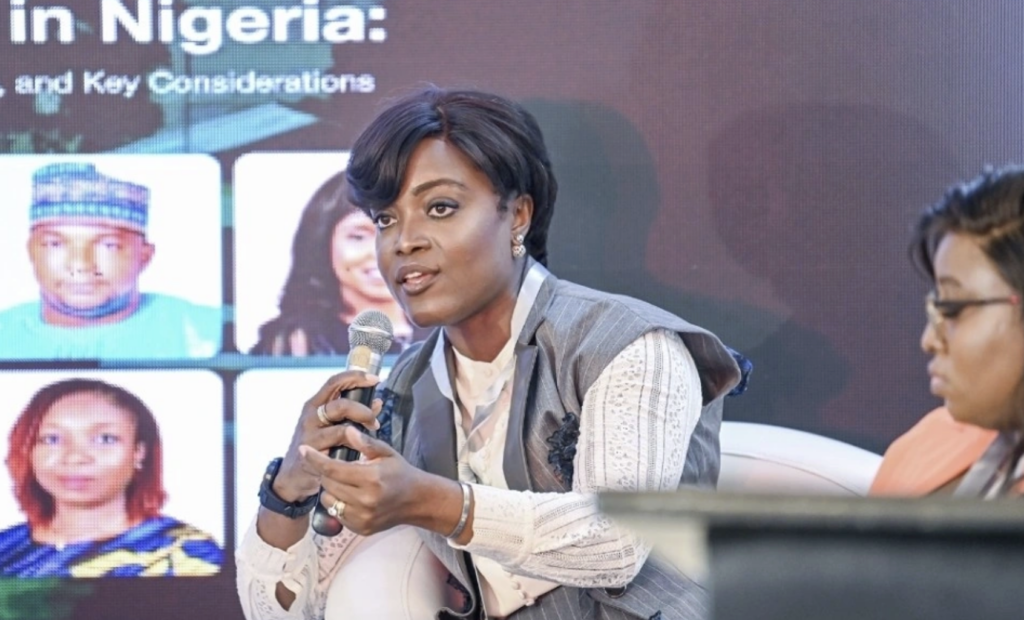
Fiscal retreat has entrenched a system where access is determined solely by purchasing power. With households forced to bear nearly 80% of medical costs out-of-pocket, healthcare spending has become a contributor to poverty.
The 2025 UHC Global Monitoring Report by the WHO and World Bank confirms this reality, warning that financial hardship is intensifying for the world’s poorest, with an estimated 4.6 billion people globally still lacking access to basic health services and 1.6 billion people further pushed into poverty due to out-of-pocket health expenses.
Yet, money is only part of the crisis.
“Without enforcing standards for workforce support, data management, and governance, pouring cash into the sector is like throwing money to the wind,” Oreh, the Rivers State Commissioner for Health, told Health Policy Watch.
This structural void has collapsed the referral hierarchy.
“The teaching hospital system, designed to be the final referral point for complex cases, has been ‘bastardized’ into handling primary care overflow,” wrote Dr Popoola Daniel, a medical doctor based in Nigeria, via his X account.
Instead of focusing on research and specialist care, tertiary centers are clogged with uncomplicated cases.
A 2025 review by the African Health Observatory Platform (AHOP) found that the Nigerian health system is performing at only 45% of its capacity – below the WHO African Region average of 52.9% – with 80% of health infrastructure classified as dysfunctional.
The exodus and the exhausted
This dysfunction drives a massive “brain drain”, with the Nigeria Health Statistics Report 2024 revealing a 200% surge in health workforce migration.
In 2024 alone, over 4,000 doctors and dentists migrated, with the United Kingdom absorbing more than half of them.
The mass exodus has left a doctor-to-patient ratio of 1:9,083, way higher than the recommended 1:6000 ratio.
With the rapid exit of skilled professionals, trust in local capacity has weakened. The wealthy go abroad to access better healthcare. The late former Nigerian President Muhammadu Buhari spent over 200 days on medical trips abroad, including a 104-day stretch in London.
Adichie’s son was also reportedly being prepared for evacuation to Johns Hopkins Hospital in the United States. Euracare, despite its elite status, was functioning merely as a diagnostic stopgap.
The clinicians who stay to practise in Nigeria are overstretched. “There are times I work until I cannot think again,” Daniel wrote.
Doctors reportedly work up to 120 hours a week for as little as ₦750 ($0.52) per hour. In September 2023, a resident doctor at Lagos University Teaching Hospital died after a 72-hour shift after weeks of overwork. Nigeria does not have regulations protecting doctors from overwork.
A ‘SWAp’ for survival
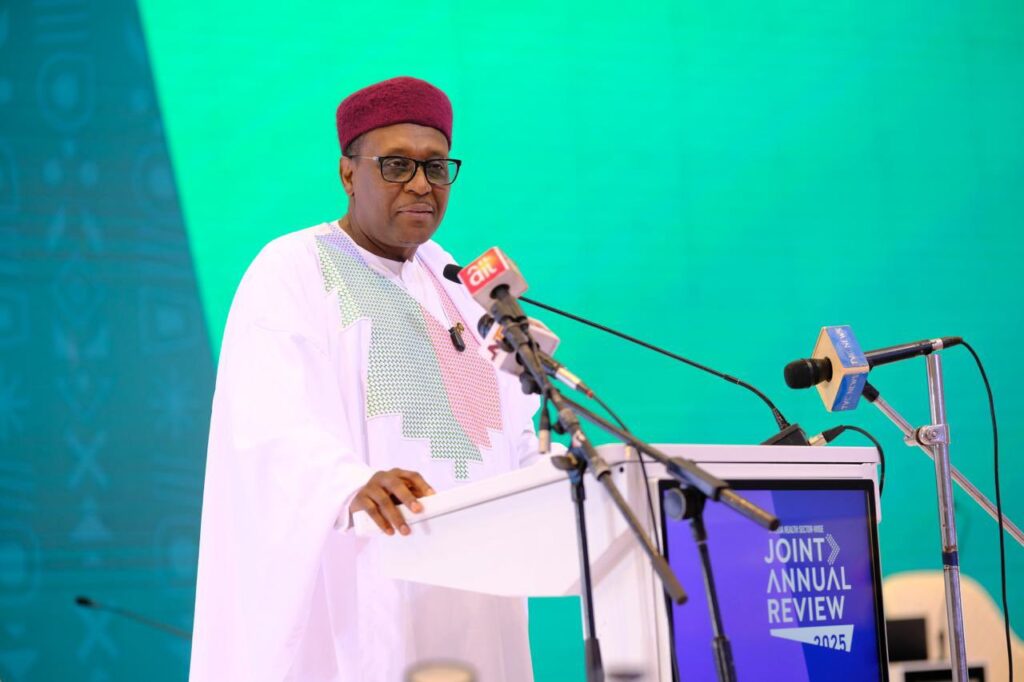
Pate became Minister of Health in August 2023, and in his first year, he operationalised the Nigeria Health Sector Renewal Investment Initiative (NHSRII). This strategy aims to end the fragmentation that has historically paralyzed the sector through the Sector-Wide Approach (SWAp).
This ensures that stakeholders align with a single master plan, allowing the Ministry to streamline governance and channel resources where they are most needed.
At the November 2025 Joint Annual Review, the Ministry presented its progress towards SWAp with a reported 17% reduction in maternal mortality and a 12% decline in newborn deaths within 172 high-burden Local Government Areas.
It also highlighted renewed public confidence in PHCs, with a rise in visits from 10 million visits in early 2024 to 45 million in mid-2025.
Reality check: Budget cuts
But the path to Universal Health Coverage (UHC) by 2030 is mined with fiscal contradictions. While the SWAp demands “One Budget,” the federal government allocated just 4.2% to health in the 2026 budget.
Worse, family planning funding was slashed by 97% in 2025, a cut that came at a time when the country was grappling with the exit of a critical funder, the United States Agency for International Development (USAID), from family planning support programs.
The human cost of this underfunding is a workforce in freefall as the high doctor-to-patient ratio means that the remaining staff are burned out.
Oreh argues that Nigeria can circumvent these circumstances through the active participation of the state government.
“The beauty of a truly federal system… is that despite budgetary constraints, the SWAp agenda can effectively bridge the gaps between policy and patient safety if committedly adopted by the subnational,” Oreh said.
“The key lies in state-level implementation driven by national regulatory standards. If this occurs, the power of the collective will lead to exponential improvements… towards UHC 2030.”
Skeleton without flesh
Nkanu’s death is not an anomaly. In her statement, Adichie alleges that there have been two previous instances where the same anesthesiologist reportedly overdosed children.
Yet, as is often the case, it has taken a high-profile case to force a brutal confrontation with the urgent structural reforms required to save the country’s health sector.
Minister Pate’s SWAp offers a logical framework to halt the decay in pursuit of Universal Health Coverage by 2030. The scorecard from the Joint Annual Review proves that the methodology can work.
But SWAp is currently a skeleton without flesh, as key components – funding, workforce, and regulation – are missing.
Combat the infodemic in health information and support health policy reporting from the global South. Our growing network of journalists in Africa, Asia, Geneva and New York connect the dots between regional realities and the big global debates, with evidence-based, open access news and analysis. To make a personal or organisational contribution click the donate button below.